IT Modernization: How to eliminate technical debt and build an AI-ready architecture
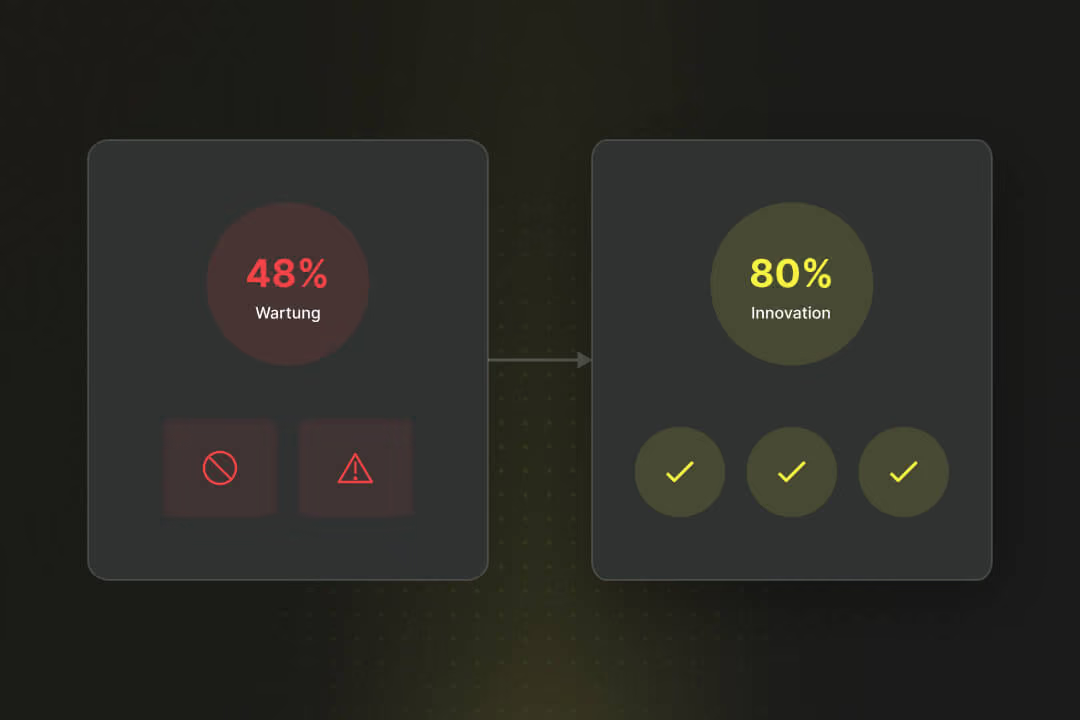
IT modernization is about eliminating technical debt that stifles your innovation. In many companies, outdated systems consume up to 80% of the IT budget solely for maintenance and also pose significant security risks. Strategic modernization frees up your resources and creates the necessary data infrastructure to leverage modern software and AI.

IT Modernization: Key Takeaways
- Technical Debt Reduction: You identify and replace outdated codebases, infrastructures, and software that cause high maintenance costs and hinder your business agility.
- Security Update: Outdated (legacy) systems are a popular target for cyberattacks. Modernization closes these security gaps through contemporary architectures and regular updates.
- AI Readiness: You utilize adaptable, API-based structures. This is the only way you can digitize and automate, and become ready for AI applications.
- Data Migration: With refactoring or replatforming, you gradually transfer your data to the new (cloud) system.
- ROI: Amortization occurs through significantly reduced Total Cost of Ownership (TCO) and a drastically shortened time-to-market for new digital functions.
When should I modernize my IT?
The security risks of old systems, overall high maintenance efforts, and incompatibility with new software are strong indicators that you should modernize your IT:
- Security Risk of Outdated Legacy Systems: Outdated software is sometimes no longer provided with security updates (end-of-life). These systems form the weakest link in your defense chain.
- Maintenance: The older your IT landscape, the more resources are needed to maintain the status quo. However, personnel tied up in this way are unavailable for new developments and innovations.
- Innovation Blocker: Digitizing your processes requires modern systems and software, without which you will be stuck indefinitely. Only once this step has been taken will your company be ready for AI agents that enable additional growth.
Application Modernization Strategies: The 7-R Model
Depending on the technical condition and business relevance of your systems, you choose between different levels of intensity. The internationally recognized 7-R model serves as the basis for this decision:
The core question: Repair or Replace?
For you as an owner, the 7-R model typically boils down to a fundamental decision: Do I invest in maintaining (Refactor/Rebuild) or do I switch to a current standard (Replace)?
- The case for a new build/rebuild: If your software handles processes that make you unique (e.g., a special production algorithm), then modernizing your own code is appropriate. That is your competitive advantage.
- The case for replacement: When it comes to administration, sales, or accounting, you should not modernize, but replace. Powerful systems like HubSpot are more secure, always up-to-date, and offer interfaces that you would painstakingly have to build yourself with an in-house solution. You cannot achieve or even surpass this high standard with an in-house development.
{{fs-hubspot-quickstart="/en/article-inject-elements"}}
Roadmap: IT Modernization in 5 Steps
You modernize your IT by proceeding from a risk analysis, through data cleansing, to a gradual migration to the Cloud . This process ensures that you reduce technical debt without affecting ongoing operations.
Step 1: Risk Assessment
First, you need to know where your biggest risk lies. Create a list of your most important programs and evaluate them:
- Maintainability: Is there still someone in the company who fully understands the system?
- Security: Does the software still receive security updates?
- Business Value: How bad would a 24-hour outage be?
- Your Goal: Identify the system that has the highest business value while also having the worst technology. This is your starting point.
Step 2: Choosing the Target Architecture (Where are we headed?)
Define how your IT should communicate after the transformation. Nowadays, the goal is almost always a cloud-native or hybrid structure.
- Ensure that every new system has an open interface (API).
- Avoid new 'black boxes': Every system must be able to communicate with others (like your CRM or accounting).
- Your Goal: A rough plan of which data flows should be automated in the future.
Step 3: Data Cleansing
Before migrating or rebuilding a system, you must clean your data. If you migrate 'dirty' data (duplicates, outdated contacts) into a new system, you'll immediately incur technical debt again.
- Define a Single Source of Truth: A core software system where all data is accurate and up-to-date.
- Clear out data clutter before migration.
- Your goal: A clean data foundation, ready for modern and powerful applications and AI.
Step 4: Phased Migration
- Migrate non-critical functions first or departments.
- Run your old and new system in parallel for a while until the new one is stable.
- Your goal: A risk-free transition with no operational downtime.
Step 5: Establishing "Life Cycle Management"
To avoid facing another modernization in a few years, you need processes that keep your IT continuously current.
- Allocate dedicated budgets for annual updates and training.
- Question systemsthat can no longer be easily updated.
- Your goal: IT that always grows with your company instead of slowing it down.
ROI & Cost Control: When does IT modernization pay off for me?
You achieve the Return on Investment (ROI) of IT modernization primarily by lowering your operating costs and significantly reducing the risk of downtime.
- Opportunity Costs: If your business cannot offer new digital services due to technical debt, or if employees spend hours on manual data maintenance, you are losing money every day. These opportunity costs are usually significantly higher than the project budget for a transformation.
- Reducing Total Cost of Ownership (TCO): Old systems cause steadily increasing costs for software development and hardware, maintenance contracts, and experts who master outdated programming languages. By switching to modern cloud architectures or established SaaS solutions, you only pay for what you actually use.
- Faster Time-to-Market (Time-to-Market): With modern IT, you can implement new requirements, such as a new customer interface or a process adjustment, in days instead of months.
- Risk Minimization: A single day of system downtime due to a security vulnerability in outdated software can sometimes be devastating. IT modernization acts like an insurance policy here. You invest in the stability and reliability of your core infrastructure.
IT Modernization with Axisbits
Modernizing an evolved IT landscape requires experience to maintain the balance between technical innovation and economic sense. Axisbits helps you to systematically reduce your technical debt and create an architecture that is sustainable in the long term.
- Analysis of your Legacy Systems: We objectively evaluate your existing software based on risk and benefit. You receive a clear recommendation on which parts should be modernized, replaced, or decommissioned.
- Interfaces & API Design: We ensure your systems finally communicate with each other, allowing you to easily connect additional systems in the future.
- Migration During Ongoing Operations: We plan the migration to ensure your daily operations are not disrupted, using iterative steps for a smooth transition.
- Cost Control: With Axisbits, you'll always know how your budget is being spent. We focus on solutions that deliver a measurable ROI and reduce your IT costs long-term.
Learn more about the digital transformation of your SME or contact us now and book your project check, where we will review your current system. We'll show you where you can implement automations to work for you in the future.
{{fs-btn-cta}}
Wir schaffen leistungsstarke Plattformen und Websites für Startups, Scale-Ups und KMUs, von Konzept bis Go-Live.
We objectively evaluate your existing software and identify automation opportunities. Get started now!
IT Modernization – Frequently Asked Questions
The right time is when the maintenance costs of your existing systems (technical debt) exceed the costs of a re-alignment, or when technical limitations block your business goals. Another clear warning sign is the end of support (end-of-life) for important software components, as this poses a significant security risk.
While not strictly mandatory, the cloud is typically the goal for achieving greater agility in the future. Modernization here means transforming rigid structures into modular, interoperable architectures. Whether these run on your own servers (on-premise), in a private cloud, or with public cloud providers depends on your compliance and performance requirements.
For systems that are technically outdated but business-critical and difficult to replace, the "encapsulation" approach is recommended. The legacy software is wrapped in a modern shell (container) and connected to the modern IT landscape via newly built interfaces (APIs). This preserves its functionality.
The nDSG requires "Privacy by Design" and "Privacy by Default". Many legacy systems are technically unable to meet these requirements (e.g., the right to be forgotten or granular access controls). Modernization is often the only way to properly implement the legally mandated data security and disclosure.
A well-planned, iterative (step-by-step) modernization minimizes risk. By utilizing parallel infrastructures and Blue-Green deployments (where the new system runs alongside the old one for testing), the cutover can be performed without any downtime for users.
More articles

Many teams experience Sprint Planning in one of two extreme ways: either as an endless meeting that drags on for three hours and still provides no clarity, or merely as a ticket-shuffling exercise in Jira that could just as easily have been handled via email. Neither of these approaches aligns with the true purpose of Sprint Planning.

According to the swissICT Digital Excellence Report, only 35 percent of Swiss companies are on track with their digital alignment. For 26 percent, there is significant need for action (Source: swissICT). Companies invest in tools, cloud services, and AI pilot projects without a plan that holds it all together. The result: fragmented system landscapes, duplicated work, and budgets that don't flow where they have the most impact. The right IT strategy is the answer to this.

Artificial intelligence is now an established tool in software development, integrated directly into the programming environment. Developers spend less time writing boilerplate code and can instead focus on how the different parts of an application logically interact.