Digital Transformation for SMEs: How to Secure Your Business's Competitiveness
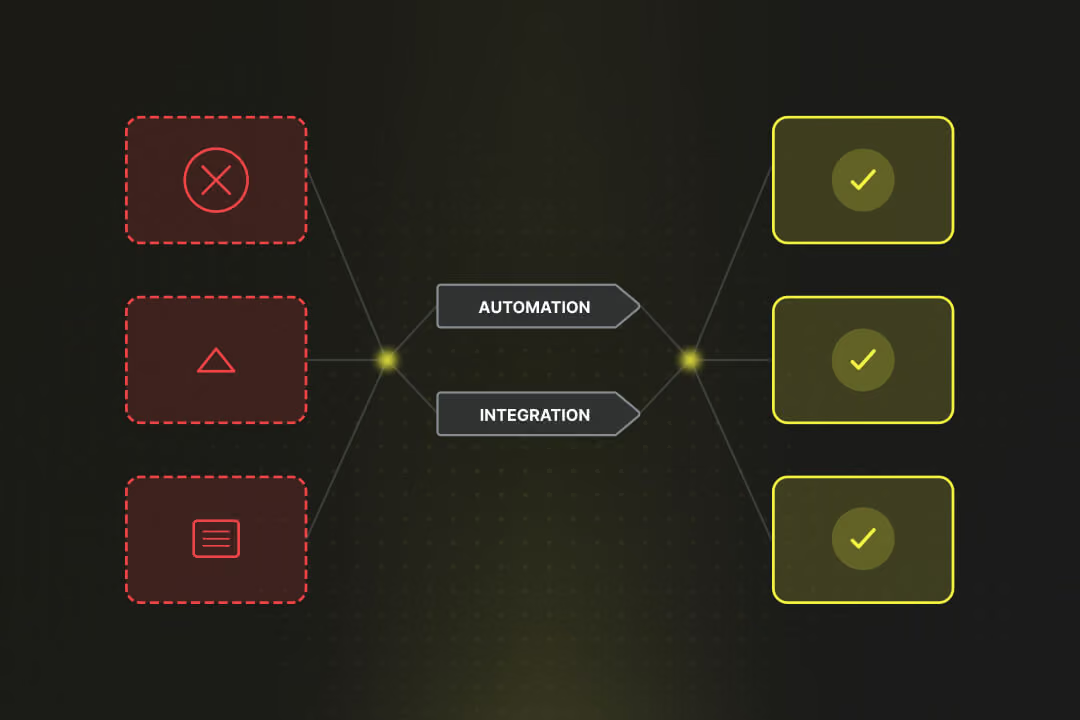
Digital transformation in SMEs is the answer to the acute shortage of skilled workers and your customers' increasing expectations for speed. You restructure your internal infrastructure so that as many processes as possible are automated and all information is available and synchronized for all departments.

Digital Transformation: Key Takeaways
- Solution for the Skilled Worker Shortage: You automate routine administrative tasks to relieve your existing team and allow them to focus on core business.
- Process Speed: Interconnected systems ensure that customer inquiries, quotes, and invoices are processed without manual delays.
- Data Control: Every employee is immediately and fully informed, without having to search for information.
- Scalability: A digital structure allows you to handle more orders without having to proportionally hire new administrative staff.
- Easy Start: Instead of expensive specialized software, you use integrated platforms like HubSpot that can grow with your business.
Why is digital transformation so important for Swiss SMEs?
In a high-cost country like Switzerland, well-structured internal processes are a prerequisite for remaining profitable. For example, if you can't find skilled workers for the back office, technology must fill this gap.
Addressing the Skilled Worker Shortage Operationally
When positions in administration or customer service remain unfilled, the pressure on the rest of your team increases. This is where digital transformation directly steps in: software handles scheduling, data transfer between CRM and accounting, or sending standard documents. The result is a digital employee who frees your team from troubleshooting and manual data entry.
Speed as a Competitive Advantage
With digital transformation, the speed of your processes also increases. Previously, the processing times between initial customer contact and quote generation were often the biggest time-wasters in small and medium-sized businesses.
Through automation, for example, the direct qualification of a lead via a form and the immediate creation of a draft in the CRM, you reduce the "Time-to-Response". This increases the likelihood of a deal closing, as the interaction takes place precisely when customer interest is highest.
Scalability of Administrative Costs
An analog operation typically scales proportionally: More orders lead to a linear increase in administrative effort.
Digital transformation, in contrast, decouples revenue growth from personnel costs. Since systems like HubSpot or ERP integrations handle data management for 10 or 100 orders with almost the same amount of time, your relative administrative costs per order decrease. This secures the necessary margins for you in a high-cost environment like Switzerland.
What does digital transformation mean for my company?
Digital transformation in small and medium-sized enterprises consists of four functional areas: the consolidation of data sources (Single Source of Truth), the automation of recurring process chains, the digitization of the customer interface, and legally compliant archiving according to nDSG.
Data Consolidation (Central Memory)
You consolidate information from various sources, such as emails, phone notes, and invoice data, into a central system (CRM). The goal is for every employee in the company to have immediate access to the current status of a project or customer without having to consult with other departments.
Process Automation
You identify processes that follow clear rules and delegate them to software. An example is automated dunning or the assignment of inquiries to the correct contact person based on postal code or product interest.
Time that would otherwise be lost to manual sorting and forwarding of information is freed up by these automations.
Digital Customer Interface
You offer your customers the ability to handle interactions independently and digitally. This ranges from online appointment booking, directly synchronized with your team's calendars, to customer portals where documents can be downloaded independently. This relieves your back office from simple support inquiries.
Integrated Compliance (nDSG)
You design your IT structure so that data protection requirements are handled by the system. Instead of manually deleting data or individually checking access rights, the software automatically manages retention periods and permissions. This reduces your liability risk, as many controls are performed automatically.
How do I start with digital transformation in my company?
You proceed step by step to provide quick relief for your team and keep costs under control.
Phase 1: Identifying Time Wasters
First, you analyze your daily work for constantly recurring tasks. You look for typical breaks in the digital workflow where information has to be transferred manually. Look out for the following warning signs in your operations:
- Manually typing out: A customer fills out a PDF form, and an employee then types the data into the CRM or accounting system.
- The Search: An employee has to open various Excel lists or email inboxes to find out what was last discussed with a customer.
- The Manual Transfer: When an order comes in, someone first has to write an internal email to production or the warehouse for anything to happen there.
These inefficiencies are your first targets. Every time an employee shuffles data from A to B, that's a suitable starting point for automation.
Phase 2: Choosing the Right Platform
Instead of buying separate software for each problem, you opt for a versatile platform. For many SMEs, HubSpot is suitable because it offers a database (CRM), a sales tool, and a customer service module.
In the future, make sure that potential new software has interfaces through which you can connect it to your existing software. Only this way can you ensure that data can be transferred between programs.
{{fs-hubspot-quickstart="/en/article-inject-elements"}}
Phase 3: Rolling Out Initial Automations
You select a single process and digitize it completely. A classic example is online appointment booking: Instead of writing three emails to find an appointment, you send the customer a link. The system checks your availability, books the appointment, and automatically creates the Zoom link or directions.
In addition to online appointment booking, there are other typical automations:
- Document Sending: As soon as a prospect fills out a specific form on your website, the system immediately sends the appropriate brochure or price list as a PDF, without you having to write an email.
- Task Assignment: If an offer has not been signed after three days, the system automatically creates a task for the salesperson: "Please follow up with customer XY."
Phase 4: Data Management and Process Control (Optimization)
As technologies and market conditions are constantly changing, you regularly use key figures to check whether your processes are still functioning as intended.
You regularly check whether the automated processes still align with your goals. For example, you regularly review the processing time of an inquiry. If you notice that a process is stuck or slowing down, you adjust the digital workflow.
ROI: When does the investment in digital transformation pay off for SMEs?
The Return on Investment (ROI) of digital transformation in SMEs primarily stems from an increase in operating margin. Through automation, you can handle more orders with the same number of staff, or reduce personnel costs per order. Amortization occurs through three possible levers:
- Direct labor cost savings: If automation eliminates five hours of manual data maintenance or email correspondence per week, you already save a four-figure sum per year, based on average Swiss wage costs. With several automated processes, implementation costs often pay for themselves in the first year.
- Scalability without increasing headcount: The biggest financial lever lies in decoupling workload from order volume. An analog business would typically require additional administrative staff for 20% more orders, but a digitized system can absorb this increased volume without additional fixed costs.
- Reduction of error costs (Dirty Data): A continuous digital chain (e.g., from a website form directly into the CRM and then to invoicing) reduces the error rate to almost zero. You directly save on costs for returns, credit notes, and time-consuming complaint discussions.
Your path to digital transformation: With Axisbits. We accompany you on the way to e-business.
{{fs-btn-custom}}
What challenges can I expect during the digital transformation of my SME?
The biggest challenges in digital transformation typically arise when selecting the right technology from an overwhelming array of software offerings, and when implementing sometimes very complex systems that can quickly overwhelm inexperienced teams in their daily work.
- Market Abundance: The market for business software has grown so large that it's almost impossible to find the right tool without expert help. Business owners repeatedly choose systems based on features they don't currently need, and then pay for unnecessary complexity.
- Complexity: If you implement a powerful system like HubSpot, the potential is huge, but getting started can be frustrating for an inexperienced team.
- Outdated Legacy IT: In many established businesses, new cloud solutions must communicate with old systems that are technically difficult to adapt. Creating these interfaces requires deep technical expertise.
- Lack of expertise in the team: Transformation rarely fails due to the software itself, but rather due to a lack of internal resources. There isn't enough time to properly set up automations, clean data, and effectively train the team on how to use the new tools.
To ensure your transformation doesn't stumble over these hurdles, Axisbits offers you the right support, especially with the implementation and optimization of HubSpot and comprehensive automation of your processes.
As an official HubSpot Solution Provider, we ensure that your system runs as expected from day one and bring your employees to a level where they can work independently and effectively.
- A confident start with HubSpot: We help you leverage HubSpot as an engine for your growth. We first focus on your business's stable core processes before activating complex additional features.
- Automation: We take care of designing your digital processes. This ensures that your automations run reliably from day one and significantly lighten your team's workload.
- Third-party system integration: If you need to link your CRM with existing ERP solutions or other tools, we provide the technical integration and ensure clean, error-free data transfer.
- Training and support: We won't leave your team to navigate the new technology on their own. Through practical training, we ensure that your employees understand the new possibilities and can use them immediately. For technical questions or process adjustments, we are the only point of contact you'll need.
Wir schaffen leistungsstarke Plattformen und Websites für Startups, Scale-Ups und KMUs, von Konzept bis Go-Live.
We are a partner and official HubSpot Solution Provider, and we implement your sales automations in HubSpot!
Digital Transformation in SMEs – Frequently Asked Questions and Answers
No, most cloud solutions are designed to operate without proprietary server infrastructure and without requiring extensive IT maintenance. However, it is important to have a dedicated person within the company (Product Owner) and an external partner like Axisbits, who handles the technical setup, interface integration, and strategic guidance.
Professional cloud platforms offer security standards that far exceed those of small, local server solutions. Through features such as data hosting in European data centers, encryption, and automated deletion protocols, this transformation even helps to implement the strict requirements of the nDSG more easily and in a legally compliant manner (Privacy by Design).
HubSpot offers an all-in-one solution that combines CRM, sales management, and customer service. This prevents data silos, as all departments access the same data foundation. For SMEs, scalability is particularly advantageous: You start with the core functionalities and add automations as your business grows.
Initial measurable successes (quick wins), such as automated appointment booking or digital contact management, can often be implemented within a few days or weeks. A comprehensive transformation of core processes takes place in stages over 3 to 6 months to gradually familiarize the team with the new workflows.
More articles

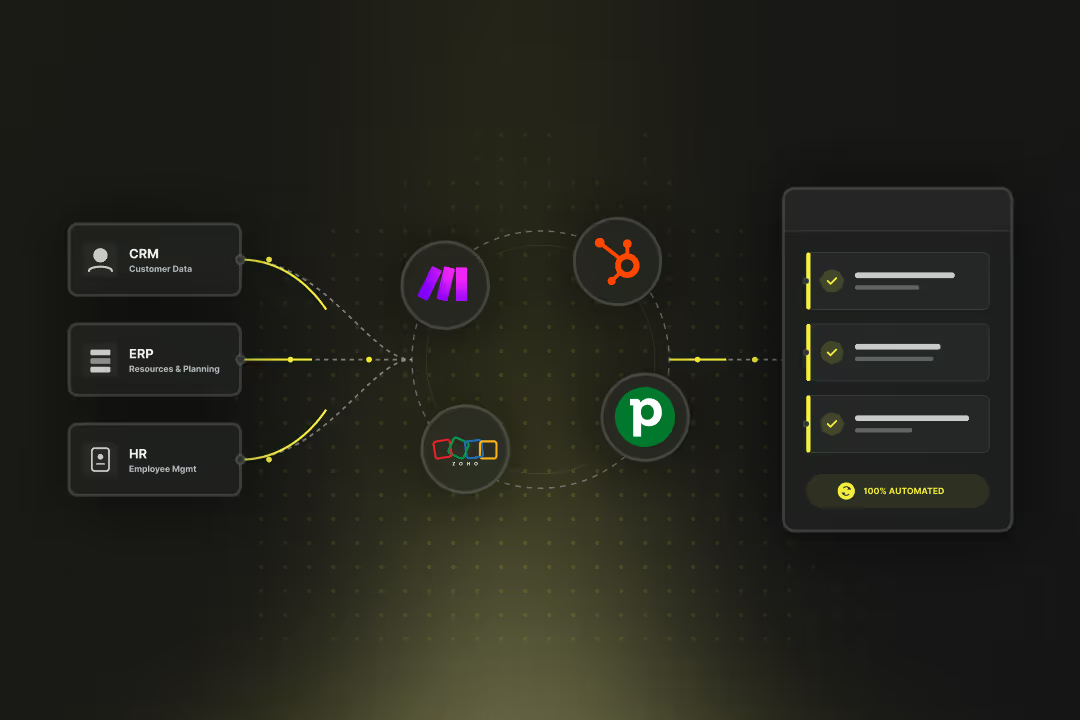
With workflow automation, you can control recurring tasks and processes with software and have them carried out automatically. Such automations connect multiple applications such as ERP, CRM or HR platforms and carry out actions independently.