Zoho vs. HubSpot: Which CRM is better?
Zoho and HubSpot are among the best-known CRM platforms for SMEs, growing companies and international corporations. Both are suitable for managing customer relationships and automating marketing and sales processes.


The differences lie primarily in the cost model, usability and available features. Zoho is cheaper, highly customisable, and offers a broad app ecosystem. HubSpot scores points as an all-in-one platform for marketing, sales and service with strong usability and an expanded partner network.
Zoho vs. HubSpot: The most important things in a nutshell
- HubSpot is suitable for companies that want to bundle marketing, sales and service in one platform and want to be productive quickly. Onboarding via a HubSpot partner ensures a quickly set-up system that your team can work with immediately.
- Zoho CRM is suitable for companies that want to combine cost optimisation and a high degree of customisability. The system already offers many features at lower price levels, but requires more in-house effort during setup and more training.
- Artificial intelligence: Zoho integrates with Zia analysis and forecasting functions directly into the CRM at no additional cost. HubSpot bundles with Breeze powerful AI agents for marketing, sales and service in a credit model.
- Data location & compliance: Both systems are GDPR and revDSG compliant. Zoho stores data in EU data centres (e.g. Amsterdam), HubSpot in several regions including Frankfurt (AWS/GCP).
How do Zoho and HubSpot compare?
Zoho CRM and HubSpot are common CRM solutions, but they differ in approach: Zoho CRM offers low price levels, high customisability and a broad app ecosystem (including Zoho One).
HubSpot impresses with ease of use, strong marketing/automation features and a large partner network. Both offer AI features and extensive integrations, but differ in pricing logic (contacts, seats, onboarding, credits) and in the depth of configuration.
How do Zoho and HubSpot use artificial intelligence?
HubSpot bundles its features under “Breeze” and thus provides agents for marketing, sales and service based on a credit model. With “Zia,” Zoho integrates an assistant directly into the CRM, which provides forecasts, anomalies and recommendations, previously without additional fees.
HubSpot Breeze AI
HubSpot bundled its AI features under the name Breeze in 2025. This is a platform that deploys multiple AI agents, a studio for automations and a marketplace for extensions.
Breeze is designed so that marketing, sales and service teams can be quickly productive, for example when creating content, enriching leads, or automating customer service. Usage is linked to a credit model, which means that costs vary depending on the intensity of use.
- Includes agents for marketing, sales and service (e.g. prospecting, knowledge base, chatbots).
- Automated content generation and workflow support.
- Credits included: approx. 3,000/month (Professional), 5,000/month (Enterprise).
- Additional consumption is charged separately.
HubSpot does not disclose fixed values for which action consumes how many credits.
Since we at Axisbits, as an official HubSpot partner, are already working intensively with HubSpot’s AI features, we can share these reference values:
- Data Enrichment: 10 credits* to enrich a data record (company/contact)
- Agent conversation: 100 credits* for a complete customer agent conversation
- Workflow action: 10 credits* for an AI workflow action
Zoho Zia AI
Zoho works with Zia, an AI assistant integrated directly into the CRM, which is closely based on existing data. Zia focuses on analysis and forecasting within the sales process:
- Leads with the highest probability of closing
- Unexpected variances in revenue
- Worthwhile actions in the respective context.
Zia is available from the third price level and is continuously integrated into other Zoho applications, such as support or campaign tools.
- Features: Anomaly Detection, predictions, scoring, recommendations.
- Supports voice input and chat.
- Included in many price levels, no separate fees.
- Focus on CRM data analysis and sales-related automation.
What integrations do Zoho and HubSpot offer?
Zoho and HubSpot provide large marketplaces for extensions: HubSpot offers over 1,200 integrations, primarily with external marketing and sales tools. Zoho offers over 2,000 extensions and its own Zoho One app ecosystem.
HubSpot integrations
- App marketplace with over 1,200 verified integrations.
- Strong coverage of marketing and sales tools, such as Mailchimp, LinkedIn, Salesforce.
- Large partner community that provides additional apps, services and consulting.
Zoho integrations
- Zoho Marketplace with over 2,000 extensions (some from third parties, a large part within the Zoho universe).
- Closely integrated with Zoho One: CRM, Desk, Campaigns, Books, Projects and many other applications.
Where is data stored at Zoho and HubSpot?
Both HubSpot and Zoho operate data centres in the EU and thus meet the requirements of the GDPR and the revised Swiss Data Protection Act (revDSG). HubSpot stores customer data in Frankfurt, among other locations.
Zoho stores data in European data centres such as Amsterdam and assigns the region based on the domain used. Both providers are therefore considered compliant for companies in Switzerland and the EU.
HubSpot data protection
- Data centres in several regions, including Germany (Frankfurt).
- Multi-cloud approach (AWS, GCP) with redundancy and resilience.
- Users can see in their account where their data is stored.
- GDPR and revDSG compliant.
Zoho data protection
- European data centres, including in Amsterdam.
- Fixed coupling: the domain used (e.g. zoho.eu) determines the storage region.
- Strict separation of data by region, GDPR and revDSG compliant.
How do implementation and scaling differ between Zoho and HubSpot?
HubSpot offers a free entry point, but the Professional and Enterprise packages require mandatory onboarding. This is chargeable and usually takes several weeks.
The benefit: your sales and lead pipelines, workflows and reports are set up correctly from the start. Especially because HubSpot should quickly become an all-in-one platform for marketing and sales with growing teams, a cleanly set-up system saves you a lot of trial and error in the early days.
Zoho can be introduced without onboarding costs, but requires more in-house effort. The configuration of modules, fields and workflows is up to you. A guided setup assistant is not available. You also have to largely design the integration of existing systems yourself or solve this with the help of an implementation partner.
Who is HubSpot for, and who is Zoho for?
HubSpot is suitable for you if your team wants to achieve results quickly, values intuitive operation and wants to scale HubSpot as a CRM in the future. HubSpot is right for you if you want to bundle marketing, sales and service in one platform. If you are in a growth phase, HubSpot’s automations and AI features will help you a great deal.
If you start directly at the Professional price level, onboarding fees apply, but this onboarding ensures that you can start productively without an experimental phase.
Zoho is suitable for companies that are looking for a cost-efficient, customisable system and are ready to invest more in-house effort into the setup. Zoho scores points with its broad-based app ecosystem.
HubSpot onboarding with a Swiss partner
Axisbits is your HubSpot agency in Switzerland and helps you set up HubSpot so that it fits your processes and your data flows directly into the right systems.
- Onboarding without detours: HubSpot requires onboarding for Professional and Enterprise packages. With Axisbits, you can carry out this onboarding directly with us, in German, with a focus on your processes and without the standard templates from the USA. This saves you costs and many hours of onboarding time.
- Tailored to your systems: Many companies are already working with accounting, ERP or HR software. We build your interfaces so that your data doesn’t have to be maintained twice. Example: new contacts from HubSpot automatically end up in your ERP, invoices or support cases flow back into the CRM.
- Local contact: If you have any questions, you can reach our team directly, get quick feedback and solutions aligned with Swiss data protection law. You don’t have to go through the US ticket system.
- Practical training: Instead of standard English tutorials, we show your team live how to use HubSpot in everyday work — from creating a deal to automating email sequences. This ensures your employees can really work with the system.
We at Axisbits have been working with HubSpot ourselves for years and are now an official HubSpot partner for Switzerland. Want your team to get started quickly with HubSpot? Then get in touch with us!
{{fs-btn-cta}}
Wir schaffen leistungsstarke Plattformen und Websites für Startups, Scale-Ups und KMUs, von Konzept bis Go-Live.
We are a partner and official HubSpot Solution Provider, set up your HubSpot setup and get your team up and running quickly!
Zoho vs. HubSpot — Common Questions and Answers
HubSpot is considered particularly user-friendly and can be quickly deployed, which is an advantage for teams without large IT resources. Zoho offers a high degree of customization, but this requires more configuration, training, and personal effort.
Although Zoho is often used by small and medium-sized enterprises (SMEs), corporations such as Amazon or Renault also use individual Zoho apps. However, Zoho is often used in larger companies for specific departments or processes. HubSpot is positioned as a central platform for marketing, sales and service.
Yes, HubSpot stores data in Frankfurt (AWS/GCP), among others, Zoho operates data centers in Amsterdam. Both providers are GDPR and RevDSG compliant and thus offer a secure basis for companies in Switzerland and the EU.
Both systems provide import functions for contacts, companies and deals. With HubSpot, onboarding makes migration much easier because workflows and pipelines are professionally set up. Zoho requires more effort, but also provides migration assistance and partner support.
HubSpot has a large, global network of certified partners who offer implementation, training, and support. Axisbits is your HubSpot partners in Switzerland. At Zoho, the partner network is smaller and the implementation is more often done in-house.
More articles
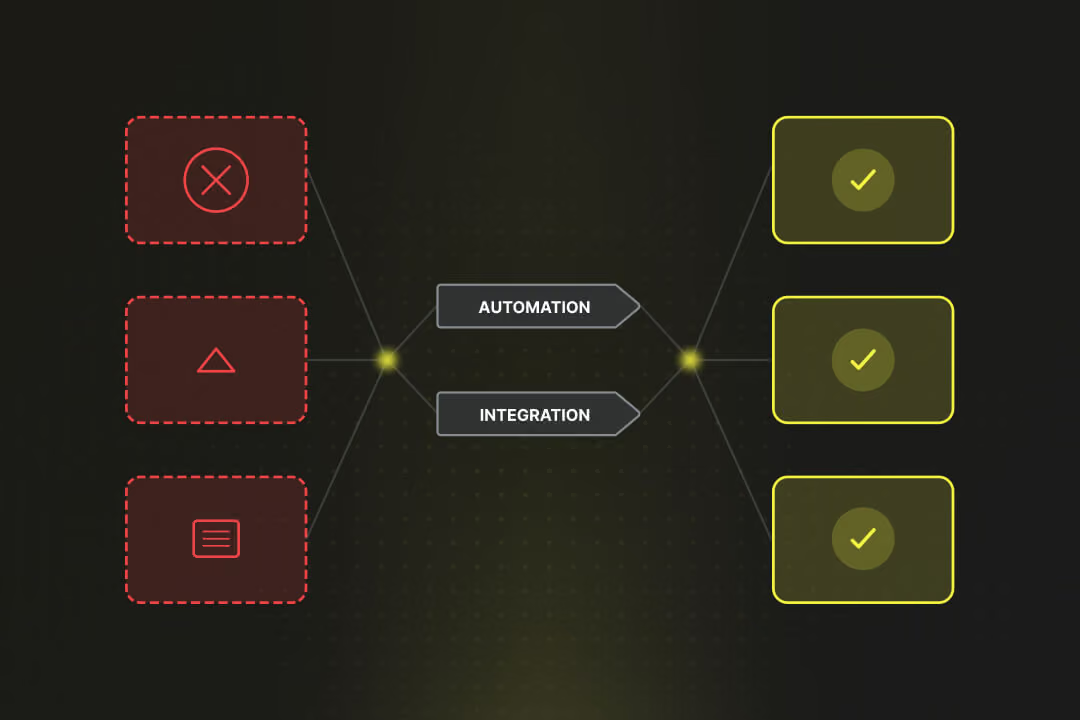
Digital transformation in SMEs is the answer to the acute shortage of skilled workers and your customers' increasing expectations for speed. You restructure your internal infrastructure so that as many processes as possible are automated and all information is available and synchronized for all departments.
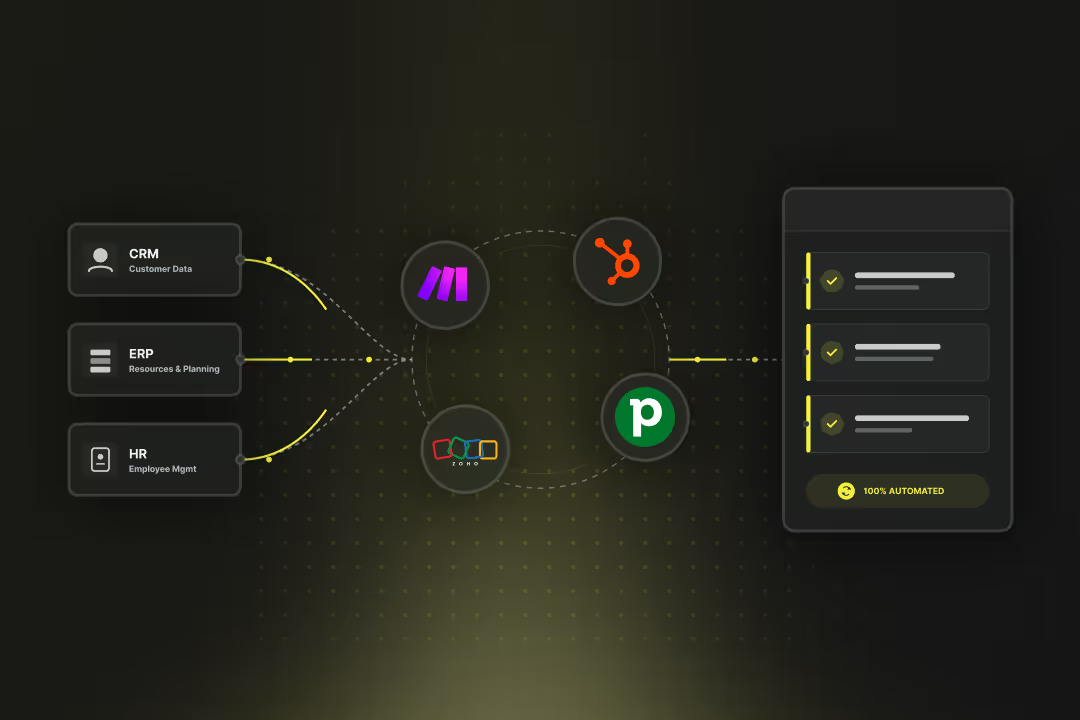
With workflow automation, you can control recurring tasks and processes with software and have them carried out automatically. Such automations connect multiple applications such as ERP, CRM or HR platforms and carry out actions independently.