IT Change Management: Mastering Change Without Operational Risk
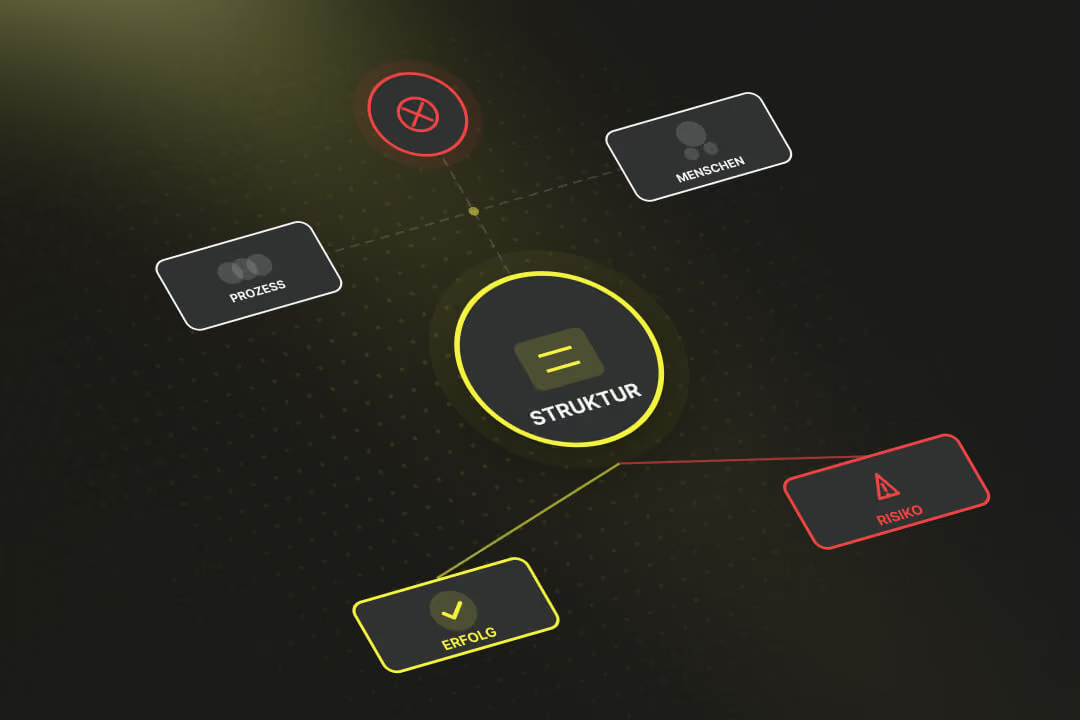
Anyone introducing new software, rebuilding server infrastructure, or automating existing processes encounters the same resistance: systems, teams, and habits don't change on their own. IT Change Management is the structured approach that guides changes in IT systems and organizations to ensure that ongoing operations are not disrupted and the new implementation is successfully adopted. What sounds simple often fails in practice for two reasons: the process and the people.

IT Change Management: Key Takeaways
- Definition: IT Change Management is the controlled process by which changes to IT systems, infrastructure, and processes are planned, reviewed, approved, and implemented, with the goal of preventing operational disruptions.
- Two Dimensions: IT Change Management has a technical side (changes to systems, governed by ITIL) and an organizational side (guiding people through the change). Neither can succeed without the other.
- Change Types: Standard Changes (low risk, pre-authorized), Normal Changes (case-by-case approval), and Emergency Changes (immediate implementation for critical disruptions).
- nDPA Relevance: The revised Swiss Data Protection Act sets requirements that can only be consistently met with a structured change process: audit trail, access rights, data localization.
What is IT Change Management?
The term may sound like management consulting, but it describes something very concrete: the process by which companies implement changes to their IT in a controlled and traceable manner. The ITIL framework (Information Technology Infrastructure Library), the most widely adopted standard worldwide for IT service management, defines it as follows:
IT Change Management ensures that all changes to the IT infrastructure are carried out in a controlled, efficient manner, minimizing risks to ongoing operations.
This sounds technical, but it precisely addresses the core requirement: IT systems are critical for business operations. A software update that crashes a production database costs more than the update itself. A poorly planned migration breaks interfaces with partners or customers. A security patch rolled out too quickly blocks employees. Change Management is the structure that lies between "we want to change something" and "the change is live and working."
IT Change Management should be distinguished from a similarly sounding term: Organizational Change Management. The latter deals with how people and cultures are guided through major transformation processes. Both disciplines are closely related, and in practice, every successful IT change requires both.
What types of IT Change Management are there?
Not every change requires the same effort. Anyone who goes through the same approval process for creating a new user account as for a database migration has misunderstood Change Management. Here, a distinction is made between three basic types:
| Change Type | Description | Typical Use Case |
|---|---|---|
| Standard Change | A pre-approved, low-risk change that follows a proven procedure and does not require individual approval. | Routine updates, user account creation, and known configuration adjustments. |
| Emergency Change | Implemented immediately without the regular process when a critical incident must be resolved. Documentation is completed afterwards. | Actively exploited security vulnerabilities and business-critical system outages. |
| Normal Change | Any change that does not fit the other categories. Requires risk assessment, testing, and approval by the Change Advisory Board (CAB). | New system components, major software updates, and infrastructure modifications. |
In ITIL, practical implementation follows a fixed procedure: submit a Request for Change (RFC), classify, assess risks, test, approve, implement, and evaluate after implementation. The complexity of this process depends on the type. Standard Changes are pre-authorized and run automatically. Normal Changes require review by a team or committee. Emergency Changes prioritize speed, with documentation following later.
ITIL 4, the current version of the framework, incidentally uses the term "Change Enablement" instead of "Change Management." This is more than just a renaming: the focus has shifted. Instead of controlling changes, they should be enabled, with calculated risk rather than excessive bureaucracy. This shift in self-perception is important for companies that want to iterate quickly.
Why do IT Change projects fail so often?
The figures are sobering. Studies consistently show that a large proportion of all IT projects and change initiatives do not fully achieve their original goals, are completed late, or cost more than planned. The reasons rarely lie in technical problems. The technology usually works. It's the surrounding conditions that fail.
Too much process, too little pragmatism
The most common misconception: the more extensive the process, the better Change Management is. The opposite is true. If every minor adjustment goes through a multi-stage approval process, it creates a bottleneck that frustrates developers, slows down projects, and undermines the intended protective effect. Teams then look for ways to circumvent the process, and that is more dangerous than lean Change Management with a clear focus on truly high-risk changes.
The Rule of Thumb: The full process applies to the 20% of changes that carry 80% of the risk. For the rest, standard paths, templates, and pre-authorization are needed.
The human component is underestimated
ITIL provides a very good structure for technical processes. What it doesn't solve: the resistance of employees who are expected to work daily with new software they don't know, didn't want, or don't understand. "We've always done it this way" is not a misconception, but an understandable reflex. New systems mean uncertainty, and uncertainty creates resistance.
This resistance is a communication problem. Those who explain early on why something is changing, what specific benefits it brings to individual daily work, and what risks arise if everything stays the same, have significantly better chances of acceptance.
Lack of feedback after implementation
Many change processes end with the go-live. What happens afterwards is rarely systematically evaluated: Did the change deliver what was expected? What unexpected side effects occurred? Without this post-implementation review (PIR), the organization learns nothing. The next change starts with the same blind spots.
Shadow IT as a sign of a broken process
When departments start introducing their own tools without involving IT, it's a signal that the official process is too slow, too cumbersome, or too opaque. Shadow IT arises because teams have a problem and need a solution, now. Anyone who wants to prevent Shadow IT must first understand why it arises.
What does an IT Change Management process look like?
The ideal process is as lean as possible and as robust as necessary. It follows a clearly defined procedure, differentiates between change types, and gives teams room to maneuver without relinquishing control.
Step 1: Submit Change Request (RFC)
Every change begins with a documented request. It states what is being changed, why, what the risk is, what the fallback plan is, and who is responsible for implementation. The simpler the RFC form, the better the data quality. Complicated forms are filled out superficially.
Step 2: Classify and prioritize
Immediately upon receipt, the change is classified: Standard, Normal, or Emergency. This determines which path is followed. Standard changes are automated. Normal changes go through review. Emergency changes are implemented immediately and documented afterwards.
Step 3: Risk assessment
Two questions are central: How severe would a failure be? And how likely is it? These two axes determine a risk class, which in turn dictates the approval effort. A change with high impact and a high probability of failure requires more scrutiny than one with low impact and a proven approach.
Step 4: Testing in a staging environment
Normal and major changes are tested in a staging environment (test environment) before they are deployed to the production environment. This includes a defined rollback plan: What happens if the change causes issues in production? Who decides on a rollback, and how quickly must it be executed?
Step 5: Approval
For normal changes, the Change Manager or the Change Advisory Board (CAB) decides whether the change will be implemented. Ideally, the CAB consists of representatives from various departments: development, operations, business units. For emergency changes, an Emergency Committee (ECAB) is responsible, making quick decisions and bearing the risks.
Step 6: Implementation and Monitoring
The change is implemented, the team monitors the systems and verifies that everything is working as expected. The change status is continuously documented.
Step 7: Post-Implementation Review (PIR)
After implementation, a brief evaluation follows: Did the change achieve the desired outcome? Were there any deviations? What can be improved next time? These insights are incorporated into the further development of standard procedures.
Checklist: Is your change well-prepared?
- RFC complete: What is being changed, why, by whom, and by when?
- Risk assessed: Impact and likelihood of failure have been estimated.
- Fallback plan defined: A documented rollback process is in place.
- Staging tested: The change has been verified in a test environment.
- Affected parties informed: Teams and users know what is changing and when.
- Communication plan in place: It is clear who informs whom by when.
- Approval obtained: The appropriate decision-maker has approved.
- Monitoring planned: After go-live, the system will be actively monitored.
- PIR scheduled: There is a fixed date for the post-evaluation.
How does IT Change Management differ from DevOps and agile working?
This is a tension many development teams are familiar with: DevOps teams want to deploy quickly, several times a day, without waiting for a CAB meeting next week. IT operations teams want stability and traceability. Classic Change Management according to ITIL V3 often acted as a bottleneck in this conflict.
ITIL 4 has responded by directly integrating DevOps concepts such as Continuous Integration, Continuous Delivery, and automated tests into the change model. The idea: Instead of routing every deployment through a human committee, the review process is automated. A deployment that passes all defined tests is de facto pre-authorized. Human intervention is required when risks arise that no test can mitigate.
Fast changes are automated, while risky changes receive more attention. A well-configured CI/CD system (Continuous Integration/Continuous Delivery) can effectively accelerate Change Management because routine checks are no longer performed manually.
Your IT modernization.
{{371-next-steps="/en/article-inject-elements"}}
What role does the nDSG play in IT Change Management in Switzerland?
The revised Swiss Data Protection Act (nDSG, in force since September 2023) sets specific technical requirements that are difficult to meet without a structured change process. The two central principles of "Privacy by Design" and "Privacy by Default" mean in practice: data protection must be built into every system from the outset, not added later as a feature.
For IT Change Management, this has direct consequences:
- Audit Trail: Every change to systems processing personal data must be fully documented. Who changed what, and when? This is not an optional best practice, but a mandatory proof in case of an incident.
- Review access rights with every change: When a new system is introduced or an existing one is extended, it must be checked whether the access concepts still comply with the principle of least privilege. Overly broad rights often arise from uncontrolled changes.
- Data Localization: If a system change moves data to new cloud regions, this must be reviewed. Data migration without a change process can unknowingly violate nDSG compliance.
- Data Protection Impact Assessment (DPIA): For changes that introduce new processing of personal data or significantly alter existing ones, a DPIA is required. This is a formal step that must be embedded in the change process.
What's Changing in IT Change Management in 2026?
IT change will become a continuous operation in 2026. What was once understood as a time-limited project is now a permanent process: new tools, new integration requirements, new regulations, new security threats. Companies that have only set up change management for large transformation projects are realizing that the process is not designed for the frequency of today's changes.
Three developments are shaping the landscape:
- AI in the Change Process: AI tools are beginning to take over change management steps: risk assessment based on historical data, automatic classification of change requests, prediction of deployments with high failure risk. This accelerates the process without loss of control.
- Automation Replaces Manual Approvals for Routine Changes: "Policy as Code" means that compliance rules are built directly into the deployment pipeline. A change that meets all defined rules is automatically approved. Humans only review what machines cannot reliably assess.
- Interoperability as a New Constant: Due to the multitude of cloud services, APIs, and SaaS products, new interfaces are constantly emerging. Each of these is a potential location for uncontrolled changes. Change management must co-manage these boundaries, not just internal systems.
Wir schaffen leistungsstarke Plattformen und Websites für Startups, Scale-Ups und KMUs, von Konzept bis Go-Live.
We modernize your systems and guide IT transformations.
IT Change Management: Frequently Asked Questions
IT Change Management focuses on the technical management of changes to IT systems, infrastructure, and processes, including risk assessment, approval processes, and audit trails. Organizational Change Management focuses on the human aspect, meaning how teams, cultures, and ways of working are navigated through change. Successful IT projects require both: a structured technical process and thoughtful communication with stakeholders.
Whenever IT changes have the potential to impact ongoing operations, a minimal process is worthwhile. This applies even to teams of five to ten people who manage production systems. A full ITIL process with CAB and formal documentation is overkill for most SMEs. A pragmatic approach involves a lightweight process: a clear RFC process, risk categorization into three categories, and a defined rollback plan for every change. This alone prevents most common outages.
Through automation. ITIL 4 has explicitly integrated DevOps principles: Low-risk standard changes are pre-authorized and automatically processed through CI/CD pipelines. The system handles the review, not a manual committee. Normal and high-risk changes still require human review. This allows teams to deploy multiple times a day while still demonstrating that every change was controlled.
The revised Swiss Data Protection Act (nDSG) mandates Privacy by Design and Privacy by Default, meaning data protection must be built into systems from the outset. For IT Change Management, this creates a direct requirement: Every change affecting systems with personal data must be documented (audit trail), access rights must be verified for accuracy after each change, and a Data Protection Impact Assessment (DPIA) is required for new processing activities.
A Change Advisory Board is a committee that reviews and approves risky changes before they are implemented. Ideally, it consists of representatives from various departments: Development, Operations, Business Units, and sometimes external compliance expertise. Whether a formal CAB is appropriate depends on the company's size and the complexity of its IT. Many companies operate with an informal CAB, a small group with clearly defined decision-making authority that convenes as needed.
More articles
Business Process Management (BPM) is the structured control of business processes through modeling, automation, measurement and optimization. The EU rules DORA and NIS2 reach Swiss companies too, by way of their supply chains.
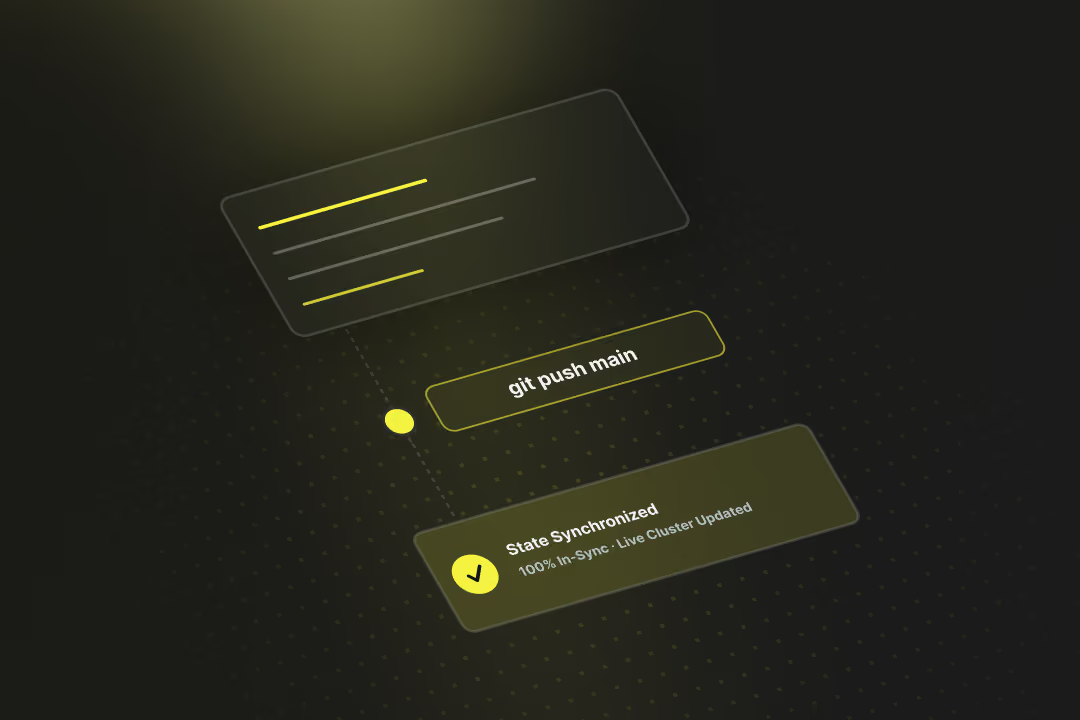
Software deployment is the process that moves finished code out of the development environment and into live production. GitOps, Progressive Delivery and DevSecOps make releases faster and safer. At the same time, the revDSG and even EU regulations reach into Swiss pipelines.
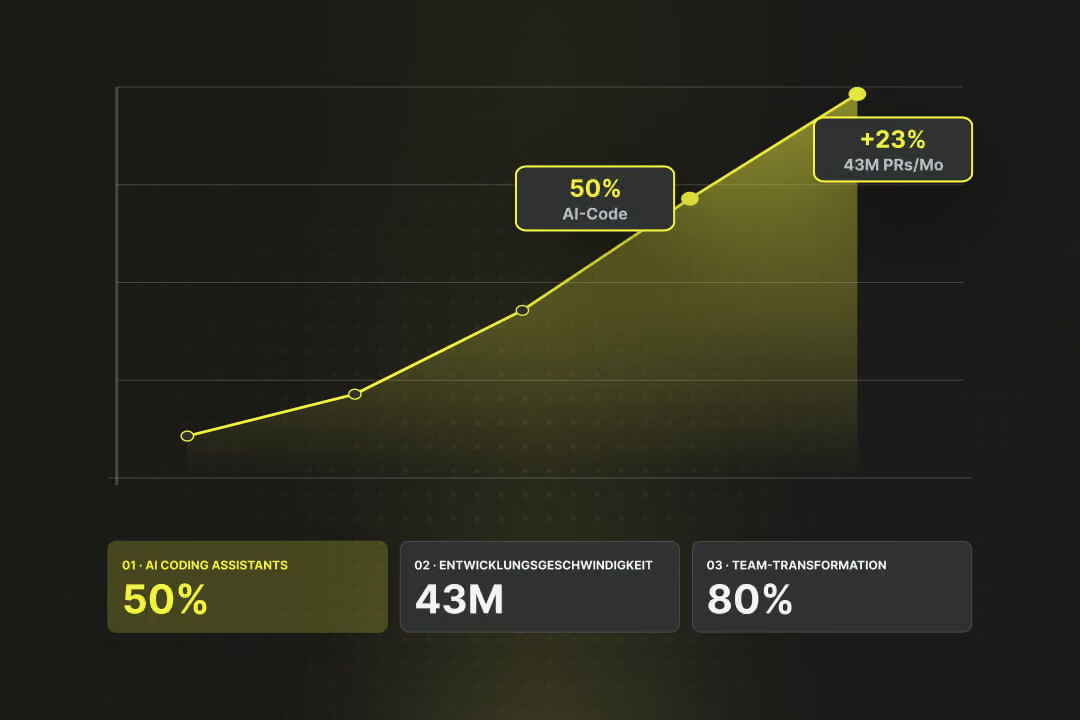
By the end of 2025, almost half of all code on GitHub was generated using AI tools, according to EY Switzerland. Each month, 43 million pull requests were merged, a 23% year-over-year increase (Source: EY Switzerland). Gartner predicts that by 2030, AI-native development platforms will lead to 80% of organizations transforming large developer teams into smaller, AI-augmented units (Source: Gartner). Software development is changing faster than ever before. We highlight the trends that truly matter in 2026, what's driving them, and what this specifically means for businesses.