Your 9-Step Product Strategy
Your product strategy defines the specific value you create for different customer segments and how this value contributes to business success. It forms the foundation for all subsequent product decisions, from development and pricing to market launch.

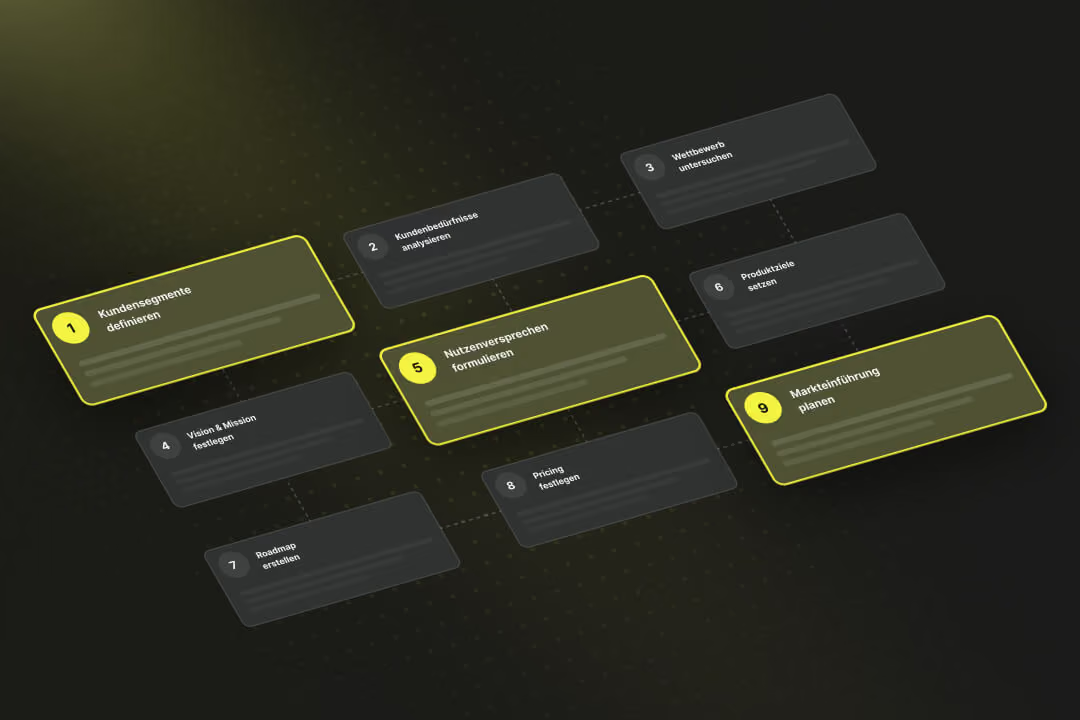
Product Strategy: Key Takeaways
- A product strategy describes who you are developing a product for, what value it provides, and how it contributes to business success.
- The product strategy translates business goals into concrete product decisions and helps you set the right priorities and use resources purposefully.
- Key components of a product strategy include target audience, problem, value proposition, and goals.
- The success of a product strategy is measured with a few meaningful metrics, such as revenue, customer retention, or frequency of use.
How Do I Develop a Product Strategy?
1. Understand the Market and Customers
Before making decisions about product features, prices, or target audiences, you need to understand the market and the actual needs of your customers. Only then can you be sure you're not developing past their problems or investing in an oversaturated segment.
- Analyse market volume, key competitors, and pricing structures.
- Conduct at least five structured customer interviews. Ask how they currently solve their problem, what frustrates them, and what they would prioritize.
- Document the key findings in a concise market and customer profile (1 to 2 pages).
- Define the three most important customer needs (“Jobs to be done”) your product should address.
Result:
A market and customer profile with the biggest opportunities, the main problems of the target group, and quantified market sizes.
2. Clearly Define the Problem
Your product strategy works when it is built on a concrete customer problem. The more clearly you define this problem, the easier it will be to align features, communication, and pricing with it.
- Describe the problem in one sentence: “Customers lose time because …”
- Add measurable impacts, for example: “an average of 30 minutes of manual work per order”.
- Check whether the problem is frequent, cost-relevant, and largely unsolved.
- Initially eliminate all secondary problems that have no direct impact on business value.
Result:
A validated problem statement with concrete data and quotes from customer interviews.
3. Define Your Vision
The vision describes how the product will create a clear benefit in the future. It serves as a north star for all decisions and helps measure short-term priorities against a long-term goal.
- Describe in one paragraph how your product should be used in three years.
- Define a north star metric that expresses the core value of the product, for example “X active users per week” or “X completed transactions per customer”.
4. Formulate Your Value Proposition
The value proposition explains why customers should use your product and not someone else’s. It is the bridge between understanding the problem and positioning.
- Use the structure: For [target segment] we solve [problem] by [solution], as opposed to [alternative].
- Add the main benefits, for example time savings, fewer errors, lower costs.
- Validate the value proposition in conversations with at least three potential customers.
Result:
A precise Value Proposition statement that captures the unique selling point.
5. Evaluate Strategic Options
A product cannot simultaneously be affordable, comprehensive and specialized. Therefore, in this step you decide which competitive strategy to pursue.
- Analyse the market positioning of the key competitors.
- Evaluate three main options:
- Differentiation: Higher value through quality or functionality.
- Cost leadership: More affordable with comparable performance.
- Niche: Focus on a clearly defined target group with specific needs.
- Choose one main option and document the rationale.
6. Set Goals and Metrics
Set your goals and associated metrics to track progress.
- Define three to five measurable goals for the next 12 months.
- Use SMART or OKR logic, for example: “Increase revenue in segment A by 15%”.
- Define the key metrics: revenue, new customer rate, retention, CAC, LTV, NPS.
- Add target values in CHF or percentages and review progress monthly.
7. Prioritize Initiatives
In this step, you determine which initiatives should be implemented first. This ensures that resources are allocated where they have the greatest impact.
- List all possible initiatives from product, marketing, and sales.
- Evaluate each initiative using the RICE model: Reach, Impact, Confidence, Effort.
- Sort by score and verify that the selected initiatives actually contribute to the defined goals.
8. Test and Validate Hypotheses
Every product strategy contains assumptions. Testing allows you to find out whether your assumptions hold true, or where you need to make adjustments.
- Define a hypothesis for each initiative, for example: “If we implement X, Y will increase by Z%”.
- Test with minimal effort (prototype, MVP, landing page, A/B test, interview).
- Define criteria for success or discontinuation.
- Document the results.
9. Roadmap and Communication
Your Product Roadmap translates the product strategy into a concrete plan. It shows what will be implemented and when.
- Create a roadmap in which you assign each planned initiative to a concrete goal, for example “Feature A → higher customer retention” or “Marketing campaign X → more new customers”.
- Group similar initiatives into thematic blocks, such as product quality, growth, or efficiency.
- Plan regular reviews (e.g., quarterly) to adjust priorities and track progress.
- Keep your team informed about the current status and next steps so everyone is aligned.
8 Tips for Your Product Strategy
- Decide what to build your product on: Think about what truly makes your product strong — is it quality, price, specialization in a niche, or a particularly simple workflow?
- Measure success with a few meaningful metrics: Choose KPIs that best show whether your product is working, for example recurring revenue, active users per month, or completed orders.
- Talk to customers weekly: Schedule regular conversations or feedback sessions. This helps you see whether your assumptions hold true and where customer perceptions are shifting.
- Weigh effort against benefit: List all ideas on the table and evaluate each one based on its potential benefit and the effort required. This will help you identify which actions make sense to pursue first and which ones you should postpone.
- Calculate the cost of delays: For every project, ask yourself: What do we lose if we only start next month? This could be lost revenue, a competitive disadvantage, or simply wasted time. This approach helps determine the priority of your projects.
- Write down your strategy: A brief description of one to two pages is sufficient. Describe: What problem you solve, for whom it is important, how your product helps, and how you make money. This document serves as a common reference point for everyone.
- Define when to stop: Before starting a project, define what constitutes success or failure and when you would abandon it. This prevents work from continuing even if it yields no results.
- Separate planning and goal setting: The product strategy describes what you want to achieve. The roadmap, on the other hand, shows the order in which you proceed.
Product Strategy: Leverage Help and Experience from Product Developers
You don’t have to go through every step of developing your product strategy alone.
There are phases where external support can save you weeks or even months, for example, when building initial prototypes, during technical feasibility testing, or when evaluating user data.
At Axisbits, we are experienced product developers and bring proven methodologies, market knowledge, and a trained eye for common problems. We quickly identify where a concept falters and help implement your ideas so they become marketable.
Leverage the knowledge we’ve gained from numerous successful projects.
You already have a specific project idea you’re working on and don’t know how to develop the right product strategy? Get in touch with us! Our team will show you how we can support you.
{{fs-btn-cta}}
Wir schaffen leistungsstarke Plattformen und Websites für Startups, Scale-Ups und KMUs, von Konzept bis Go-Live.
We create powerful custom software, apps, and online platforms for startups, scale-ups, and SMEs, from concept to go-live.
Product Strategy – Frequently Asked Questions
A product strategy outlines the target customers for your product, the value it aims to deliver, and its contribution to business success. It defines the goals you pursue, the priority actions, and how progress is measured.
Without a strategy, there's no clear direction and no common framework for important decisions. Your team gets lost in individual initiatives, budgets are allocated more by gut feeling, and products evolve without a clear objective. A strategy ensures that development, marketing, and sales work towards the same outcome.
Corporate strategy defines the markets a company operates in and how it aims to grow there. Product strategy, on the other hand, outlines an individual product's contribution to this, specifying its target audiences, features, and revenue models.
The product strategy describes what you want to achieve and why. The Product Roadmap shows how and when you will implement these goals.
Typically, the Product Lead or Product Manager develops the strategy together with management, sales, and development. The entire product team is responsible for its implementation.
More articles
White label software refers to fully developed software that you license, brand and sell to end customers under your own brand name, without programming it yourself. For SMEs and agencies, this model can be a fast route to market.
Platform Engineering alleviates the burden on developer teams who, in addition to coding, often have to manage the entire configuration of cloud systems and security pipelines. By building an Internal Developer Platform (IDP), you equip your team with self-service capabilities that make databases or servers available at the push of a button.
.avif)
A prototype is a simplified, partially functional model of a product or software. It is used to test certain characteristics such as usability, function, form, or technology before the final version is developed or produced. A prototype is therefore a validation tool. It forms the basis for verifying assumptions about user behavior, technical feasibility, or market acceptance before a project moves into the often costly implementation phase.