Agile Software Development: 18 Tips for Real Release Speed
These agile software development tips will help you combat endless standups and story point discussions. This way, you'll once again ensure the rapid delivery of working software.


Tips for Strategy & Workflow in Agile Software Development
Set Limits for Work in Progress
If your team has too many projects going on at once, nothing will ever get finished. Set a limit on the number of tasks that can be worked on simultaneously (e.g., a maximum of two per developer). This forces your team to truly complete tickets instead of starting a new task every time they encounter an obstacle. The result: Less work in progress, more completed features.
Focus on Real User Value
A feature that doesn't help any user is a waste. For every task, ask: "What problem are we solving with this?" If the added value is unclear, scrap the ticket. This saves valuable capacity for the things that truly advance your product.
Measure More, Estimate Less
Break down tasks into small, similar chunks so you no longer have to estimate them. Instead, look at how many of these chunks your team completes per week. This provides a much more honest forecast for your planning.
Visualize the Code Flow
Once a month, analyze where the code truly gets stuck. Often, coding isn't the problem, but the time in between: waiting for a code review or approval from a stakeholder. By making these "idle times" visible, you immediately identify where you can speed up the process.
Try a Flow System Instead of Sprints
Fixed sprints can create artificial stress when everything "has to" be finished by the end. If your team is well-coordinated, try a system without fixed timeframes instead (like Kanban). You simply work through priorities one after another and release updates as soon as they are ready. This ensures a more consistent workflow.
Tips for Agile Software Development Practices
Use Test-Driven Development (TDD) as an Investment
Write the test before you write the code. This may seem slower at first, but it pays off: The error rate drops drastically, and your team will later feel confident to change code boldly because the tests provide immediate feedback. You save yourself expensive bug-fixing rounds just before release.
Test Behavior, Not Implementation
Avoid tests that check every small internal function. Focus on behavior from a user's perspective (Behavioral Testing). This keeps your tests stable, even if you clean up the code under the hood (refactoring). Nothing demotivates developers more than tests that unnecessarily turn "red" with every small change.
Embrace Trunk-Based Development
Avoid long-lived feature branches that are only merged after weeks. Integrate code changes daily into the main branch (Main/Trunk). This avoids the notorious "merge hell" and forces the team to break down tasks into small, integrable pieces.
Establish the Scout Rule
Always leave the code a little cleaner than you found it. Small, continuous improvements prevent technical debt from piling up into an insurmountable mountain. It's more effective to invest five minutes daily than to have to schedule a complete "refactoring sprint" every six months.
Automate Setup and Pipeline
If a new developer needs more than a morning to set up their work environment, you're losing time. Automate environments (e.g., with Docker) and ensure that every merge automatically triggers tests and deployments (CI/CD). Automation is a prerequisite for being able to release at any time.
Tips for AI & Automation in Agile Software Development
Use the “Head Chef” Model for AI Code
Have your experienced developers use AI agents to create the "assistant code" (boilerplate). The developer can then focus more on architecture and logic. Important: Humans bear full responsibility for the final result, and blindly copying AI suggestions is not effective.
Examples: Cursor (as an AI-native IDE) or GitHub Copilot Workspace. These tools allow generating a plan and the corresponding code draft across multiple files directly from a natural language description (issue).
Have AI do the First Review Pass
Integrate AI tools directly into the code review process. They excel at finding careless errors, security vulnerabilities, or style guide violations. This relieves human reviewers, allowing them to focus on the truly complex questions of software architecture.
Examples: CodeRabbit or Panto AI. These services automatically analyze pull requests, summarize changes, and point out logic errors or security risks before a human takes a first look.
Documentation as an Automatic Byproduct
Nobody likes writing documentation, but everyone needs it. Use AI tools that automatically generate up-to-date READMEs or API descriptions from your code changes and commits. This keeps documentation always in sync with the code, without your team having to sacrifice valuable development time.
Examples: Swimm or Mintlify. These tools detect code changes and suggest documentation updates, or directly generate appealing developer portals from existing repositories.
Deploy Agents for Tedious Refactorings
Updating outdated libraries or migrating old patterns across an entire project is prone to errors and unpopular. AI agents can take on these tasks. They implement the changes and immediately run the test suite to confirm correctness.
Examples: Claude Code (terminal agent) or OpenCode. These agents can execute complex commands via the terminal, such as "Update all outdated API calls in this repo to version 2.0," and autonomously suggest the necessary file changes.
Tips for the Team and Communication in Agile Software Development
Use Silent Meetings for Decisions
Start important meetings with ten minutes of silence, during which everyone reads a short preparation document and comments on it digitally. This prevents only the loudest voices from being heard and gives introverted experts the space to contribute their knowledge. The result is highly well-thought-out decisions in less time.
Establish a "Blameless" Post-Mortem Culture
When an error occurs or a system fails, look for the cause in the process, not the person. Looking for a "scapegoat" ensures that errors will be covered up in the future. If you instead analyze which safety mechanisms were missing in the system, you build a resilient team where everyone dares to take responsibility.
Embrace Openness Regarding Technical Debt
Hidden problems in the code are time bombs. Therefore, maintain an open list for technical debt that is visible to everyone, including product management. Only when the risks are known can the team jointly decide when refactoring is more important than the next feature.
Use Pair Programming Intentionally, But Don't Force It
Use Pair Programming for highly complex logic, architectural decisions, or onboarding new team members. Apply it where "four eyes" truly prevent errors or facilitate knowledge transfer.
Is your agile software development not progressing fast enough?
If your software development is too slow despite sprints and standups, the problem very often lies with legacy issues that are holding you back. At Axisbits, we help companies like yours find a way out and deliver real results faster again.
- Workflow Audits: We find out why your releases get stuck and eliminate idle times in your process.
- High-End Engineering: We help your teams not just to know modern standards like TDD, CI/CD, and AI-native development (Cursor, Agentic Workflows), but to implement them profitably.
- Partnership of equals: We are developers who work hand-in-hand with you to deliver code that works: nDSG-compliant, scalable, and maintainable.
{{fs-btn-cta}}
Wir schaffen leistungsstarke Plattformen und Websites für Startups, Scale-Ups und KMUs, von Konzept bis Go-Live.
We develop custom software for startups, scale-ups, and SMEs – from idea to finished product.
Agile Software Development Tips – Common Questions and Answers
This is very often due to what is known as Agile Theater: The outward rituals (dailies, sprints) are performed, but the technological foundations are missing. If every deployment takes hours or requires manual tests, technology slows down the process. True speed only arises through the combination of lean processes and radical automation (CI/CD).
They are a waste when misused for control or when they consume hours in meetings. A more modern approach is to break down tasks into small, similarly sized units. Then you simply measure throughput (how many tasks are completed per week). This is statistically more accurate and saves the team valuable focus time.
TDD is a powerful tool for combating technical debt. Without automated tests, every new feature introduces the risk of breaking existing functionalities. This inevitably makes the team slower and more cautious. TDD ensures that the codebase remains flexible and maintainable, even years down the line.
AI should not be seen as a replacement for developers, but as a "Force Multiplier" (Head Chef Model). Tools like Cursor or CodeRabbit take over routine tasks such as boilerplate code or initial code reviews. The team retains architectural control but gains a significant amount of time for solving the actual business problems.
Scrum works well for teams requiring clear structure and fixed planning cycles. Kanban (the flow system) is preferable when the team is highly experienced or priorities shift rapidly. It eliminates the artificial pressure at sprint-end and enables a continuous, smooth workflow.
More articles
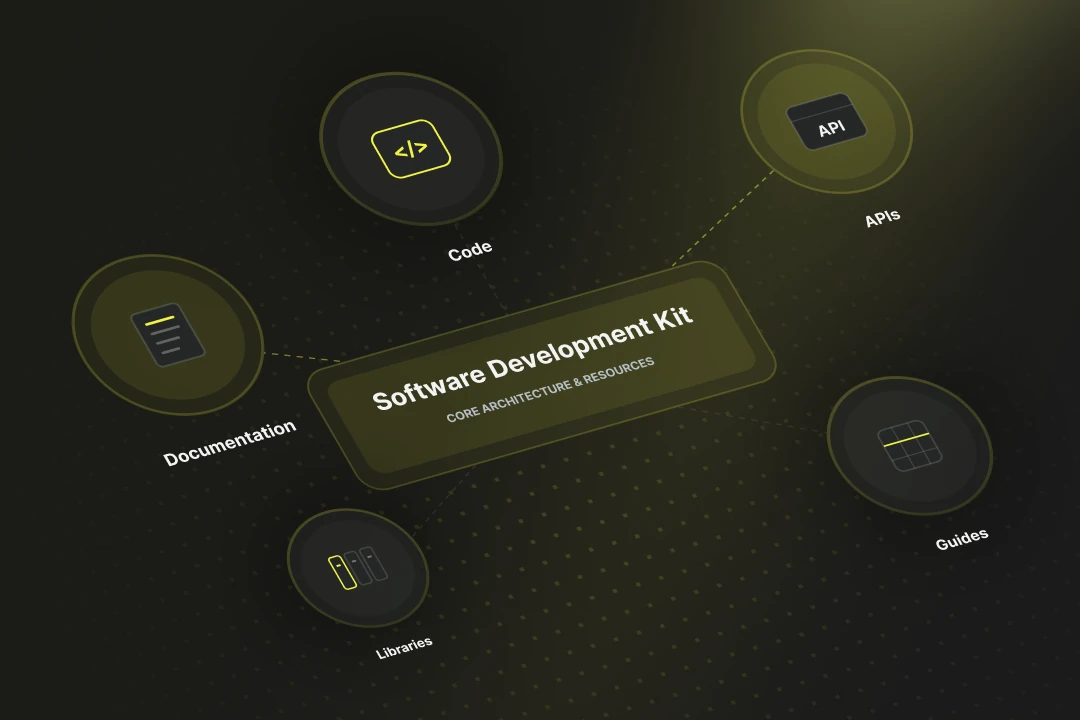
SDK stands for Software Development Kit. Online the abbreviation also turns up for a German health insurer, but in software development SDK always means a package of tools, libraries and documentation for a particular platform. It lets you build apps faster, because standard functions such as login or payment ship ready-made.
Embedded software is control code that runs directly on a hardware system, without a generic operating system in between. In 2026 embedded software has become a compliance topic, because the Cyber Resilience Act (CRA) starts to bite from September 2026 with its first reporting duties — including for Swiss manufacturers active on the EU market.
