Accelerate Software Projects: How to Halve Time-to-Market Without Sacrificing Quality
The true impediments to software development are unclear requirements, too many manual processes, and lengthy decision-making processes. To accelerate software projects, you need to identify and eliminate the friction points in your development pipeline. By leveraging automation, AI-driven software development, and a strict prioritization of core value (MVP), you can massively increase development velocity.


Accelerating Software Projects: Key Takeaways
- Focus on the MVP: Start as simply as possible. A Minimum Viable Product (MVP) gets you to market in weeks, not years, and provides real user feedback.
- Automation (CI/CD): Replace manual deployments and tests with automated pipelines. This shortens release cycles from days to minutes and prevents costly rework.
- AI Integration: Leverage AI copilots for generating standard code. This boosts efficiency in core development.
- Lean Methods: Limit parallel tasks (WIP limits). Teams that start fewer tasks simultaneously complete features measurably faster. Short feedback loops prevent you from developing in the wrong direction.
- Smart Scaling: Augment your team with external experts before deadline pressure becomes too great. Through modular division of labor, you circumvent Brooks’s Law and immediately gain capacity.
Quick Check: Why is my software project so slow?
Before taking action, you need to understand the root cause. In software development, three factors are typically responsible for delays:
- Scope Creep: Your project expands uncontrollably during its runtime because new ‘must-have’ features are constantly being added.
- Manual Work Bottleneck: Your team loses valuable days due to manual testing or complex release processes during deployment.
- Waiting for Decisions: Developers are stalled because feedback loops are too long or responsibilities between business and IT remain unclear.
Can an MVP help me get to market faster?
The most effective way to accelerate a software project is to radically cut requirements that are not absolutely essential for initial market success. Instead of spending years building a supposedly perfect version, you develop a Minimum Viable Product (MVP), a truly usable product that focuses on the core idea.
- MVP: The first productive version on the market. “Will customers pay for this solution?”
- Proof of Concept (PoC): A mere proof of concept. “Does the technology even work?”
- Prototype: A clickable model for visual alignment. “Do users understand the design?”
An MVP is your most important tool for risk management. You avoid large investments in features that might not even be needed later. By using Low-Code and No-Code technologies, we at Axisbits can realize this version within a few weeks.
- Real Feedback: Data from actual usage immediately flows into the next phase.
- Stopping “Scope Creep”: New ideas are disciplinedly placed in the backlog for Version 2.0, instead of jeopardizing the current release date.
- Planned Evolution: You only develop what your users truly demand.
What role do automation and AI play in development speed?
You accelerate your software projects by using automated CI/CD pipelines instead of manual programming, shifting quality assurance left (Shift-Left), and leveraging AI tools for code generation.
CI/CD Pipelines
A common reason for delays is the error-prone manual deployment of software updates. Through Continuous Integration (CI) and Continuous Deployment (CD), every change in the program code is automatically thoroughly tested and immediately deployed to the target environment.
What used to take hours or days of coordination between developers and IT operations now happens fully automatically in just a few minutes.
Automated Quality Assurance (Shift-Left Testing)
High speed is achieved by preventing errors. However, if you only discover errors shortly before the planned release, this often sets you back by weeks.
With the Shift-Left approach you integrate automated tests into the very first phase of programming. Errors are thus immediately detected and fixed before they can escalate into a complex problem that derails the schedule.
AI Development
AI has become one of the most important levers for implementation speed. With it, you can quickly create standard components, boilerplate code, and documentation. This frees up valuable time for your team to focus on solving more significant challenges.
What methods can be used to accelerate software projects?
You increase your team’s development speed by consistently capping the number of concurrently started tasks (Work in Progress), shortening decision paths through clear role distribution, and preventing unnecessary misdevelopments through short feedback loops.
- Limiting Work-in-Progress (WIP): Instead of working on many tasks simultaneously, you set limits for parallel tasks. This forces the team to fully complete features once started ("Stop starting, start finishing"), which measurably increases overall throughput.
- Clear Definition of Done (DoD): You prevent time-consuming rework by unambiguously defining when a task is truly finished (incl. tests and documentation). This avoids the "90% done syndrome," where tasks resurface just before release.
- Short Feedback Loops (Sprints): Through agile software development with 1 to 2-week intervals, you ensure that any incorrect developments are identified immediately.
- Empowered Product Owner: Shorten waiting times by having a single person (the PO) make immediate decisions on priorities and requirements.
- Pair Programming & Code Reviews: Even if it sounds paradoxical, when two developers work on a problem or review each other’s code, speed increases. The error rate drops so significantly that the time saved during later troubleshooting (debugging) is immense.
- Backlog Refinement: You accelerate implementation by ensuring that tasks in the backlog are already fully prepared ("Ready") before they enter development.
- Daily Stand-ups: These maximum 15-minute meetings are solely for immediately identifying and resolving blockers (impediments) on the same day, rather than letting them linger for days.
{{fs-magnet-prototype="/en/article-inject-elements"}}
How can I speed up my software project with additional resources?
You can only speed up a software project with additional staff and resources if you minimize the onboarding time and divide the team into modular working units. Simply throwing “more heads” at a delayed project, according to Brooks’s Law, initially makes it slower, as communication becomes exponentially more complex. With the right strategy for involving external experts, you can avoid this pitfall.
- Create autonomous “feature teams” that can work independently on different software components.
- Plug-and-Play Documentation: Clean technical documentation and standardized development environments (e.g., Docker) that allow new developers to be ready to start within hours instead of days.
- Knowledge Transfer: External experts bring best practices from dozens of other projects, which typically leads to existing internal processes being incidentally optimized and accelerated.
We at Axisbits are your accelerator throughout the entire lifecycle of your software. We help you eliminate the typical roadblocks in development:
- Rapid Time-to-Market (MVP): We bring your idea to market readiness within a few weeks using Lean Startup methodology and low-code/no-code technologies.
- Custom High-End Software: From web platforms to mobile apps, we develop full-stack solutions precisely tailored to your data structures and processes.
- Process Automation: We transform analog processes into digital workflows and automate routine tasks, so your team can focus on innovation.
AI & Innovation: We integrate AI platforms into your products to make them future-proof and competitive.
{{fs-btn-cta}}
Wir schaffen leistungsstarke Plattformen und Websites für Startups, Scale-Ups und KMUs, von Konzept bis Go-Live.
We develop custom software for startups, scale-ups, and SMEs – from idea to finished product.
Accelerating Software Projects – Frequently Asked Questions
Forcing things by demanding 'more overtime' typically leads to quality loss and long-term delays due to errors. You only achieve genuine acceleration systemically: By eliminating unnecessary tasks (Waste), automating processes, and reducing Work-in-Progress. Speed is the result of a frictionless process, not of increased pressure on the team.
While the initial setup of automated tests requires an investment of time, this effort pays for itself after just the second or third release. During the maintenance phase and for regression tests, time savings can exceed 70%. Moreover, 'Shift-Left-Testing' prevents errors from being discovered late in the process.
The biggest time sink is incomplete requirements and slow decision-making processes. When developers have to guess what's meant, or wait days for a design to be approved, the project grinds to a halt. Introducing an empowered Product Owner and clear 'Definition of Ready' checklists for backlog tasks almost completely eliminates these downtimes.
It's worth bringing in external help when the backlog grows faster than your in-house team can manage, or when specific expertise (e.g., in AI or cloud architecture) is missing.
An MVP saves a significant amount of money and time by preventing you from building a product that misses the market. Many features in large software products are rarely or never used. With an MVP, you only build the features that truly generate value. What might seem like 'double effort' is actually a low-investment testing phase that ensures the subsequent full version will be a success.
More articles
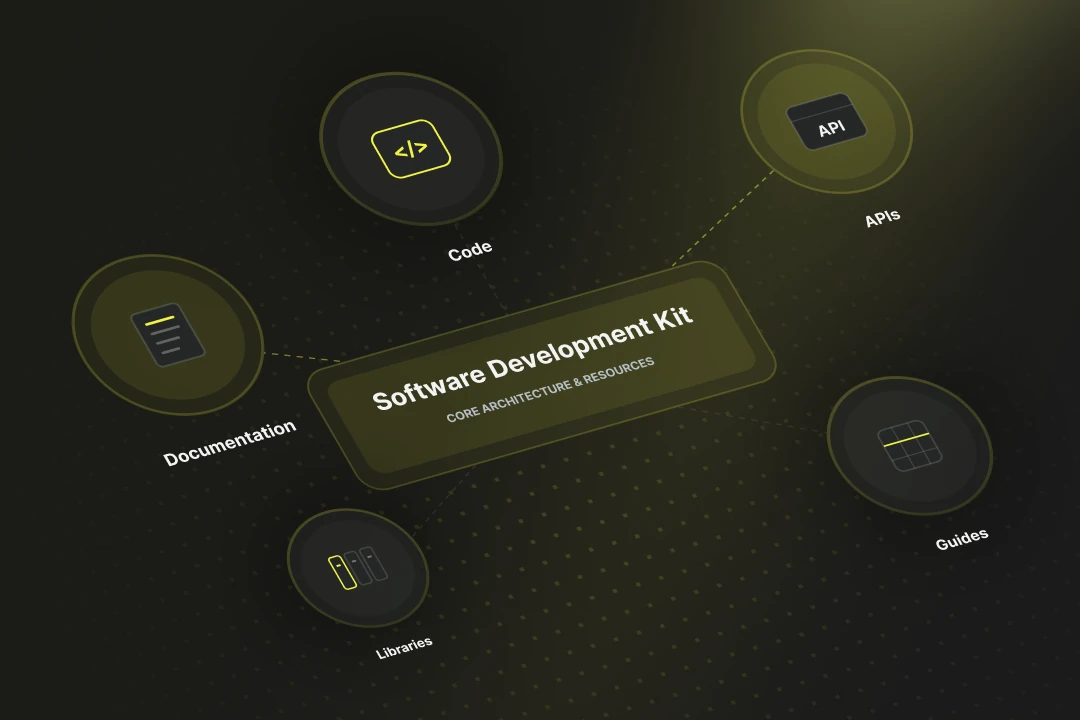
SDK stands for Software Development Kit. Online the abbreviation also turns up for a German health insurer, but in software development SDK always means a package of tools, libraries and documentation for a particular platform. It lets you build apps faster, because standard functions such as login or payment ship ready-made.

Embedded software is control code that runs directly on a hardware system, without a generic operating system in between. In 2026 embedded software has become a compliance topic, because the Cyber Resilience Act (CRA) starts to bite from September 2026 with its first reporting duties — including for Swiss manufacturers active on the EU market.
