SDK Explained: What is a Software Development Kit?
SDK stands for Software Development Kit. Online the abbreviation also turns up for a German health insurer, but in software development SDK always means a package of tools, libraries and documentation for a particular platform. It lets you build apps faster, because standard functions such as login or payment ship ready-made.

SDK: Key Takeaways
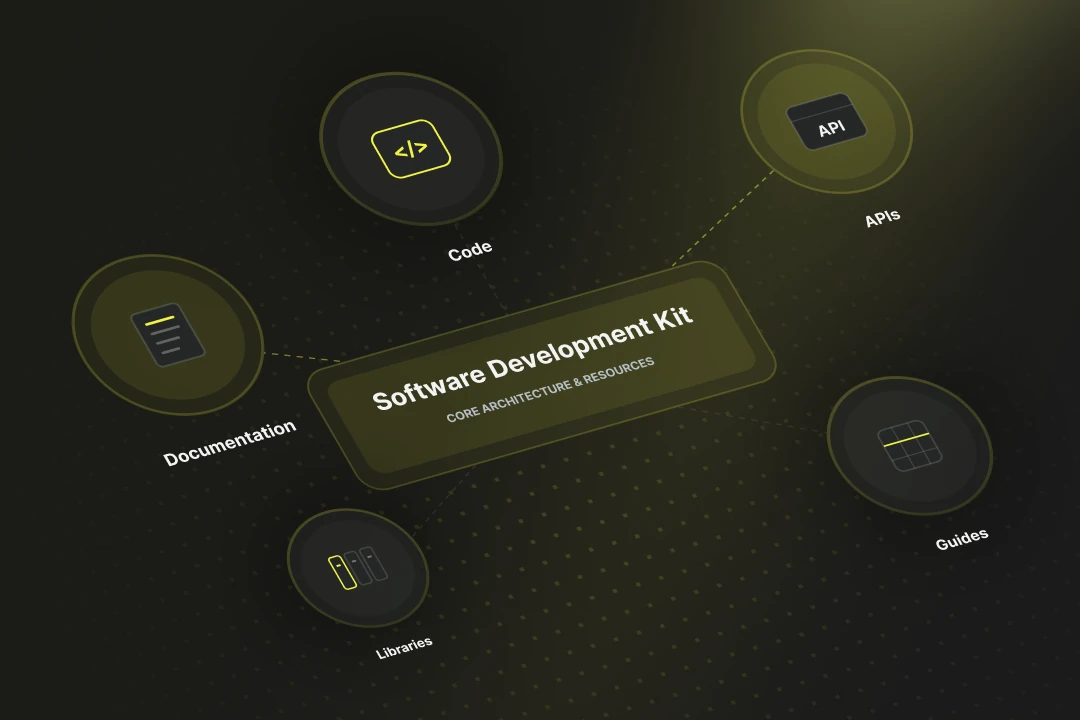
- An SDK (Software Development Kit) is a package of libraries, APIs, documentation, code samples and development tools that helps developers build applications for a particular platform or service.
- Well-known examples are the Android SDK for native Android apps, the iOS SDK for Apple devices, the dotnet SDK (.NET SDK) for cross-platform applications, and the SDKs from Firebase, Stripe and AWS for services such as authentication, payment and cloud access.
- An API is a single interface to an external service. An SDK delivers the complete toolset including APIs, documentation, code samples and build tools, with which developers assemble an application faster.
- Axisbits is a Swiss software team that supports companies in selecting, integrating and maintaining SDKs in web and mobile apps over the long term, with senior review on every line of code.
Which components make up an SDK?
An SDK typically contains five core components that together cover every tool needed to develop applications on a platform. The scope varies by vendor, but the following building blocks are present in almost every SDK.
| Component | Function | Example |
|---|---|---|
| Libraries | Reusable code building blocks for specific functions | Crypto library for encryption |
| APIs | Programming interfaces through which your app talks to the service | REST API for reading user data |
| Documentation | Instructions for using the library and the APIs | Quickstart guide for integrating the SDK |
| Code samples | Runnable sample apps for typical use cases | Example app for Stripe Checkout |
| Development tools | Debuggers, emulators, compilers, build tools | Android Emulator in the Android SDK |
By shipping an SDK, makers of operating systems, programming languages or services give other developers a far easier route to building applications for those platforms. The SDK delivers every tool in a single package, so none of it has to be written from scratch.
An SDK exists so you can reuse code that is already tested and documented for the platform in question and comes with the right build tools. Stripe payments, Google Maps, or push notifications via Firebase all ship as SDKs, and you integrate them into your app development with a few lines.
What Distinguishes an SDK From an API?
An API is a single interface to a service. An SDK gives you the complete toolset including APIs, documentation, sample code and build tools. The API is therefore part of the SDK, and the SDK goes considerably further in scope and convenience.
| Characteristic | API | SDK |
|---|---|---|
| Scope | A single interface | A complete toolset |
| Contents | Endpoints and data formats | APIs, libraries, docs, tools, samples |
| Integration | You build the connecting code yourself | Ready-made code is dropped straight in |
| Typical example | OpenAI REST API | Firebase SDK for iOS |
For example: with the bare Firebase REST API you formulate the HTTP requests yourself, manage tokens and catch errors. With the Firebase SDK a single function call is enough and the login works.
Which well-known SDKs should developers know?
The important and therefore well-known SDKs are the Android, dotnet, iOS, Flutter, Firebase, Stripe and AWS SDKs.
Android SDK
The Android SDK is Google's official toolkit for developing native Android apps. It provides the Android platform libraries, the Android Emulator, build tools, a debugger and the integration into Android Studio. You download the Android SDK directly through the SDK Manager in Android Studio and configure it per target API level for your app.
dotnet SDK (.NET SDK)
The dotnet SDK, officially the .NET SDK, is Microsoft's open-source toolkit for applications built on .NET. It covers the .NET runtime, compilers for C#, F# and Visual Basic, the MSBuild build tool, and templates for web apps, console apps and APIs. You can install the dotnet SDK cross-platform on Windows, Linux and macOS.
Other Important SDKs in App Development
- iOS SDK: Apple's toolkit for iPhone and iPad apps, integrated into Xcode.
- Flutter SDK: Google's toolkit for cross-platform apps built on the Dart language.
- Firebase SDK: backend services such as auth, realtime database and push notifications.
- Stripe SDK: payment integration for web and mobile apps.
- AWS SDK: access to AWS cloud services such as S3, Lambda and DynamoDB.
In cross-platform development with Flutter or React Native you work from a shared codebase for iOS and Android, while the respective platform SDK stays active in the background.
Which applications does an SDK make easier?
An SDK smooths your path as soon as your app reaches out to an external platform or service whose functions you have no wish to rebuild yourself. These four examples show how using particular SDKs reduces your effort:
- Payment: the Stripe SDK delivers PCI-compliant payments with minimal integration effort and supports cards, wallets, Apple Pay and Google Pay.
- Push notifications: the Firebase Cloud Messaging SDK handles token management and delivery, and you send messages through the Firebase Console or via a backend call.
- Maps and location: the Google Maps SDK provides map display, geocoding and routing for web and mobile applications.
- Auth: the Supabase or Auth0 SDK handles login, session management and token refresh, including social logins.
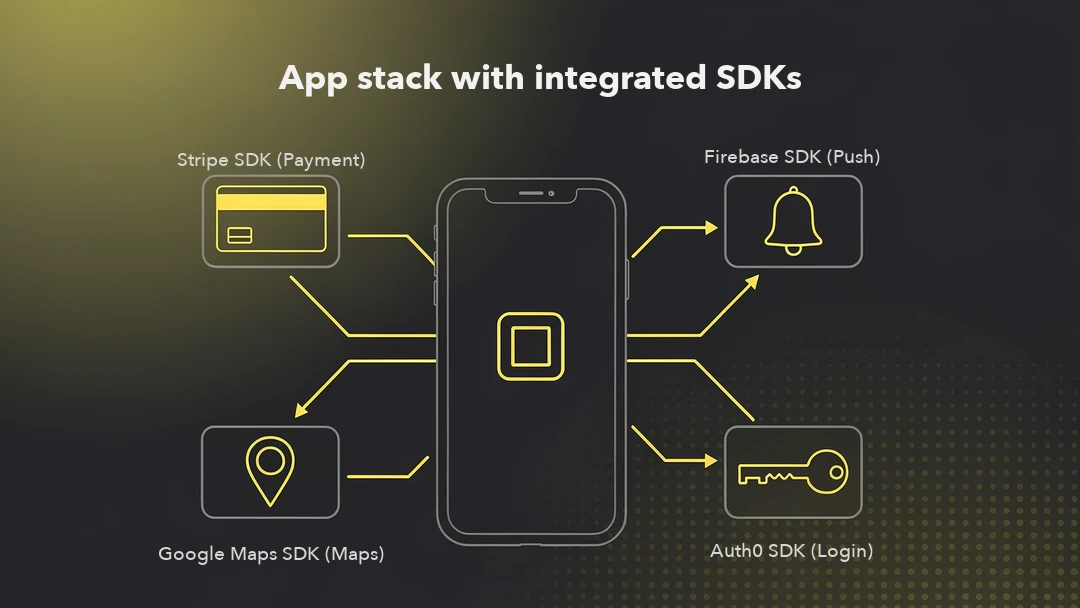
In mobile app development you generally combine several SDKs in a single application. An average Android app contains between 15 and 20 SDKs for functions such as analytics, crash reporting, push, auth and payment.
Maintaining and looking after SDKs
SDKs speed up development considerably, deliver high quality through already-tested code, and open access to platform functions that would otherwise take weeks or months to build yourself.
The flip side of SDKs shows up in maintenance. Every integrated SDK brings its own updates, security patches and licence terms, which your team has to look after continuously.
We at Axisbits can help you with that. Axisbits is a Swiss software team that supports companies in software development, including the selection, integration and maintenance of SDKs. With us you get a specialist team at senior level:
- Senior review on every line of code: every pull request is checked and signed off by a senior before the merge.
- Full code ownership: the entire code belongs to you, no vendor lock-in, pausable at any time.
- Swiss contracting party: binding under Swiss law, DSG-compliant and with ISO 27001 certification in progress.
Book your free intro call. In 30 minutes we clarify together which SDKs your project needs and how best to build your app. You get an honest assessment of development time and costs, with no sales pressure.
{{fs-btn-cta}}
Wir schaffen leistungsstarke Plattformen und Websites für Startups, Scale-Ups und KMUs, von Konzept bis Go-Live.
Get the speed of AI-assisted workflows combined with the assurance of a Swiss senior sign-off. We build your interfaces and platforms at senior level, for the price of a mid-level team.
SDK – Frequently Asked Questions
In software development the abbreviation SDK stands for Software Development Kit, a package of tools, libraries and documentation for building applications. In the insurance sector you will also come across the abbreviation as Süddeutsche Krankenversicherung, a private health insurer based in Stuttgart.
Most platform SDKs, such as the Android SDK, the iOS SDK or the dotnet SDK, are free and open source. Commercial services such as Stripe or Twilio bill for the use of their platform, while the SDK itself stays free. With enterprise licences from individual vendors, fees sometimes apply for extended support or additional modules.
The programming language always follows the SDK's target platform. The Android SDK works primarily with Kotlin and Java, the iOS SDK with Swift and Objective-C, and the dotnet SDK with C#, F# and Visual Basic. Cross-platform SDKs such as Flutter rely on Dart, while React Native works with JavaScript and TypeScript.
An average Android app contains between 15 and 20 SDKs for functions such as analytics, crash reporting, push, auth and payment. Every additional SDK increases app size, load time and maintenance effort. A deliberate selection, with replacement paths thought through ahead of critical updates, keeps the codebase maintainable over the long term.
More articles
Embedded software is control code that runs directly on a hardware system, without a generic operating system in between. In 2026 embedded software has become a compliance topic, because the Cyber Resilience Act (CRA) starts to bite from September 2026 with its first reporting duties — including for Swiss manufacturers active on the EU market.

