Understand Fullstack Development in Minutes
Fullstack development means working on both layers of a web application: the frontend (user interface, browser) and the backend (server logic, databases, APIs). A Fullstack web developer covers both areas.


Fullstack Development: The Essentials
- Not an Expert in Everything: Fullstack means having an overview of the entire system, not deep expertise in every technology. In complex systems, specialists are faster and more precise than a single fullstack developer.
- Typical Stack: React or Next.js for the frontend, Node.js with TypeScript for the backend, PostgreSQL or MongoDB as the database, Docker for deployment, AWS or Azure as the cloud. Today, TypeScript connects both layers.
- When it's Worthwhile for Businesses: Startups, MVPs, small to medium-sized web apps where a team without strict frontend/backend separation can deliver faster.
- When Specialists Make More Sense: Large, complex systems with heavy load on one layer, such as very elaborate UX or a very computationally intensive backend. In such cases, depth is needed, not breadth.
What Does Fullstack Development Mean?
Every modern web application consists of at least two layers. The Frontend is everything the user sees and interacts with: buttons, forms, navigation, animations, the entire visual and interactive part of an application that runs in the browser. The Backend is everything that runs behind the scenes: servers, databases, business logic, API endpoints, authentication, data persistence.
A frontend developer's home is in the first layer, a backend developer's in the second. A fullstack developer operates in both. This doesn't mean they have the same depth of expertise in both as a specialist; it means they understand both layers, can program in both, and have an overview of the system as a whole. They can build an API in the backend and consume it in the frontend without anyone else translating or mediating.
This overview is the core value of fullstack development: less communication overhead between teams, faster development of small to medium-sized applications, and a deeper understanding of how the individual layers interact.
What is the Difference Between Frontend, Backend, and Fullstack Development?
The distinction between these three roles is fluid in everyday practice, but relevant when deciding who you need for a project:
| Role | Area of Responsibility | Typical Technologies | Strength |
|---|---|---|---|
| Frontend Developer | Browser, UI, user interaction | HTML, CSS, JavaScript, React, Vue, Angular, TypeScript | Deep UX expertise, browser performance, design implementation |
| Backend Developer | Servers, APIs, databases, business logic | Node.js, Java/Spring Boot, Python, PHP, PostgreSQL, MongoDB, REST, GraphQL | Data security, scalability, complex business logic |
| Fullstack Web Developer | Both layers | React + Node.js + TypeScript + Database + Deployment | System overview, independence, rapid implementation without team handoffs |
Important for practical application: The boundaries between these roles are increasingly permeable. TypeScript, as a common language for both frontend and backend, has significantly simplified switching between the two layers. Many fullstack projects today run entirely in TypeScript, from the React frontend to the Node.js backend. This makes it easier to switch between them without having to completely rebuild the mental context.
What skills must a Fullstack Web Developer master?
A realistic view of an experienced Fullstack Developer's skills covers several layers:
- Frontend: HTML, CSS, and JavaScript as fundamentals, plus a modern framework like React or Vue, TypeScript as the standard language, basic knowledge of UX principles, and Responsive Design.
- Backend: Server-side programming (Node.js/TypeScript as the most common choice, alternatively Java/Spring Boot, Python, or PHP), API design following REST or GraphQL, authentication, and authorization.
- Databases: Relational databases like PostgreSQL or MySQL, knowledge of NoSQL (MongoDB, Redis), database modeling, and query optimization.
- DevOps Fundamentals: Version control with Git, deployment processes, Docker for containers, basic knowledge of cloud platforms (AWS, Azure, or GCP). Cloud expertise is a prerequisite in most job postings.
- Testing: Unit tests, integration tests, fundamental understanding of CI/CD pipelines.
TypeScript as a Common Denominator: TypeScript adoption has exceeded the 80 percent mark in new projects. Anyone who masters TypeScript can work in both the frontend and the backend without switching programming languages. This is one of the main reasons why the JavaScript/TypeScript stack attracts so many Fullstack Developers.
Which tech stacks are typical for Fullstack development?
In practice, a few stacks have become established for Fullstack web development, depending on the team's background and project requirements:
| Tech Stack | Description |
|---|---|
| JavaScript/TypeScript Stack | Frontend: React or Next.js Backend: Node.js + Express or Fastify Database: PostgreSQL or MongoDB Deployment: Docker + AWS / Vercel Strength: One language (TS) across all layers |
| Java/Kotlin + React Stack | Frontend: React or Angular Backend: Java/Kotlin with Spring Boot Database: PostgreSQL or MySQL Deployment: Docker + Azure or AWS Strength: Enterprise-ready, highly scalable |
| Python Stack | Frontend: React or Vue Backend: Python with Django or FastAPI Database: PostgreSQL + Redis Deployment: Docker + GCP or AWS Strength: Strong for data processing and AI integration |
| .NET/C# + React Stack | Frontend: React or Angular with TypeScript Backend: ASP.NET Core / C# Database: PostgreSQL, SQL Server Deployment: Azure DevOps + Azure Cloud Strength: Microsoft ecosystem, enterprise-grade |
{{fs-banner-cta}}
When does Fullstack make sense?
This is the crucial question for companies assembling a development team or hiring a service provider. The answer depends on project size, complexity, and budget:
| Situation | Recommendation | Why |
|---|---|---|
| Startup, MVP, first version | Fullstack | A small team can oversee the entire application and iterate quickly without frontend/backend coordination overhead. |
| Medium-sized web app with clearly separated responsibilities | Fullstack or Hybrid | Use Fullstack for features spanning both layers and specialists for specific requirements. |
| Complex UX, animation-heavy applications, design systems | Frontend Specialist | Deep UX expertise and browser performance optimization require specialized frontend knowledge. |
| High load, scalable microservices, critical data security | Backend Specialist | Performance tuning, database optimization under load, and security architecture are specialist domains that Fullstack breadth cannot replace. |
| Internal tools, dashboards, B2B applications | Fullstack | Functionality matters more than visual perfection; rapid feature delivery is the main value. |
The decision between Fullstack and specialists is not a technical one, but a strategic one. A single experienced Fullstack Developer delivers faster and more cost-effectively for a small product than two specialists who first need to learn to collaborate. For complex, growing systems, this ratio reverses. Then, depth pays off faster than breadth.
Axisbits offers both Backend development as well as Frontend development as separate specializations, depending on what the project actually needs.
How to get started in Fullstack development?
Becoming a Fullstack Developer is not a quick process. Anyone starting from scratch needs a realistic learning path. Good news: TypeScript as a common base for frontend and backend makes the path shorter today than it was five years ago.
Web Fundamentals
HTML, CSS, JavaScript. Then directly TypeScript. Don't jump into frameworks too early: first understand the language, then the framework.
Frontend with React
React and Next.js as dominant frameworks, components, state management, API calls. First personal projects with real data.
Backend with Node.js
Express or Fastify, REST APIs, database connection with PostgreSQL, authentication. Connect your own frontend with a real backend.
DevOps Fundamentals and Cloud
Git, Docker, Deployment on AWS or Vercel. CI/CD pipeline for your own project. Basic cloud knowledge is mandatory in almost every position.
The most common mistake in the learning path: learning too many technologies simultaneously too early. Implementing a lean project from start to finish – frontend, backend, database, deployment – and then refactoring it, is more beneficial than working through ten different tutorials.
Full Stack Development with Axisbits
Axisbits develops web applications and platforms using modern Fullstack technologies, from architecture to productive operation. We combine frontend and backend expertise within the same team and decide on a project-by-project basis when Fullstack breadth or specialization is more sensible.
- Fullstack development: React, Next.js, Node.js, TypeScript, PostgreSQL, Docker, AWS or Azure, depending on your project's requirements.
- Architecture Consulting: We analyze your requirements and recommend the stack and team structure that best suits your growth goals.
- Legacy Modernization: Existing systems are gradually migrated to modern stacks without service disruption.
- AI Integration: We integrate LLM APIs, agentic workflows, and AI features into Fullstack apps, API-first and with a clear data strategy.
{{fs-btn-cta}}
Fullstack Development for Your Project?
We develop web apps and platforms with modern Fullstack technologies, from architecture through to deployment. In the Project Review we clarify what your project needs.
Wir schaffen leistungsstarke Plattformen und Websites für Startups, Scale-Ups und KMUs, von Konzept bis Go-Live.
We develop web apps and more using modern Fullstack technologies.
Fullstack Development: Frequently Asked Questions
Experienced Fullstack Developers with three to five years of professional experience in the DACH region typically earn between CHF 90,000 and 130,000 per year, depending on location, tech stack, and company size. For freelancers/agencies, hourly rates range from CHF 100 to 180 per hour, depending on experience and technology. Specialists in particularly in-demand stacks, such as React with TypeScript and AWS or Java/Spring Boot with React, tend to be at the higher end of this range.
Neither. Fullstack development has different strengths than specialization; it's not a step up from one level to the next. An experienced frontend specialist for complex UX or a backend specialist for high-load systems will be faster and have deeper expertise in their domain than a Fullstack developer. The question is what the project needs. For many roles and projects, especially in startup and SME environments, the breadth of a Fullstack developer is more valuable than the depth of a specialist.
TypeScript is currently the top choice for Fullstack development. It runs in the browser (frontend with React or Next.js) and on the server (backend with Node.js), boasts one of the most active communities in web development, and is the standard language for over 80% of new projects. The learning path is: understand JavaScript, then learn TypeScript, then React for the frontend, and Node.js for the backend. Using a single language for both layers significantly reduces the learning curve.
Basic knowledge of UX principles and responsive design is essential for a Fullstack profile, as the frontend falls within their scope of work. In-depth UI design or specialized UX research, however, are separate disciplines. In practice, Fullstack developers usually work with design system specifications (Figma designs, component libraries), which they implement but do not conceive from scratch. Those who work without designers need more basic design knowledge; those who work with a design team can focus on the technical implementation.
More articles
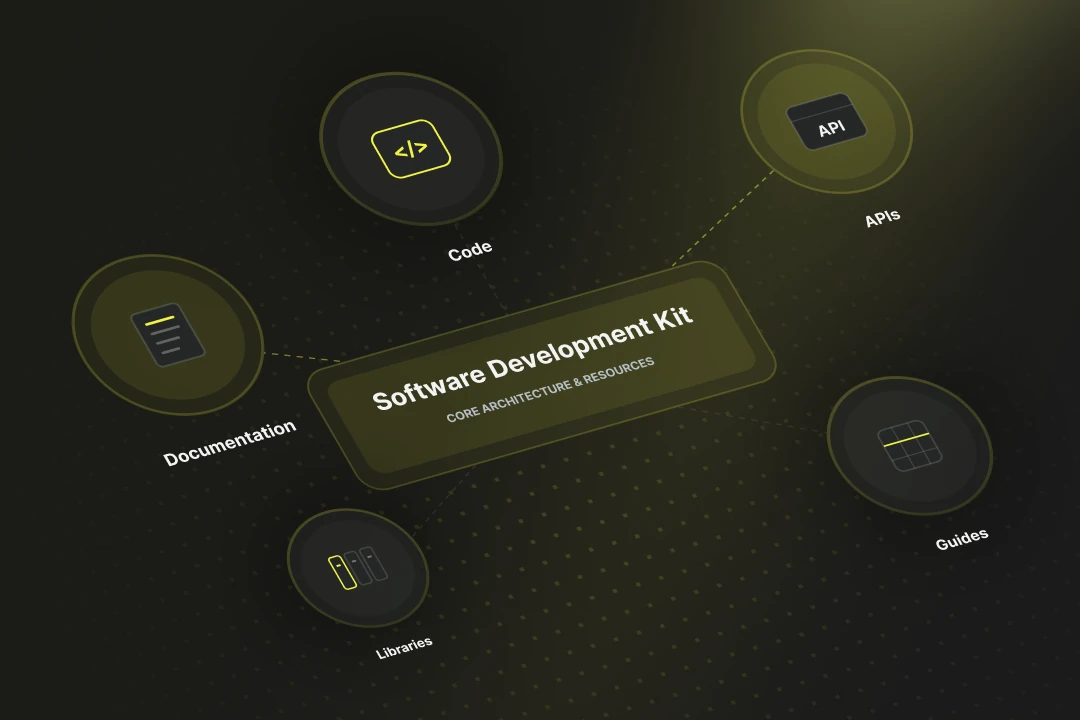
SDK stands for Software Development Kit. Online the abbreviation also turns up for a German health insurer, but in software development SDK always means a package of tools, libraries and documentation for a particular platform. It lets you build apps faster, because standard functions such as login or payment ship ready-made.
Embedded software is control code that runs directly on a hardware system, without a generic operating system in between. In 2026 embedded software has become a compliance topic, because the Cyber Resilience Act (CRA) starts to bite from September 2026 with its first reporting duties — including for Swiss manufacturers active on the EU market.
