Software Development Outsourcing: How to Expand Capacity Without Losing Control
If your in-house team can no longer manage the required workload, software development outsourcing offers a clear path to continued growth. By partnering with external experts, you can systematically reduce technical debt and gain new operational flexibility.

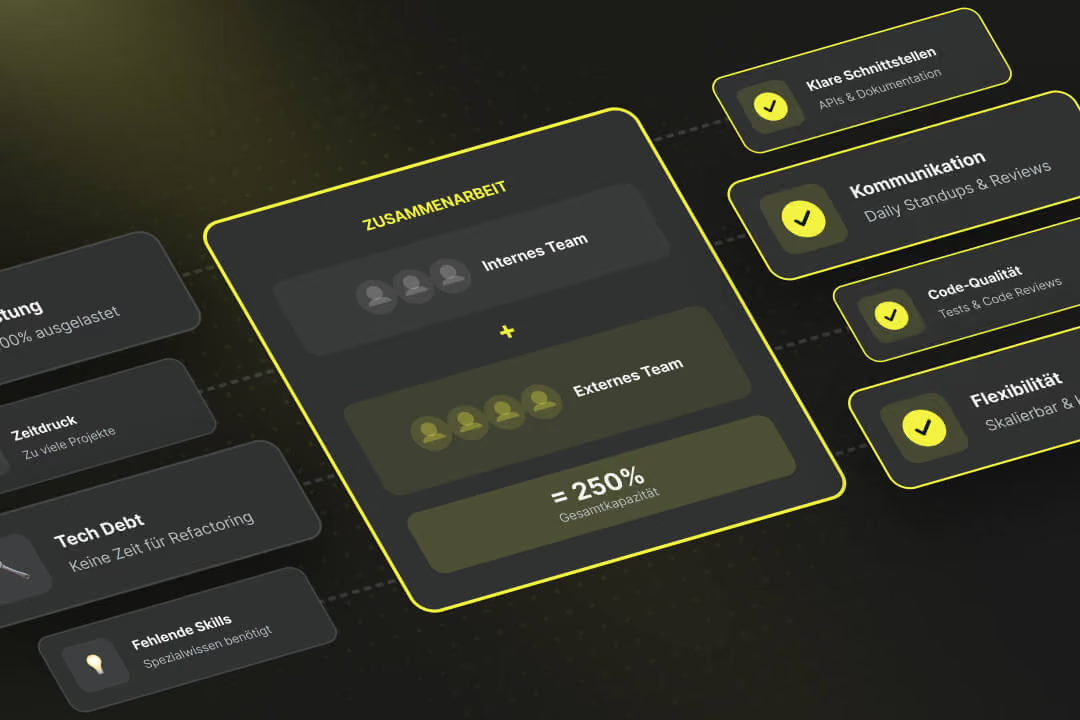
Software Development Outsourcing: Key Takeaways
- Capacity: You overcome the talent shortage and scale your development through external experts, without committing long-term to high fixed costs or personnel risks.
- Onshore/Nearshore: You benefit from the optimal balance of attractive costs and geographical proximity. No or minimal time difference enables synchronous collaboration.
- nDSG Compliance: You meet the requirements of the new Swiss Data Protection Act through partners with EU standards. Your intellectual property remains fully protected.
- Model Selection: Depending on the model, you can strengthen your team with external resources, delegate entire project components, or outsource the entire software development.
Which outsourcing model is right for my project?
Which outsourcing model best suits your project depends on your need for control and the clarity of your requirements: Staff Augmentation is suitable for quickly filling expertise gaps. A Dedicated Team acts as a long-term, self-sufficient 'extended workbench' for continuous product development. Project-based outsourcing is the best choice for clearly defined projects with a fixed goal.
- Staff Augmentation (Team Extension): You already have a capable team, but you occasionally lack senior developers for technologies like React or Node.js. The external resources integrate into your processes and tools (Jira, Slack). You retain technical leadership and full control over every detail.
- Dedicated Team (Extended Workbench): You want to build a new product module without distracting your core team from daily operations. The team consists of developers, testers, and a Scrum Master. It is a 'plug-and-play' solution that operates technologically independently and grows with your company long-term.
- Project Outsourcing: You have a business idea, but no capacity for technical management. You hand over the requirements to an agency. The implementation risk lies with the service provider.
{{fs-cta-main="/en/article-inject-elements"}}
Choosing a Location for Software Development Outsourcing
The location of your outsourcing partner influences the Total Cost of Ownership (TCO) of your project: Offshore models (e.g., Asia) attract with very low hourly rates, but time differences and cultural barriers drive up the ancillary costs for management. Nearshoring in Eastern Europe has established itself as an excellent choice for Swiss companies, as it combines high technological quality with minimal time differences. With a Swiss agency, you take the shortest path and find it easiest to comply with the Swiss Data Protection Act (nDSG).
Even though the hourly rate itself might be higher in Switzerland, the biggest advantage lies in legal certainty and trust:
- Highest Compliance Standards: With a Swiss partner like Axisbits, the entire process is directly subject to Swiss law and the nDSG. There are no grey areas for data transfer across continental borders.
- No Language Barriers: Requirements are understood precisely. Nuances are not lost in translation, which reduces the number of revision cycles.
- Local Liability & IP Protection: Your intellectual property is protected according to Swiss standards. Contracts are directly enforceable, without having to resort to international arbitration courts.
Hybrid Model: Some agencies combine two worlds: Swiss project management and on-site architectural design, combined with highly qualified nearshore resources for implementation. This way, you get Swiss security at optimized overall costs.
What to look for when choosing and managing a partner
Successful outsourcing is an active partnership. However, to ensure quality and keep the project on schedule, you should define guardrails for the collaboration. This involves establishing processes and mutual openness.
Choosing the right outsourcing partner for software development
A suitable partner must be a technological and cultural fit for your company. Consider the following points:
- Technical Deep Dive: Ask for code examples from similar projects. Pay attention to documentation, test coverage, and clean architecture.
- Process Matching: Does the partner work with agile methodologies (Scrum/Kanban) that are compatible with your way of working?
- Scalability: Can the partner quickly provide additional experts if needed, without diluting quality?
The role of your internal Product Owner
The most important interface to the service provider is your internal Product Owner (PO). Their task is to define your requirements in such a way that no room for interpretation remains. An external service provider can only deliver as well as they have been briefed. The PO ensures that your company's goals are maintained in every sprint.
Quality assurance through "Definition of Done"
Clearly define from the outset when a task is considered done . A good Definition of Done (DoD) includes in professional outsourcing:
- Code reviews: Every code section is reviewed by a second developer.
- Automated tests: No new feature without a corresponding unit or integration test.
- Documentation: The code must be documented in such a way that it can be easily maintained by third parties.
Axisbits: Your partner for high-end outsourcing
We at Axisbits are your Swiss agency for software development projects. We take on parts or entire projects and ensure that you are always provided with the highest quality.
- Scalability without personnel risk: You scale up capacities exactly when your project requires it and reduce them again when the phase is complete.
- Legal certainty according to Swiss standards: We operate strictly in accordance with the revised Data Protection Act (nDSG). Usage and ownership rights to the source code are contractually secured for you.
- Free up capacity: While we handle routine tasks, time-consuming tests, or the creation of WCAG-compliant accessible platforms, your in-house team can focus on the strategic development of your product.
- Rapid Market Launch (MVP): We bring your idea to market readiness within just three months. We leverage efficient no-code and low-code technologies to significantly reduce initial development time.
Do you need custom software that precisely maps your processes, or do you want to automate existing workflows via HubSpot? We support you every step of the way. Even after launch, we ensure that your digital product's performance consistently remains at its peak through systematic A/B testing and usability analyses.
{{fs-btn-cta}}
Wir schaffen leistungsstarke Plattformen und Websites für Startups, Scale-Ups und KMUs, von Konzept bis Go-Live.
We develop custom software for startups, scale-ups, and SMEs – from idea to finished product.
Software Development Outsourcing – Frequently Asked Questions
You secure your intellectual property through a contractual agreement that stipulates all usage and ownership rights to the source code fully transfer to your company upon payment. Axisbits also ensures that the code is cleanly documented and resides in your own repositories (e.g., GitHub) to ensure your continued independence.
Yes, it is fully compliant with the law, provided a data processing agreement (DPA) is in place. This agreement governs how the external partner handles personal data. Ensuring compliance is particularly straightforward with nearshoring within the EU, as the GDPR and the Swiss nFADP are largely aligned.
Require automated tests and regular code reviews. A reliable partner will give you full access to the repository at any time. Furthermore, it's advisable to conduct a technical audit at the outset to objectively evaluate the team's working methods.
Effective communication in outsourcing is all about timing. Beyond daily video call stand-ups, we leverage asynchronous tools like Slack or Microsoft Teams for direct developer-to-developer exchange. It's crucial that all requirements, decisions, and feedback are centrally documented, ensuring the project status is 100% transparent for you at all times.
More articles
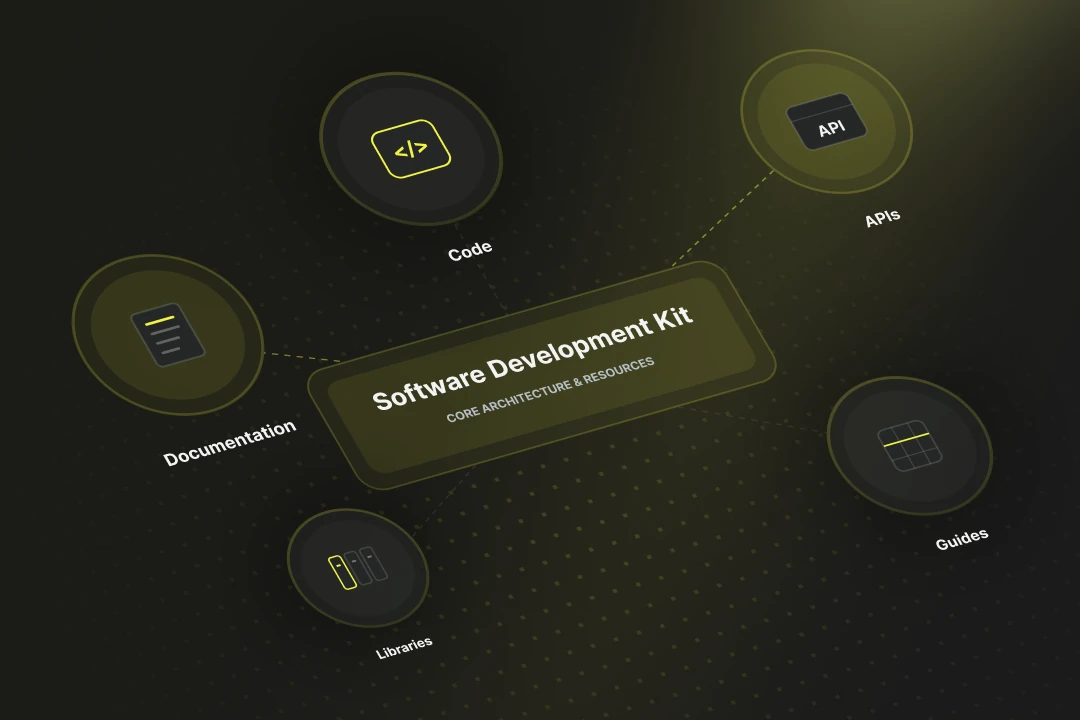
SDK stands for Software Development Kit. Online the abbreviation also turns up for a German health insurer, but in software development SDK always means a package of tools, libraries and documentation for a particular platform. It lets you build apps faster, because standard functions such as login or payment ship ready-made.
Embedded software is control code that runs directly on a hardware system, without a generic operating system in between. In 2026 embedded software has become a compliance topic, because the Cyber Resilience Act (CRA) starts to bite from September 2026 with its first reporting duties — including for Swiss manufacturers active on the EU market.
