What is custom software?
Custom software is developed for a single client. It is programmed to represent specific processes, data structures or interfaces of a company. By contrast, standard software is produced as a finished product for a broad market. It covers functions such as accounting or invoicing within a predefined scope.

Custom software is developed for a single client. It is programmed to represent specific processes, data structures or interfaces of a company. By contrast, standard software is produced as a finished product for a broad market. It covers functions such as accounting or invoicing within a predefined scope.
Key points about custom software at a glance
- Custom software is developed for a single client and maps processes, data models or interfaces with precision.
- Custom software is programmed to order, whereas standard software is a finished product for many users.
- Costs for custom software: higher initial investment, but no ongoing licence fees. Price range between CHF 20,000 and 300,000. More for higher requirements.
- Cloud & location: operation is possible both on your own infrastructure and in Swiss cloud regions; industry-specific rules may be stricter.
How do custom and standard software differ?
Custom software is developed for a single client and reflects that client's processes and interfaces. Standard software, by contrast, is a finished product that provides the same set of functions for all customers.
When is custom software worthwhile?
Using custom software is worthwhile when your processes, data models or integrations cannot be adequately represented by standard software. It is particularly useful when you have unique requirements or when existing systems need to be connected to one another.
Typical decision points for custom software:
- Specific processes: when processes cannot be covered by the functions of common standard solutions.
- Integration: when systems, machines or databases need to be connected via interfaces that aren't provided in standard software.
- Industry requirements: when regulatory requirements or specific standards must be taken into account.
- Scaling: when the software needs to grow and be extended.
- Data sovereignty: when full control over data, source code and infrastructure is needed or required.
Examples of custom software
- A production company wants to bundle machine control, quality control and reporting in one system.
- A marketplace provider builds a platform that connects payment systems, booking logic and user management.
- A cantonal authority needs an application that brings together data from different registers.
- A federal office wants to speed up an administrative process with the help of AI but is bound by strict data-protection requirements.
{{fs-btn-cta}}
How much does custom software cost?
The software development costs are primarily driven by the actual development effort, ongoing development, maintenance and operation. An initial viable version for market testing (MVP) costs between CHF 20,000 and 60,000, a platform between CHF 80,000 and 300,000, and an app between CHF 60,000 and 200,000.
- Scope of features: the more modules and features, the greater the development effort.
- User interface: sophisticated designs and interactions take longer to develop.
- Integrations: interfaces to third-party systems or machines can be complex.
- Scalability: systems with high performance and resilience requirements need additional architecture and infrastructure.
- Maintenance and further development: even after go-live, there is ongoing effort for fixes, updates and new features.
How does a custom software project work?
Developing custom software takes place in several phases: first the requirements are captured and a concept is drawn up, then development begins. A Minimum Viable Product (MVP) is often built that contains only the core functions and enables first use. After go-live, the software is operated, maintained and extended.
- 1. Requirements analysis: capturing processes, data flows and interfaces.
- 2. Concept: defining architecture, data models, security requirements and schedule.
- 3. Development with MVP: first an MVP is built that contains the most important functions. It makes the software usable very quickly and lets you incorporate feedback from real use. Afterwards, it is expanded into a comprehensive solution.
- 4. Testing: checking the software for functionality, security and performance.
- 5. Rollout: deployment for users, including training.
- 6. Operation and maintenance: bug fixes, updates and ongoing adjustments.
In the private sector, agile methods such as Scrum or Kanban are used, which enable gradual development and the integration of an MVP.
In public administration, the HERMES project management model is often used. It divides projects into clearly structured phases with defined roles and milestones.
Want to know what working with a software development team looks like? Here you'll find our roadmap for creating custom software.
Which legal aspects are relevant for custom software in Switzerland?
When developing and using custom software in Switzerland, the main considerations are data protection, contract design and industry-specific requirements. European regulations such as the GDPR or the AI Act can also be relevant if data or user relationships cross national borders.
Data protection for custom software in Switzerland
- The revised Data Protection Act (revDSG) has been in force since 1 September 2023.
- Companies must document the processing of personal data, implement technical and organisational measures, and fulfil information duties.
- A contract is required for order processing, governing responsibilities, measures and rights.
Contracts and rights for the creation of custom software
For custom software, a work contract (Werkvertrag) is usually concluded. It defines which services are owed and how the rights to the source code are regulated.
Alternatively, a service contract (Dienstvertrag) can be used, which focuses on an ongoing service rather than a finished product.
Rights of use and ownership of the source code should be clearly set out in the contract. Escrow agreements can provide additional protection.
Procurement of custom software for public administration
The federal government, cantons and municipalities work with templates such as the model contracts from the KBOB (Koordinationskonferenz der Bau- und Liegenschaftsorgane der öffentlichen Bauherren) or the terms and contract templates from Swiss Digital Administration (Digitale Verwaltung Schweiz).
Administrative projects mostly follow the HERMES standard, which also takes legal and organisational aspects into account.
European requirements for custom software
The General Data Protection Regulation (GDPR) is also relevant for Swiss companies when data from people in the EU is processed.
The EU AI Act has been in force since 2024 and has set out obligations for AI systems since 2025.
How is custom software operated in the cloud with Swiss data location?
Custom software can be operated both on your own infrastructure and in the cloud. In Switzerland, the location of the data plays an important role, as legal requirements and internal policies repeatedly require storage within the country.
Operation of custom software by Swiss SMEs
For small and medium-sized enterprises (SMEs) in Switzerland, there is no legal obligation to store data in Switzerland. However, the requirements of the revised Data Protection Act (revDSG) and, where there is an EU connection, the GDPR always apply:
- revDSG: allows data processing abroad when adequate data protection is ensured. For countries without an adequate level of protection (e.g. the USA without a specific agreement), additional safeguards must be in place.
- GDPR: corresponds to the revDSG in this regard, but also requires safeguards for data transfers to third countries.
For Swiss SMEs without international business, it is often simpler to choose cloud regions within Switzerland, as this removes questions about data transfer.
For SMEs with EU customers, it is advisable to use providers that offer a clear legal basis for data transfers.
There is no legal obligation to store data exclusively in Switzerland unless required by industry regulations, for example from the Swiss Financial Market Supervisory Authority (FINMA) or in healthcare.
Cloud options for custom software in Switzerland
- Hyperscalers with CH regions: providers such as Microsoft Azure operate data centres in Zurich and Geneva. Data can be stored exclusively in Switzerland there.
- Public Clouds for the federal administration: a specific framework governs the use of public-cloud services by the federal administration.
- Swiss Government Cloud (SGC): a project by the Federal Office of Information Technology, Systems and Telecommunication, running from 2025 to 2032, providing a dedicated cloud environment for federal agencies.
Creating custom software in Switzerland
Custom software differs from standard software in that it can map your processes the way your team needs and brings along all the interfaces and functions you want.
Creating custom software is always worthwhile when there is no other software that matches your expectations. In that case, your team typically works with a compromise solution, which also comes with performance trade-offs.
We at Axisbits build your custom software. We make sure you can work free of constraints going forward and that the software matches your expectations exactly. You can find successfully delivered software projects in our portfolio.
If you already have a project idea on the table, get in touch with us!
{{fs-btn-cta}}
Wir schaffen leistungsstarke Plattformen und Websites für Startups, Scale-Ups und KMUs, von Konzept bis Go-Live.
We build powerful custom software for start-ups, scale-ups and SMEs, from concept to go-live.
Custom software — frequently asked questions and answers
Through clear contractual provisions on source-code ownership, access to documentation and data-export formats. Escrow agreements can provide additional security.
A small project or an MVP can be delivered within a few months. Larger systems, depending on scope, take between six months and more than a year.
Yes, a hybrid approach is often chosen. Standard software handles generic functions like Office or CRM, and custom software adds or integrates additional processes.
Open-source libraries or frameworks are often used to reduce development effort. Licence terms need to be reviewed, especially if the software is sold commercially or passed on.
More articles
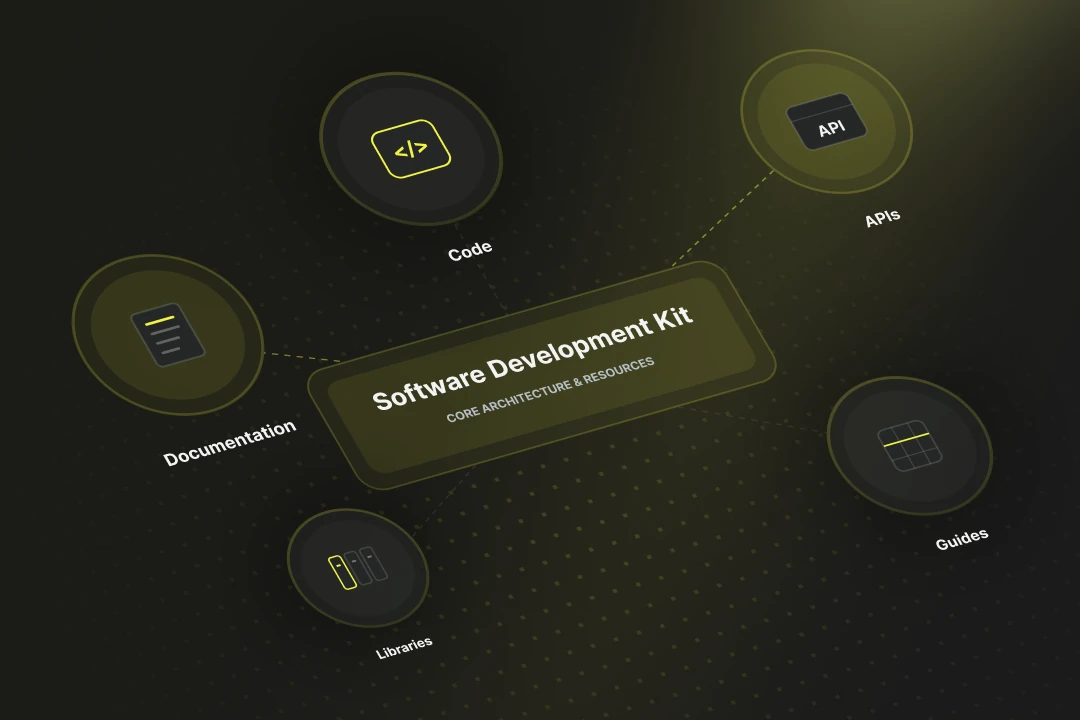
SDK stands for Software Development Kit. Online the abbreviation also turns up for a German health insurer, but in software development SDK always means a package of tools, libraries and documentation for a particular platform. It lets you build apps faster, because standard functions such as login or payment ship ready-made.
Embedded software is control code that runs directly on a hardware system, without a generic operating system in between. In 2026 embedded software has become a compliance topic, because the Cyber Resilience Act (CRA) starts to bite from September 2026 with its first reporting duties — including for Swiss manufacturers active on the EU market.
