Guide: Your product roadmap step by step
Bringing a new product from idea to market readiness is challenging. A product roadmap can help you structure and share your vision with stakeholders. It makes all steps understandable for everyone involved, from the initial sketch to delivery, and promotes team collaboration. At the same time, it creates external trust and arouses interest among potential customers.


Not sure whether you need a product roadmap or how to create it? This article will help you make a decision and show you the first steps on the way to your own roadmap.
What are product roadmaps?
A product roadmap is a strategy paper that relates directly to an individual product. It shows where you want your product to develop and why. The roadmap shows the vision, direction, and priorities of your product over a specific period of time.
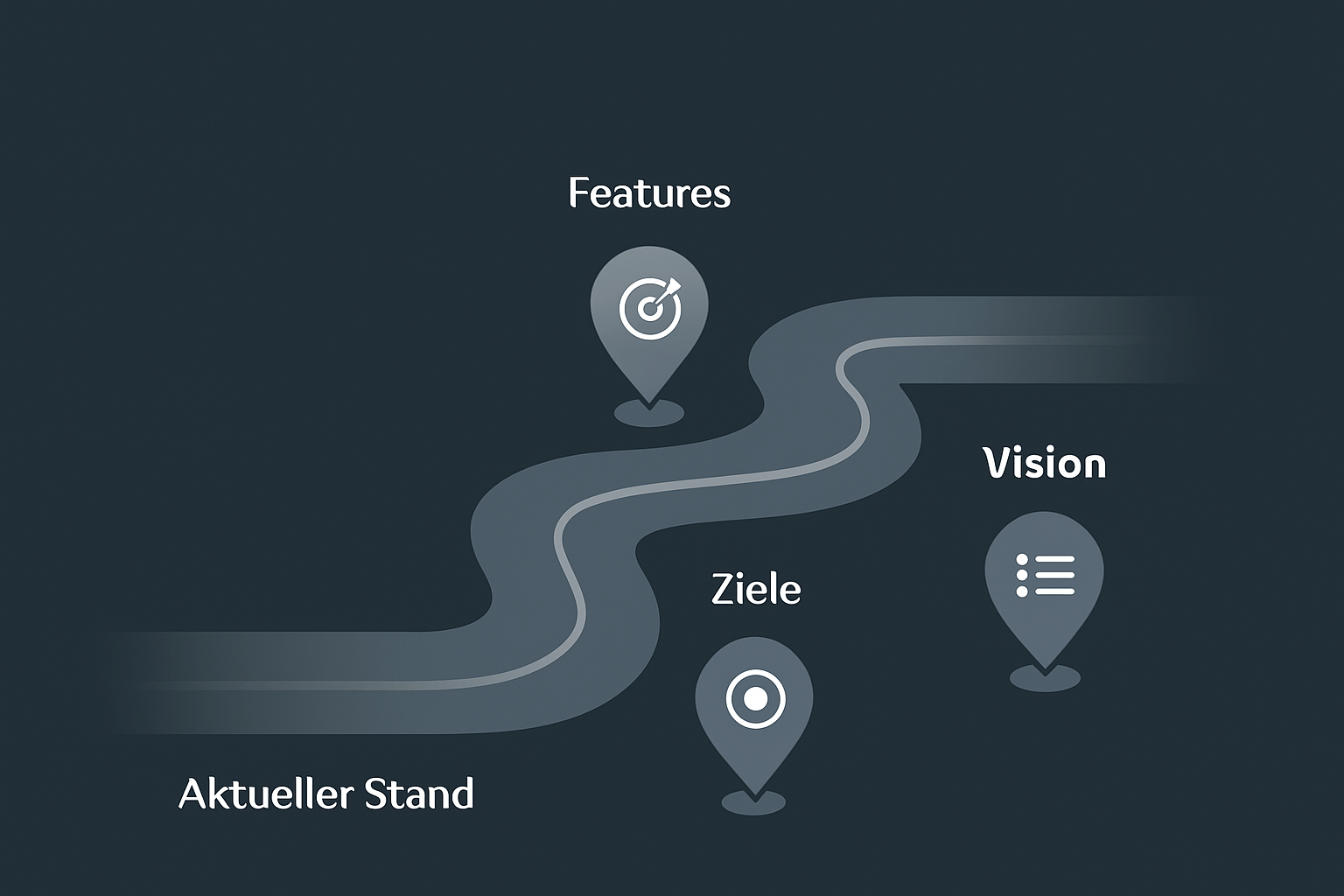
In essence, a product roadmap answers three questions:
- Why are we developing the product in this direction?
- What are we going to build to get there?
- When do we plan to implement these steps?
A roadmap sets the direction without defining every step in detail. However, this is not about detailed task lists or exact appointments.
Distinction: Product roadmap vs. project plan vs. feature list
Product roadmap vs. project plan:
A roadmap shows the strategic direction and major subject areas. A project plan, on the other hand, defines specific tasks, resources and deadlines for a project, i.e. goes into much more detail overall. The roadmap is the “what” and “why”, the project plan the “how” and “who”.
Product roadmap vs. feature list:
A feature list collects features that are to be developed. A roadmap places these features in context and explains which business goals are to be achieved with them. It combines features with outcomes.
The roadmap is hierarchically above two other documents: It provides the direction from which project plans and prioritized feature lists can then be derived.
What are product roadmaps for?
Product roadmaps create clarity and direction in your company. They translate abstract product visions into concrete, comprehensible steps.
- Strategic orientation: A roadmap combines daily work with long-term corporate goals. It shows each team member how their tasks contribute to the larger vision. This connection motivates and makes sense.
- Communicate priorities: In product teams, there are always more ideas than available resources. The roadmap helps you make and justify decisions for or against a specific idea. It clarifies why certain features are more important than others.
- Build stakeholder trust: Executives, investors, and other stakeholders want to understand where the product is heading. A well-thought-out roadmap demonstrates your strategic thinking and creates trust in your product decisions.
- Enable collaboration: Design, engineering, marketing and sales all work in different ways to achieve product success. The roadmap gives all teams a common point of reference and coordinates their activities.
- Flexibility when making changes: Markets are changing, new insights are being added, priorities are shifting. A roadmap makes these changes visible and helps to make conscious adjustments instead of reacting haphazardly.
What types of product roadmaps are there?
There are four main types of product roadmaps: Feature roadmaps list specific functions in time and are suitable for stable markets. Outcome-based roadmaps focus on goals rather than features and offer comprehensive freedom.
Now-Next-Later Roadmaps divide initiatives into three time horizons. Agile roadmaps are based on short sprints and enable quick adjustments. The choice depends on market dynamics, product maturity and organizational culture.
Feature roadmap
.jpeg)
The feature roadmap is the classic approach. It lists specific functions that are to be developed and classifies them in time. This roadmap is well suited for established products with clear requirements.
When to use the feature roadmap:
- For stable markets with predictable customer needs
- When specific feature promises have been made to customers
- For developments with longer planning cycles
Advantages: Clearly understandable, easy to communicate, concrete delivery promises
Disadvantages: Not flexible, focused on output rather than outcome
Outcome-based roadmap

This roadmap focuses on desired outcomes and goals, rather than specific features. It defines which problems should be solved or which metrics should be improved.
When to use the outcome-based roadmap:
- For innovative products with unclear solutions
- If you want to test different approaches
- In organizations with clear KPIs
Advantages: Focus on value creation, high flexibility in implementation
Disadvantages: More difficult to communicate, requires mature product organization
Now-Next-Later Roadmap

This approach divides initiatives into three time horizons: immediate priorities, next steps, and future opportunities.
When to use the Now-Next-Later Roadmap:
- In fast-moving markets with frequent priority changes
- For start-ups and currently fast-growing companies
- If you want to give stakeholders direction without fixed deadlines
Advantages: Balances planning and agility, easy to update
Disadvantages: Less specific dates for longer-term planning
Agile roadmap
.jpeg)
The Agile Roadmap is based on sprints and short cycles. This involves continuous adjustments based on feedback and new findings that arise from this feedback.
When to use the Agile Roadmap:
- For experimental products or features
- When rapid iteration is more important than long-term planning
Advantages: Maximum flexibility, tight customer feedback loops
Disadvantages: Difficult long-term planning, can unsettle stakeholders
Which teams use product roadmaps?
Product roadmaps are used by all core teams in the company: Engineering uses them to plan technical decisions and architecture, marketing coordinates campaigns and product launches, sales inform customers about future features, and management makes overarching and linked decisions. Each team requires different levels of detail and time frames for the same roadmap.
Product management
Product management creates and maintains the roadmap. Product managers use them as a strategic means of communication to communicate vision and priorities. They thus coordinate all other teams and ensure alignment with common goals.
Engineering teams
Developers need the roadmap to see which features are coming. This allows them to plan the architecture accordingly. The roadmap helps them avoid technical debt and develop scalable solutions.
Design and UX
Designers use the roadmap to plan user studies, prototyping, and design sprints. They see at an early stage which user experiences need to be developed and can prepare design systems accordingly.
Marketing teams
Marketing plans campaigns, content and product announcements based on the roadmap. They prepare launch materials and develop the communication of the new features to the outside world. The roadmap helps to coordinate the market launch.
Sales teams
Sales teams use the roadmap to inform customers about future developments and set expectations. They can better assess sales opportunities and conduct customer conversations more strategically.
Management level
Executives use the roadmap for strategic decisions and resource planning. They see how product investments contribute to business goals and can allocate budget and personnel accordingly.
Customer support
Customer support is preparing for new features and can inform customers about upcoming improvements. The roadmap helps to develop support materials in a timely manner.
Guide: How do I create my own product roadmap?
A product roadmap is created in five structured steps: define product strategy and goals, analyze customer needs and market data, prioritize features and group them into topics, set time frames and visually prepare the roadmap. The process is iterative and always starts with the “why” before the “what” and “when”.
Roadmap step 1: Define product strategy and goals
Before you plan features, clarify the foundations: What is your product vision? What business goals should the product achieve? Define measurable outcomes that you want to improve, such as user activation, retention, or revenue growth.
Specific questions that you should answer:
- Which customer problems does our product solve?
- Which KPIs do we want to improve over the next 3 to 6 months?
- How does product development fit in with corporate strategy?
Roadmap step 2: Collect data and generate insights
Systematically collect information from various sources: user feedback, support requests, analytics data, market analyses, and input from sales and marketing. This data shows you where the greatest potential for the product lies.
- Quantitative data: user behaviour, performance metrics, A/B test results
- Qualitative data: Customer interviews, support tickets, sales feedback
- Market data: Competitive analysis, market trends, regulatory changes
Roadmap step 3: Prioritise features and create topics
Evaluate all feature ideas based on impact and effort. Use prioritisation frameworks such as RICE (Reach, Impact, Confidence, Effort) or the value-vs-effort matrix. Group related features into topics, each with an overall goal.
Roadmap step 4: Set time frames and milestones
Schedule the prioritised topics. Work with rough periods of time (quarters, not weeks) and plan buffers for unforeseen events. Define clear milestones by which you can measure progress.
- Short term (0-3 months): Specific features with a high level of certainty
- In the medium term (3-6 months): Rough topics with medium certainty
- Long term (6+ months): Strategic directions with low certainty
Roadmap step 5: Visualise and communicate the roadmap
Create different views of your roadmap for different audiences. All versions remain strategic but emphasise different aspects:
Engineering sees the technical topics and dependencies, management sees the connection to business goals, sales sees customer benefits. The level of detail deliberately remains high enough for strategic orientation.
Tools for creating product roadmaps
Easy tools to get started:
- PowerPoint, Google Slides: Good for presentations, hard to maintain
- Miro, Mural: very flexible but little structure
- Excel, Google Sheets: Structured but not visually appealing
- Canva: Visually appealing, easy to use
Roadmap tools:
- ProductPlan, Roadmunk, Aha!: Built for product roadmaps
- Productboard, airfocus: Combine roadmapping with prioritisation
- Craft.io, Monday.com: Integrate roadmaps into project management
Free templates for product roadmaps:
- Miro Product Roadmap Templates: 20+ different roadmap templates including Now-Next-Later and Agile variants
- Smartsheet Product Roadmap Templates: Free templates for Excel, Word and PowerPoint
- Office Timeline Free Templates: Especially for PowerPoint with agile and feature roadmap templates
- Atlassian Confluence template: Free template with quarterly planning
- Canva Roadmap Templates: Visually appealing templates for presentations
- Zoho Tables template: Collaborative roadmap template with comment function
How do I present a product roadmap?
Presenting your product roadmap is an important moment for stakeholder alignment and trust in your product strategy. Different stakeholders need different perspectives on the same strategic content. Engineering focuses on technical dependencies, sales on customer benefits, management on business goals.
Preparing the presentation
Know your audience before you present! Think about what questions to expect. What are the participants’ concerns? Prepare answers to critical issues and get feedback from key people in advance.
Typical stakeholder questions:
- Engineering: “Have we considered the technical dependencies?”
- Sales: “When can we communicate Feature X to customers?”
- Management: “How does this contribute to our quarterly targets?”
- Marketing: “How much lead time do we get for the launch?”
Develop the presentation storyline
Start with the “why”, not the “what”. First explain the overall goals and market opportunities, then show how your roadmap addresses them. Only a clear narrative makes complex plans truly understandable.
Proven presentation structure:
- Set context: Current market situation and challenges
- Explain vision: Where should the product develop?
- Show strategy: How do we achieve this vision?
- Present roadmap: Specific steps and priorities
- Measure success: Which metrics show progress?
Different roadmap presentations for different target groups
Don’t create completely different roadmaps for individual target groups, but different views of the same strategic planning. Each target group sees the aspects relevant to them highlighted.
Executive View:
- Focus on business impact and ROI
- Quarterly overview with rough periods
- Link to business goals and KPIs
- Few technical details, more strategic outcomes
Engineering View:
- Technical topics and architectural decisions
- Dependencies between different initiatives
- Resource requirements and capacity planning
- Link to technical debt and infrastructure
Sales & Marketing View:
- Customer advantages and competitive advantages
- Rough time frames without firm promises
- Connection to customer feedback and market needs
- Launch coordination and go-to-market planning
How do I keep my product roadmap up to date?
An outdated roadmap is worse than no roadmap. Teams lose trust when reality constantly deviates from documented planning. Successful product managers develop a clear rhythm for reviews and updates: predictable enough for orientation, agile enough for adjustments. To do so, follow this process:
- Collect data
- Evaluate & Analyse
- Adjust priorities
- Update roadmap
- Communicate
- → back to the start “Collect data”
Fixed review rhythm for the product roadmap
Schedule regular roadmap reviews in your calendar, ideally monthly for operational adjustments and quarterly for strategic reviews. These deadlines are just as important as other product decisions.
Proven review schedule:
- Weekly: Review the progress of individual initiatives
- Monthly: Adjust priorities and time estimates
- Quarterly: Evaluate strategic orientation and larger subject areas
- Half-yearly: Question the basic product strategy
Collect in parallel and continuously information from various channels. The wider the database, the more effective the adjustments:
- Analytics and usage metrics: Which features are actually being used?
- Engineering feedback: Are the time estimates realistic?
- Sales input: What really motivates customers to buy?
- Support tickets: Where do users have the biggest problems?
External signals:
- Customer feedback and interviews: Are needs changing?
- Market developments: New competitors or technologies?
- Regulatory changes: Do we need to prioritise compliance features?
Clearly communicate changes to the product roadmap
When you adjust the roadmap, explain the “why” behind the decision. Teams accept changes when they understand the reason:
- What has changed?
- Why is the change being made?
- What are the effects?
- What are the next steps?
Best Practices for Product Roadmaps: How do I avoid typical mistakes?
Creating and maintaining a successful roadmap is a continuous learning process. With a few best practices, you’ll lay the groundwork for a roadmap that teams trust and actually use.
- Adjust the level of detail to the target group: Engineering needs different information than management. One roadmap, different views.
- Connect short and long-term goals: Show how the work of the next few months will contribute to the major strategic goals.
- Check and adjust regularly: Plan fixed review dates and communicate changes transparently.
- Make available centrally: Everyone should have access to the latest version and also use it regularly.
- Continuously involve stakeholders: Stay in touch with all important teams and get regular input.
- Outcome before output: Focus on the goals you want to achieve, not just the features you’re building.
- Communicate uncertainties honestly: Use time periods instead of fixed dates and explain what might change.
Do you want to show investors and stakeholders that you can deliver on your product roadmap?
We develop high-end software for start-ups and scale-ups including monetisation in 3 months. We rely on no-code and low-code technologies combined with strategic consulting. This gets you quickly to a product you can test on the market. We make sure your product roadmap delivers on its promises!
{{fs-btn-cta}}
Wir schaffen leistungsstarke Plattformen und Websites für Startups, Scale-Ups und KMUs, von Konzept bis Go-Live.
We develop high-end software products for start-ups and SMEs: In 3 months, you will be monetized on the market!
Product Roadmaps — Common Questions and Answers
Review your roadmap monthly and update it immediately if there are important changes. On a quarterly basis, you should conduct a comprehensive strategic review. For fast-moving markets or start-ups, weekly adjustments can also be useful.
Product management guides the process, but engineering, design, marketing, sales, and customer support should all provide input. Also get feedback from key customers and involve management in making strategic decisions. The more relevant perspectives you collect, the more realistic and accepted your roadmap becomes.
In principle, all teams involved in product success should have access, including engineering, marketing, sales and support. However, create different versions: a detailed one for internal teams and a simplified one for external stakeholders such as customers or partners.
The roadmap should show strategic goals and major initiatives, but not include detailed feature specifications. As a rule of thumb, the farther into the future, the fewer details. Plan the next 3 months specifically, the following 6 months thematically.
Use rough time periods (quarters) instead of specific deadlines to maintain your flexibility. Communicate these as guidelines, not as firm promises. Even more non-binding wording such as “planned for 2025” is more suitable for external communication.
Start with the “why”: explain the market situation and customer needs that led to your decisions. Prepare yourself for critical questions and back up your priorities with data. Also show alternative scenarios and explain why you chose this path.
More articles

Many teams experience Sprint Planning in one of two extreme ways: either as an endless meeting that drags on for three hours and still provides no clarity, or merely as a ticket-shuffling exercise in Jira that could just as easily have been handled via email. Neither of these approaches aligns with the true purpose of Sprint Planning.

According to the swissICT Digital Excellence Report, only 35 percent of Swiss companies are on track with their digital alignment. For 26 percent, there is significant need for action (Source: swissICT). Companies invest in tools, cloud services, and AI pilot projects without a plan that holds it all together. The result: fragmented system landscapes, duplicated work, and budgets that don't flow where they have the most impact. The right IT strategy is the answer to this.

Artificial intelligence is now an established tool in software development, integrated directly into the programming environment. Developers spend less time writing boilerplate code and can instead focus on how the different parts of an application logically interact.