Guide: Approach software outsourcing the right way
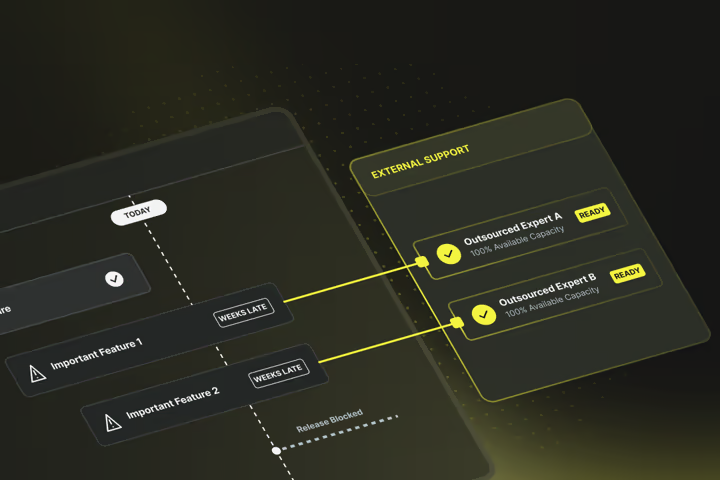
Two important features in your project are weeks overdue. One developer is on vacation, the other is tied to a customer project. You've been avoiding looking at your overtime account for a long time. You know exactly what would be technically necessary, but you simply don't have the people to do it. In such moments, the question is: Do we get external support, or do we keep going at it?

In this article, you'll learn how to make the decision to outsource software. You will learn which outsourcing models make sense, what you should pay attention to when it comes to providers and how to realistically estimate effort and costs.
What is software outsourcing?
Software outsourcing means that you hand over certain development tasks to an external partner. This can affect an entire project, i.e. from the first line of code to the finished product, or just individual roles such as backend developers, UX designers or QA specialists. What is important is: The responsibility for planning, implementation or operation lies wholly or partly outside of your company.
However, you shouldn't regard software outsourcing as a makeshift or a blind surrender of tasks. You can achieve the best results with a professional partner who works as an extended arm of your team and not as an interchangeable service provider.
.jpeg)
Typical use cases: When is software outsourcing used?
If you recognize yourself in one of these scenarios, outsourcing can be the next logical step for you too:
1. Your internal team is at the limit
If your development team is busy or lacks certain skills, outsourcing helps. This allows you to remain able to act without a lengthy search for personnel. Especially with clearly defined projects, you can get started quickly without overwhelming your team.
2. You are under cost pressure
Permanent hires are expensive and usually tied to the long term. An outsourcing partner can respond more flexibly to budget requirements: with calculable daily rates, time-limited deployment and sometimes with cheaper hourly rates than is usual in your local market.
3. You must deliver quickly
Some projects do not tolerate delays, for example when an investor puts pressure on, a customer demands a feature, or the market moves. An experienced external team can step in at short notice and work in parallel with internal operations.
4. You need specific know-how
Sometimes certain skills are missing internally, such as in cloud architecture, machine learning or UX. A specialized partner not only brings the know-how, but also best practices from comparable projects.
5. Your needs fluctuate significantly
Not every project warrants a permanent team. If your requirements move in phases, for example between product development, rollout and operation, you can add or withdraw external capacities as needed.
Software outsourcing models
What and how you outsource depends heavily on what your project looks like and how your internal team is set up. Maybe you want to have an entire project developed externally. Perhaps you only need an experienced specialist to assist you for a few months. Or you're looking for someone who takes care of running an application on a permanent basis.
To help you find the right shape, we'll show you the four models that have proven their worth.
Project outsourcing: complete project outsourcing
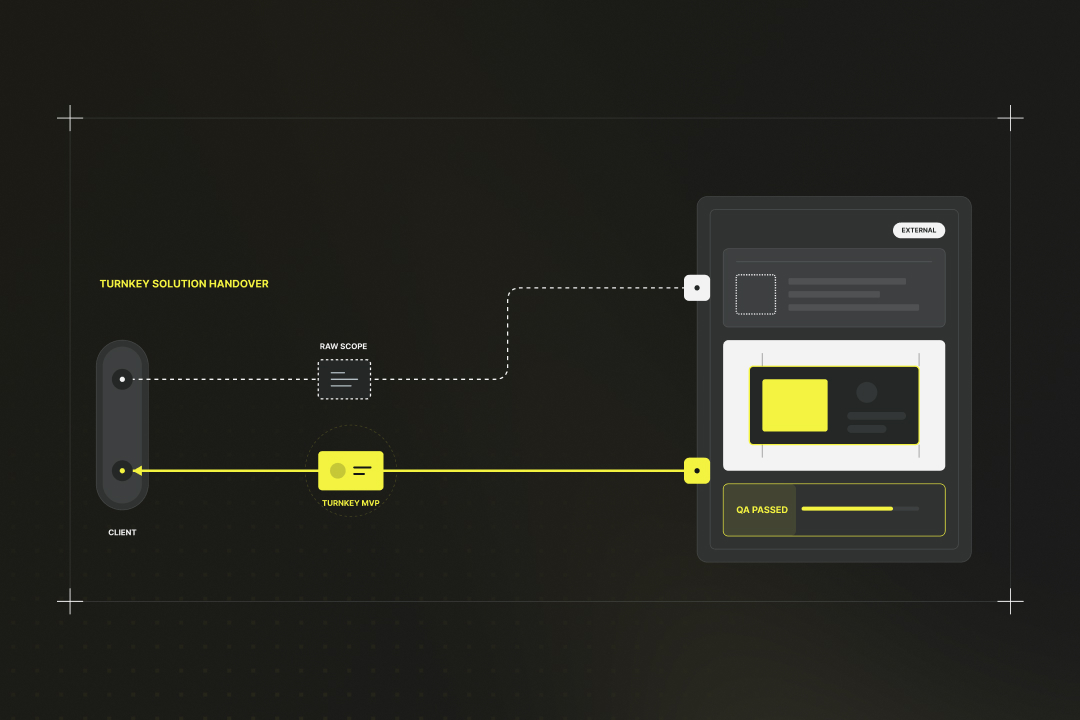
You submit a clearly defined project in full. This could be an MVP, an interface connection or a redesign. The external partner takes over the implementation on the basis of a catalog of tasks or a jointly developed scope. The end result is a finished result that you continue to use or operate internally.
Typical for: prototypes and MVPs, feasibility studies, projects with tight time frames
Advantage: You get a turnkey solution without internal restructuring.
Dedicated team: dedicated development team
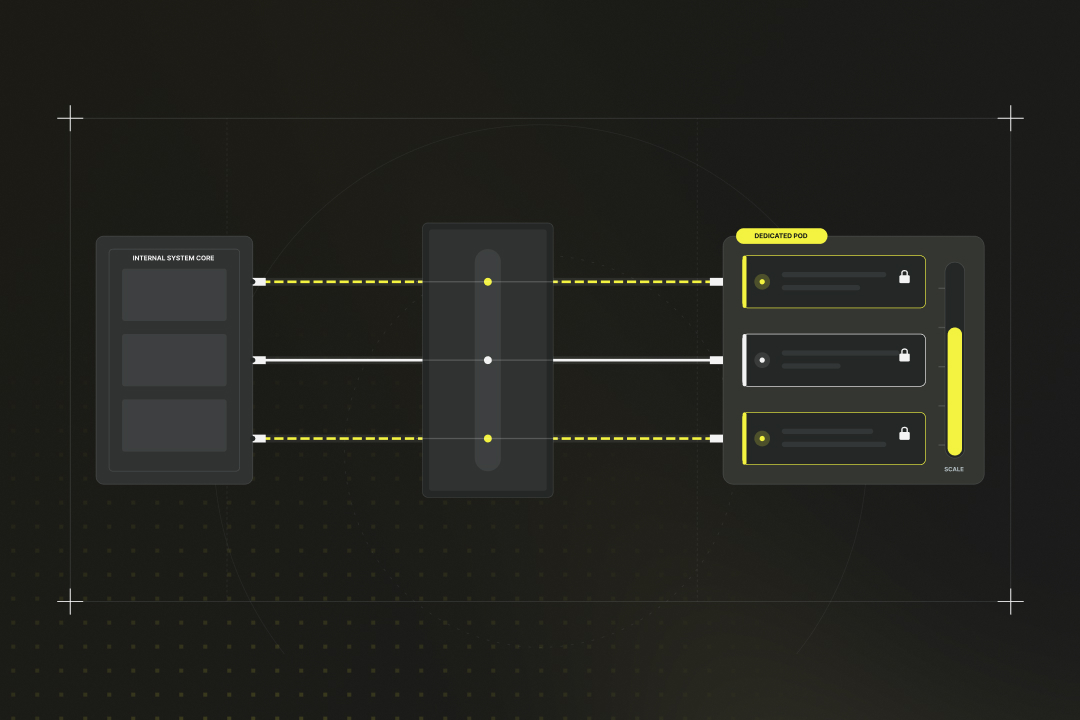
You hire a permanent remote team that works exclusively for you over a longer period of time. This model is particularly suitable if you want to implement several projects in parallel or need to strengthen your internal team permanently without recruiting yourself.
Typical for: Product roadmaps, complex modernizations, scaling scenarios
Advantage: You retain long-term knowledge in the project and can scale as needed.
Staff Augmentation: Expanding your own team
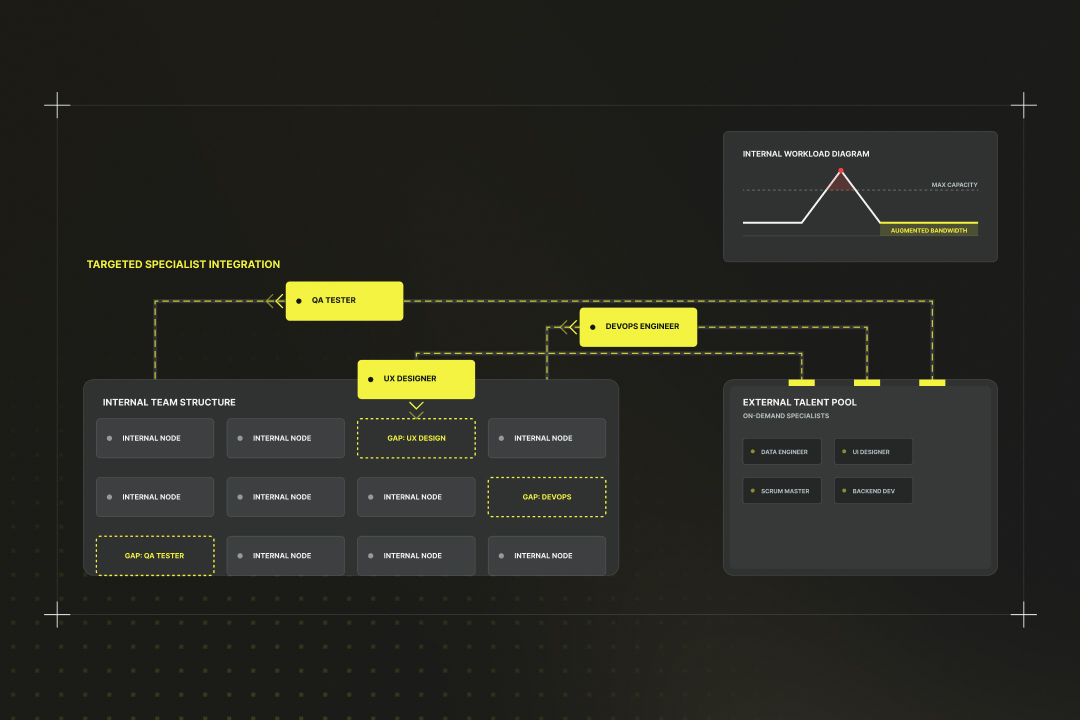
You specifically integrate individual specialists into your existing team. This could be a DevOps engineer, a QA tester, or a UX designer. The time period is also just a matter of agreement. The external specialist works like an internal colleague, but is provided by the partner or is a freelancer.
Typical for: temporary bottlenecks, selective skill requirements.
Advantage: You close gaps without overburdening or binding your team in the long term.
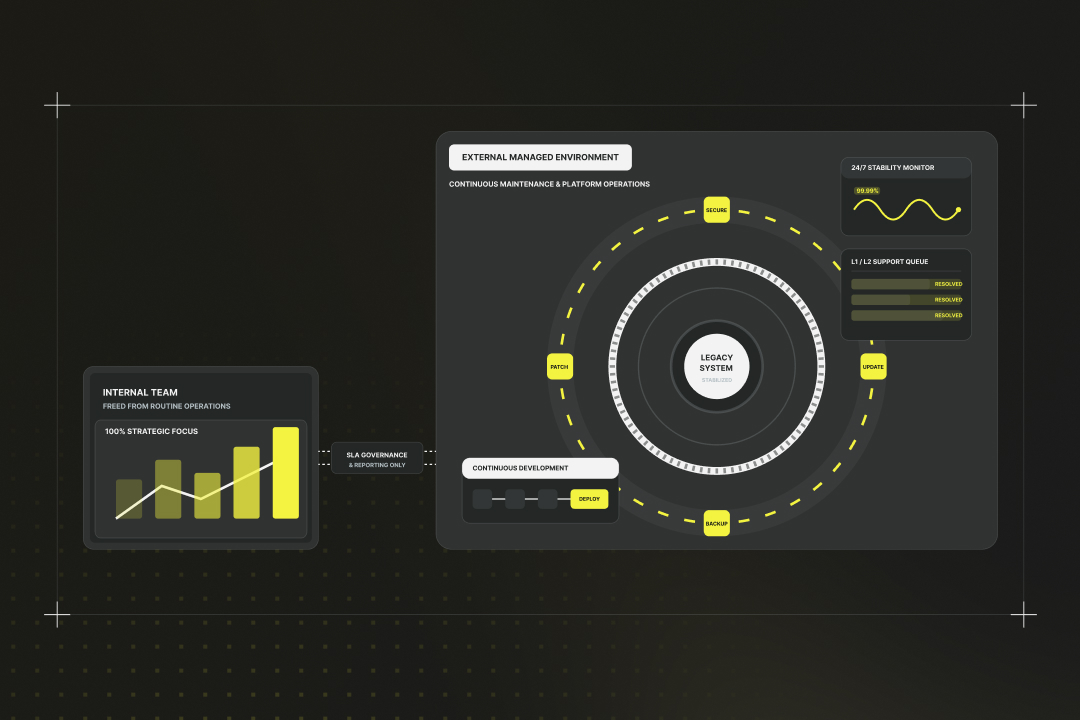
Managed Services: Outsourced Operations and Support
The ongoing operation, maintenance or development of an existing application is outsourced to an external team. This model is particularly suitable if you do not want to tie up internal capacities for operational operations.
Typical for: legacy systems, platform operation, continuous development
Advantage: You free your internal team from routine tasks and still ensure stable operating processes.
Selecting a location for software outsourcing
If you're considering outsourcing part of your software development, sooner or later a simple question will arise: Where actually? Should the partner be based in the same country? Somewhere in Europe? Or maybe in a completely different time zone? And what are the advantages and disadvantages of this?
The terms onshore, nearshore and offshore help you to classify these opportunities. But they don't say anything yet about which location is really right for your project. Because it's not just about prices, but also about communication, accessibility and cultural compatibility.
Onshore: in your own country
With onshore outsourcing, everything stays in the same country, often even in the same region. You benefit from joint working hours, cultural proximity and short distances. However, you usually pay the full local hourly rate for this.
Suitable for: Projects with a high level of coordination, legal complexity, or sensitive data
Advantage: No language barriers, maximum proximity
Nearshore: relatively close but cheaper
Nearshore partners are usually located in neighboring countries or regions with a similar time zone and cultural proximity. For Swiss companies, this often means: Poland, Romania, Portugal or the Baltic States. The advantage: lower costs with good technical training and a stable infrastructure.
Suitable for: Long-term partnerships, integrated teams, agile projects
Advantage: Good mix of cost savings and equal collaboration
Offshore: far away, highly scalable
In offshore outsourcing, the development team is typically based in South Asia, South America or Africa. Wage costs are significantly lower there, but time differences, cultural differences and coordination costs are higher. If you want to be successful with this model, you need a very good setup, experienced partner management, and patience.
Suitable for: highly standardized projects, high scaling, with clear guidelines
Advantage: Affordable hourly rates, large selection of specialists
The choice of location is not a purely mathematical question. What really matters is whether you can communicate well with your partner: professionally, linguistically and personally. If you need a lot of direct exchange, a supposedly cheap offshore offer can quickly become more expensive than expected. Conversely, due to the linguistic and cultural proximity, a local partner can implement certain projects faster and with higher quality.
Typical process of a software outsourcing project
If you've never worked with an external development partner before, you might ask yourself: How does a project like this actually work? What happens after the decision is made and what do you have to contribute yourself?
An outsourcing project follows a clear process, the details of which are worked out together. Of course, there are differences depending on size, goal and model, but the basic structure is similar in many cases. It helps you to keep an overview and set the right course right from the start.
- 1. Needs analysis: What exactly do you need? What goals are you pursuing, what budget is available, and how much responsibility do you want to delegate? Ideally, you should clarify these questions internally and before you approach service providers.
- 2. Partner selection: You can recognize good providers not only by colorful websites. Pitch rounds, references from similar projects, rehearsals or a proof of concept are more important. Professional expertise is also not enough; the collaboration must also be a human fit.
- 3. Kick-off and discovery: Before development starts, it's about building a deep understanding together: of your users, your business logic, and your tech stack. This saves a lot of time and misunderstandings later on, especially when it comes to complex projects.
- 4. Agile implementation: The actual development usually takes place in two to four-week sprints. After each sprint, there are demos, feedback rounds, and adjustments. You remain involved without leading operationally yourself.
- 5. Quality assurance: Tests are not an afterthought, but an integral part. This includes automated tests, manual approvals and, in many cases, security audits. The goal is not only functional, but maintainable, secure code.
- 6. Go-live: A good team also plans monitoring, incident handling and fallback options for the rollout so that there are no surprises during live operation.
- 7. Maintenance and development: Even after the launch, the project does not stop. Roadmap workshops, technical optimizations and new features ensure that the application remains up-to-date, performant and user-centered.
Benefits of software outsourcing
Here are the most important advantages that companies repeatedly mention about outsourcing and what they bring when the collaboration is well set up:
Focus on the essentials
When an external partner takes care of planning, development, or maintenance, your internal team can focus on what only works internally or significantly better: strategy, product management, customer contact. This not only reduces operational workload, but also creates space for further development.
Speed through experience
Good outsourcing partners have established processes: from code quality to agile processes to proven deployment routines. This saves you a lot of effort and time during onboarding and avoids many of the mistakes that new internal teams often have to experience for themselves first.
Predictability within budget
Outsourcing makes costs precisely tangible and predictable: through daily rates, package prices or clearly defined scope of services. Especially compared to long-term permanent employment, effort and risk are often easier to calculate. Provided that the requirements are clearly formulated.
Access to specialists and know-how
Many technologies are difficult to fill on the local job market. An external partner can access a wider network, whether in Europe, Asia or South America. This allows you to get the right specialist faster, without sacrificing quality.
Share responsibility
A clean contract with service level agreements (SLAs) and clear responsibilities not only relieves you of legal burden. It also ensures in everyday working life that topics do not fall through the cracks. Good providers take responsibility and deliver reliably.
.jpeg)
Outsourcing costs and budget
One of the most common reasons for outsourcing is the desire to make development costs easier to plan: both financially and in terms of personnel. At the same time, the issue of budget is often difficult to grasp, because: How much does a developer abroad cost? How does its price compare with local offers? What are the additional costs? And how do you calculate a project cleanly?
Typical hourly rates by region
These rates are averages from publicly available sources. Of course, these prices may differ depending on the company's reputation and developer level.
Additional cost factors
Project management
In practice, you should plan 5–15% of the project volume for coordination, communication and reporting (internal or external).
Travel expenses
Getting to know each other personally is particularly useful for long-term projects. Two on-site appointments per year (kick-off, review) are a good guideline.
Licenses & infrastructure
Cloud services, DevOps tools, or test environments are usually not included in the developer hourly rate and should be calculated separately.
Cost examples
Here are two examples of common development costs for software projects as a whole. How high the costs are for your service provider depends on how much of the work you want to hand over to them.
MVP for an app, approx. 1—3 months
➜ approx. 20,000 — 100,000 EUR, depending on complexity, programming approach, etc.
Large-scale software project with extended modules, automations, reporting, multiple integrations, etc., approx. 6—12 months
➜ approx. 130,000 — 250,000 EUR, depending on complexity
Tip: In our article, you can find more price examples and information about Software development costs.
Budget control
Calculate not only with the best scenario, but also with realistic buffers for communication, adjustments, and potential delays. Many projects fail not because of the hourly rate, but because of unclear goal definition or lack of follow-up.
How to recognize a good outsourcing partner
Even a good setup is of little use if the partner doesn't deliver. But how can you tell whether a provider is working professionally? And on what, whether the collaboration will work? The following features should help you make a choice. Not every point has to be met. However, as soon as you have doubts about several criteria, you know that you should keep looking.
- Transparent communication: A reliable partner not only keeps you up to date, but also makes complex topics understandable to you. This includes weekly status updates, realistic roadmaps, clearly reachable contacts and the willingness to discuss even unpleasant points openly.
- References: Live demos, project descriptions, reachable contacts for reference meetings. Ask about comparable projects and how they were handled.
- Technical excellence: No one can do everything, but a reputable partner will openly show you in which areas they are really strong. A look at well-maintained repositories, pipelines or the tool landscape in the project quickly gives you a good feeling for the technical requirements.
- Cultural fit: A lot of things can be right professionally and yet the collaboration is stuck. An experienced partner pays attention to the so-called cultural fit: common values, work rhythm, communication style. At least three to four overlapping working hours per day are ideal.
- Legal setup: Clarify how intellectual property, code rights, SLAs, and exit scenarios are handled. Good partners bring suggestions that are fair for both sides. And they're open to your requirements.
- Flexibility and scalability: A good team thinks along and can quickly contribute additional expertise when needed, for example in DevOps, data science or testing. This mobility is often already apparent in the first project phase.
Some important questions that you ask yourself when it comes to software outsourcing can often only be answered in conversation. Then it's time to think through your project, discuss technical options and find out whether the wavelength is right.
If you want to take this step, feel free to contact us. Axisbits helps companies implement software projects professionally — from the initial idea to long-term maintenance.
Overview of Axisbits' services:
- Expanding your team, e.g. with backend or frontend specialists
- Complete software projects: from MVP to complex business application
- UX/UI design and prototyping: user-centered, clickable, testable
- Code reviews and architecture consulting: as a second opinion or for quality assurance
- Agile project management: transparent, sprint-based, with continuous feedback
- Long-term maintenance and support: for scalable, resilient applications
- Experience with web, mobile and platform projects: in SME and start-up environments as well as major customers.
If you want to check whether and how a joint project makes sense, the first step is very simple: an open, non-binding discussion. Not a sales process, but an honest reconciliation of needs and opportunities. Tip: You can find software projects that have already been implemented in our Axisbits portfolio.
{{fs-btn-cta}}
Wir schaffen leistungsstarke Plattformen und Websites für Startups, Scale-Ups und KMUs, von Konzept bis Go-Live.
We take over your software project in whole or in part and create your high-end software.
Software outsourcing — frequently asked questions and answers
If you have a clearly defined project with a fixed goal, project outsourcing is suitable. For ongoing developments or product roadmaps, a dedicated team is usually easier to manage.
When someone not only answers your questions, but also thinks along — professionally and organizationally. Clarity in your approach, specific questions about your project and honest communication are good indicators.
Involve them early on, reveal the reasons and show how external support makes their work easier and not replaces it.
Don't wait. Clarify early on where things are stuck: professionally, organizationally or culturally. Check Plan B in parallel: other providers from the short list or internal collection with reduced scope.
With clear goals, reliable feedback cycles and a permanent contact person on both sides. Management does not mean micromanagement, but rather providing orientation and demanding decisions.
More articles

Many teams experience Sprint Planning in one of two extreme ways: either as an endless meeting that drags on for three hours and still provides no clarity, or merely as a ticket-shuffling exercise in Jira that could just as easily have been handled via email. Neither of these approaches aligns with the true purpose of Sprint Planning.

According to the swissICT Digital Excellence Report, only 35 percent of Swiss companies are on track with their digital alignment. For 26 percent, there is significant need for action (Source: swissICT). Companies invest in tools, cloud services, and AI pilot projects without a plan that holds it all together. The result: fragmented system landscapes, duplicated work, and budgets that don't flow where they have the most impact. The right IT strategy is the answer to this.

Artificial intelligence is now an established tool in software development, integrated directly into the programming environment. Developers spend less time writing boilerplate code and can instead focus on how the different parts of an application logically interact.