Sales psychology: 6 triggers that bring more deals
You explain your offer perfectly, the customer nods in agreement — and yet they don't buy. The problem isn't your product or price, but that you're selling against human psychology. People make buying decisions differently than they think they would. In this article, you'll learn which 6 psychological triggers really work and how to use them immediately in your sales calls.

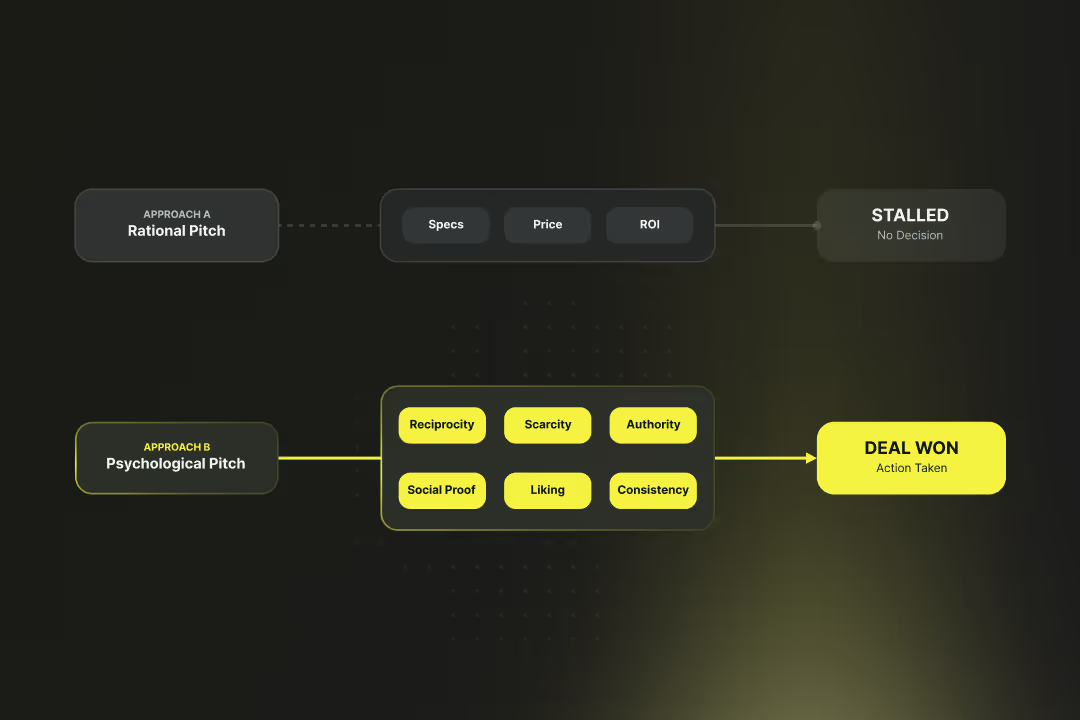
What is sales psychology?
Sales psychology explains why people buy. It uses proven psychological principles to ease purchasing decisions, not to force them. You help your customer recognise what they actually already want.
What is the difference to traditional sales technique? Sales technique shows you how to have a conversation. Sales psychology explains to you why your counterpart says yes in the first place.
People rarely buy purely rationally. Emotions, time pressure, social influences — all of this plays a role. When you understand these factors, you’re not selling against human nature, you’re working with it.
“It normally costs 5,000 francs, but we can go down to 3,500 for your project.”
Why does this sentence work so well? Because it uses the anchor effect — one of the most reliable psychological principles in sales. The first number your customer hears becomes the reference point for everything that follows. 3,500 francs feels like a good deal after 5,000 francs.
That’s sales psychology: you understand how people make decisions and help them make the right one.
The 6 most powerful psychological sales triggers in sales psychology
The 6 most powerful psychological sales triggers are scarcity, social proof, anchor effect, reciprocity, authority, and loss aversion. Each of them uses a different human behaviour pattern and you can use them all immediately in your sales conversations.
Sales psychological trigger 1: Scarcity
People want what they can’t get. As soon as something is limited, the perceived value automatically rises. Here’s how to phrase it correctly:
- In conversation: “We only have three appointment slots left this month.”
- In the email: “This offer is only valid until Friday at 6 p.m.”
- On the website: “Only 4 places left”
Be specific. “Limited” is weak; “only 3 left” is strong. Time limits work better than quantity limits because they automatically create pressure to act.
Note: Scarcity must be real. Your customers see through fake countdown timers instantly.
Sales psychological trigger 2: Social proof
We look at what others are doing before we decide for ourselves. That’s why reviews, testimonials and references work so well. The right application:
- Use numbers: “More than 200 companies already rely on our solution”
- Mention similar customers: “Müller AG also had exactly this problem”
- Tangible results: “Customer X was able to increase sales by 30%”
Wording tip: Instead of “Many customers are satisfied”, say “Our last customer said: ‘Finally a solution that works.’”
Digitally: Place testimonials directly on the offer page — don’t hide them on a separate references subpage.
Sales psychological trigger 3: Anchor effect
The first number your customer hears influences all subsequent assessments. That’s why you should always start with the highest price. Practical examples:
- Wrong: “Our basic package costs 2,000 francs, the premium package 4,000 francs”
- Correct: “Our premium package normally costs 4,000 francs, the basic package 2,000 francs”
For negotiations: “Other providers charge 8,000 francs for this; we’re at 5,000.”
In emails: Cross out the original price and write the discounted price next to it.
The anchor must be realistic. 50,000 francs as an anchor for a 500-franc service is absurd and will immediately be seen as an attempt to deceive.
Sales psychological trigger 4: Reciprocity
People feel obligated to give something back when they have received something. This mechanism works in sales too. Practical implementation:
- Free initial consultation: 30 minutes of your time creates a sense of obligation
- Useful information: “Here’s a guide that will help you even without us”
- Small favours: “I’ll send you the contact details of this expert”
Important: The gift must come first, not as a condition of purchase. “When you buy, you get...” is not a reciprocity trigger.
Timing: The favour should come immediately before your ask, not weeks before it.
Sales psychological trigger 5: Authority
People follow experts. When you’re perceived as an authority, customers are more likely to accept your recommendations. Building authority:
- Name references: “In 15 years, I have managed over 300 projects”
- Show expertise: “I know the problem. It usually comes down to three factors...”
- Industry knowledge: “I see this a lot in your industry”
Phrases that work:
“In my experience...”
“What I recommend in cases like yours...”
“It works for 90% of my customers”
Note: Authority must be authentic. Exaggeration quickly comes across as unprofessional.
Sales psychological trigger 6: Loss aversion (fear of loss)
People are more afraid of losing something than they are pleased about gaining something. Use that in your argumentation. Instead of focusing on gain:
- Weak: “You’ll save 200 francs per month”
- Strong: “Without this solution, you’re losing 200 francs per month”
Problem amplification:
“What happens if you don’t solve this problem? Your competition gets faster, your customers become more dissatisfied, your costs keep rising.”
Correct dosage: Loss aversion must not tip into fear-mongering. You can name the problem, but not dramatise it.
Examples of digital sales psychology
Sales psychology works in emails, on websites and in video calls just as well as in a personal conversation. You simply need to apply the six triggers in an adapted way for each medium.
Sales psychology in email subject lines
Your email will only be opened if the subject line sparks curiosity. Psychological triggers help:
- Scarcity: “Last day: Your offer for the project”
- Loss aversion: “What you’re missing out on without this solution”
- Social proof: “How 200+ companies solved their problem”
Important tip: Avoid spam words like “free”, “guaranteed” or “now”. They end up in the spam folder.
Sales psychology in website elements
Your website sells for you around the clock. The right psychological elements convert visitors into customers.
- Weak: “Learn more”
- Strong: “Save 30% now” (scarcity + concrete benefit)
- The button text should say exactly what happens. “Send” is weak; “Request a non-binding analysis” is strong.
Strategically place testimonials:
Place customer testimonials directly next to the offer, not on a separate page. At the moment of decision, the customer should see that others are already satisfied. Particularly effective: testimonials from customers in the same industry or with similar problems.
.png)
Price presentation with anchor effect:
Instead of just “2,500 francs”, write “normal price: 3,500 francs, your price: 2,500 francs”. Or show three packages and make the middle one the “best seller”. Most customers then automatically choose the middle, because they want neither the cheapest nor the most expensive.
.png)
Scarcity on the website:
Live counters for available spots or appointments work well — but only if they are genuine. Visitors see through fake timers immediately. Better: “3 consultation slots available this week” — that’s concrete and credible.
.jpeg)
Do you want to sell with your website, but visitors drop off too often before buying? Here we show you how conversion rate optimisation works.
Sales psychology in video calls
- Build authority: Show certificates or books in the background — subtly but effectively.
- Use reciprocity: “After the call, I’ll send you a summary and three additional tips we didn’t cover today.”
- Include social proof: “Last month I had a similar conversation with a customer in your industry...”
- Share screen strategically: Show references, success stories or specific figures. Visual social proof has a stronger effect than spoken words alone.
Reciprocity means: When you help someone, they feel obligated to help you in return. In sales, you first give something valuable — time, knowledge, or a small service — and thereby increase the likelihood that the customer will accept your offer.
Sales psychology in WhatsApp and chats
Chat messages are different from emails or conversations. They are more direct, more personal and promise quick responses. The psychological triggers work here too — you just need to adapt them to the medium.
Short, direct messages, with added value where appropriate:
- “Do you have 2 minutes? I have an idea for your project.”
- “Quick question: Is the IT issue still ongoing?”
- “Just read an article that fits your problem perfectly. Should I send it?”
Voice messages:
Your voice builds more trust than text, especially for more complex offers. A 30-second voice message feels more personal than a long text message. Use them for offers or important information — not for simple appointment scheduling.
Timing and scarcity in chats:
- “The offer is valid until 8 p.m. tonight — after that I’m travelling and won’t be reachable.”
- “I still have one free slot tomorrow at 2 p.m., otherwise not until next week.”
- “I’ve just received another enquiry for this slot — shall I hold it for you?”
Social proof in short messages:
- “A customer in your industry said yesterday: ‘I should have done this sooner.’”
- “Already 5 companies from Zurich are on board — it’s working really well here.”
Reciprocity via WhatsApp:
Small favours work perfectly: “I’ve sent you the contact details of the tax advisor I mentioned” or “Here’s the link to the tool I was talking about.”
Sales psychology checklist: The 10-minute practice test
You know the theory now. Time for practice. With this checklist, you can immediately test which psychological triggers work best for you.
Preparation: Your next customer conversation
Step 1: Select triggers (2 minutes)
Choose two triggers for your next conversation:
- One that matches your personality
- One that fits the customer’s problem
Example: You are experienced and confident → use authority. Your customer is under time pressure → build in scarcity.
Step 2: Prepare your phrasing (3 minutes)
Write down 2–3 specific sentences you want to use:
- “In 12 years, I have guided over 150 similar projects...”
- “We still have two start dates available next month...”
During the conversation: Observe and adjust
What to pay attention to:
- Is the body language of your counterpart changing?
- Is he asking more questions after your triggers?
- Is he becoming more specific in his follow-up questions?
- Stay flexible: if one trigger isn’t working, switch to the other. Don’t force anything and don’t overdo it with too many attempts.
After the conversation: Measure success (5 minutes)
Direct indicators:
- Has the customer scheduled a next appointment?
- Is he asking for specific details (price, process, timeline)?
- Is he already mentioning internal sign-off?
Note down:
- Which trigger worked?
- Which sentence had the strongest reaction?
- What would you do differently next time?
Tip: Keep a simple sales journal. After 10 conversations, you’ll see clear patterns as to which triggers work best for which types of customers.
The 3 most common mistakes in sales psychology
Mistake 1: Too many triggers at once
If you use scarcity, multiple social proof examples and the anchor effect simultaneously in a conversation, you risk coming across as manipulative. Focus on 1–2 triggers per conversation. Quality beats quantity.
Mistake 2: Fake scarcity
“Only available today” — and the same offer is back tomorrow. Your customers notice and lose trust in you. Scarcity must be real, otherwise it does more harm than good.
Mistake 3: Psychology without real value
All the triggers in the world won’t help if your offer is poor. Sales psychology amplifies a good solution — but it can’t rescue a bad one. First and foremost, your product must convince; psychology comes after.
Sales psychology on Axisbits websites
At Axisbits, we also use some of the principles from this article for the benefit of our customers. When we develop websites or landing pages, we build psychological triggers directly into the structure so that the sites actually sell or generate leads.
Do you have a website that you’d like to sell more with? Or are you planning a new landing page for your most important product? Then let’s talk about how we can implement sales psychology for your project.
{{fs-btn-cta}}
Wir schaffen leistungsstarke Plattformen und Websites für Startups, Scale-Ups und KMUs, von Konzept bis Go-Live.
We create high-selling websites and landing pages for start-ups, scale-ups and SMEs, from concept to go-live
Sales Psychology — Common Questions and Answers
No. Manipulation means harming people in order to benefit themselves. Sales psychology helps customers make better decisions. You use psychological principles to solve real problems, not to sell bad products.
Social proof works well almost everywhere because people focus on others. However, test different triggers for your situation and watch the reactions. After 10-15 conversations, you'll see clear patterns.
Yes, managing directors and buyers are also people with feelings, time pressure and social influences. They just don't want to admit that they're making emotional decisions. Shortage (“project must start by the end of the year”) and authority (“15 years of industry experience”) work very well in the B2B sector.
Pay attention to changes in the course of the conversation: Is the customer asking more specific questions? Is it becoming more specific when it comes to dates or prices? Does he mention internal voting? These are signs that he is already mentally buying.
Stay honest. “You're right, it's a psychological principle. But it works for many customers and also for myself because it simply helps me make a decision.” Most customers respect honesty more than cover-up.
Yes, email subject lines, website texts, and call-to-action buttons use the same principles. You even have advantages online: You can A/B testing Make and measure exactly which psychological triggers work best.
No, because the principles are universal and are based on human nature. However, the application is different: A lawyer uses different formulations than a software vendor, but the psychological principles are the same.
More articles

Many teams experience Sprint Planning in one of two extreme ways: either as an endless meeting that drags on for three hours and still provides no clarity, or merely as a ticket-shuffling exercise in Jira that could just as easily have been handled via email. Neither of these approaches aligns with the true purpose of Sprint Planning.

According to the swissICT Digital Excellence Report, only 35 percent of Swiss companies are on track with their digital alignment. For 26 percent, there is significant need for action (Source: swissICT). Companies invest in tools, cloud services, and AI pilot projects without a plan that holds it all together. The result: fragmented system landscapes, duplicated work, and budgets that don't flow where they have the most impact. The right IT strategy is the answer to this.

Artificial intelligence is now an established tool in software development, integrated directly into the programming environment. Developers spend less time writing boilerplate code and can instead focus on how the different parts of an application logically interact.