Understand, calculate, compare click-through rate (CTR)
The click rate measures how many users actually click after seeing a link, an ad, or a search result. In this article, you'll find out what the click rate is and what values are common, find our online click rate calculator and find out how AI changes click rates.

CTR calculator
What is the click-through rate?
The click-through rate (CTR) shows how many people clicked on a link or ad. It is set in relation to the number of impressions and given as a percentage.
Example:
You run an ad on Facebook. It is shown to users 1,000 times. If 50 people actually click on your ad, the click-through rate is 5%.
The click-through rate is a metric that allows you to measure how attractive or interesting a post, ad, or search result is for users. The higher the CTR, the better the content seems to resonate with people — at least enough to make them curious enough to click.
How is the click-through rate calculated?
The click-through rate (CTR) is calculated by dividing the number of clicks by the number of impressions. This result is then multiplied by 100 to obtain a percentage.
The click-through rate formula is:
Click-through rate (%) = (number of clicks ÷ number of impressions) × 100
- Clicks: How often someone actually clicked on the link, ad, or search result.
- Impressions: How often the content was displayed, i.e. how often it was visible, regardless of whether someone clicked or not.
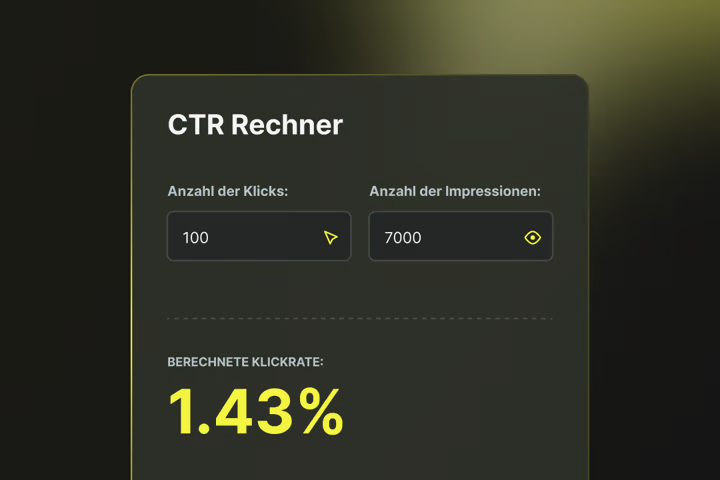
You can use our online calculator to calculate your click-through rate:
.avif)
What is a good click-through rate?
What a good click-through rate is depends on the platform, the type of content, and the region. A good CTR for organic Google search in the DACH region is between 23 and 32% in the top position, but on average around 40% in the USA. For LinkedIn ads, the click-through rate is 0.5%.
Notes on the click-through rates table: For Google Search, the CTR refers to position 1 globally (~40% CTR); in the DACH region, figures are lower, especially when ads are present.
The YouTube search CTR refers to the click-through rate of video thumbnails (YouTube impressions), with ~4 to 5% being average here.
For YouTube video ads, watch time is also often considered (on average ~30% of viewers watch an ad for at least 30 seconds).
What influences the click-through rate?
These factors influence the click-through rate:
- How visible your link or ad is (e.g. in 1st place on Google vs. poor ranking)
- How well the headline or ad copy is written
- Whether the image or creative is appealing (for ads)
- How relevant the offer is for the target group (targeting)
- Whether there is a clear call-to-action (e.g. “Buy now”, “Learn more”, etc.)
To increase content click-through rates, you can work with A/B testing. Here, two versions (e.g. shorter and longer text) of essentially the same content are shown to users in parallel to determine which variant gets more clicks.
How is the click-through rate changing due to AI?
The impact of AI is currently most obvious in Google search. Google has started delivering so-called AI Overviews for many queries. These are AI-generated summaries or direct answers appearing above normal search results. These direct AI answers mean that significantly fewer users click on organic results.
Studies show that the click share of the first search result has fallen from around 28% to just around 19% since AI Overviews were widely rolled out. This represents a decline of around 32% for the top result. Position 2 even saw a decline of around 39% (from 20.8% to 12.6% CTR).
The majority of users treat the AI answer as a final solution and skip visiting further pages — in other words, “zero-click” searches are occurring much more frequently without any external click.
This effect can also be observed in German-speaking countries. Since the launch of “Google AI Overviews” at the end of March 2025, websites in Germany, Austria and Switzerland have seen an average of 17.8% fewer clicks via Google.
In email marketing, the picture is different: Here, AI is primarily used to personalise and optimise content, which tends to have positive effects on open and click rates. AI tools are used to generate better subject lines, send times or personalised newsletter copy, which can increase the open rate by as much as 10%.
On classic social networks such as Facebook and Instagram, there are no such abrupt CTR changes due to AI search as seen with Google. Here, AI is primarily used in the targeting and delivery of ads and content. Meta uses AI algorithms (e.g. in the Advantage+ system) to address target groups even more precisely and automatically optimise creatives. The result tends to be stable or slightly improved performance values.
Conclusion: The impact of AI on the click-through rate depends heavily on the platform and initially has the biggest negative effect when AI provides a direct answer or preview.
How can I optimise the click-through rate?
Increasing the click-through rate essentially means generating more interest and attracting attention, making users more curious and hitting the mark with your messaging.
1. Use strong headlines and titles
The headline is the first thing people see — and the last, if it doesn’t appeal to them.
Tips:
- Clear and specific (“5 tips on how to do XY” instead of “Learn more”)
- Emotional (“These 3 mistakes cost you customers”)
- Curiosity-inducing, but not misleading (“What 90% of shops do wrong…”)
2. Appealing text (snippet / teaser / description)
What appears below the headline also determines whether someone actually clicks.
Tips:
- Value proposition: show the benefit (“How to save 30%”)
- Questions: ask them (“Do you want more revenue without more budget?”)
- Call to action: include one (“Discover now”, “Learn more”)
3. Optimise visuals (for ads & social media)
Images and videos attract attention immediately.
Tips:
- High-quality, clear images (no generic stock material)
- Faces, emotions, strong contrasts work well
- Always optimise for mobile (“mobile first”)
4. Improve target audience targeting
The better you know who your target audience is and how they think and act, the more likely they are to click.
Tips:
- Tailor content or offers precisely and avoid generic messaging
- Adapt your tone and voice accordingly
- Run A/B tests
5. Optimise technically & content-wise (SEO & structure)
With Google and YouTube in particular, how you structure content makes a big difference.
Tips:
- Keyword optimisation (so you can be found)
- Keep meta titles & meta descriptions clean and relevant
- Optimise for rich snippets
- Make content directly quotable so it has a chance of being included in AI Overviews
How does conversion optimisation help with falling click-through rates?
Conversion rate optimisation (CRO) means getting visitors to your website or shop to take the desired actions more often — such as buying, enquiring, or signing up.
CRO therefore ensures that more value is extracted from existing traffic. This increases the value of every single click. CRO leads to your content communicating more clearly: What do you offer? Who is it for? Why is it worth it?
When your pages perform better thanks to CRO, search engines like Google reward this with a higher quality score, which can lead to more visibility and in turn lower click costs.
Stuck with your conversion rate optimisation?
At Axisbits, we know from the experience of numerous website and shop projects that conversion rate optimisation can be very detailed and time-consuming — but equally lucrative.
If the performance of your pages consistently falls below your expectations and you’re certain that more should be possible, a neutral outside perspective can help.
Your shop should be converting more, your landing page delivering more leads, and there’s still too much room in your pipeline?
Maybe it’s time for a neutral look at your content, your landing pages and your entire website. Together, we can develop a roadmap that gets your revenue growing again. Get in touch and we’ll show you how we approach conversion rate optimisation for your site.
{{fs-btn-cta}}
Wir schaffen leistungsstarke Plattformen und Websites für Startups, Scale-Ups und KMUs, von Konzept bis Go-Live.
We systematically increase your conversion rate with A/B testing and proven UX optimization — month by month!
Click-through rate (CTR) — Common questions and answers
On average, search network ads achieve around 3% CTR, while display ads perform significantly worse, averaging 0.35% to 0.5%
Current industry comparisons can be found, for example, at WordStream/ Promodo (Google Ads), MailerLite or Brevo (email marketing), Sproutsocial (social media engagement) and Socialinsider.
Test and optimize: A/B testing for ad copy or subject lines, refine target groups, or improve landing pages. Make sure ads are more relevant and personalized to generate more clicks.
More articles

Many teams experience Sprint Planning in one of two extreme ways: either as an endless meeting that drags on for three hours and still provides no clarity, or merely as a ticket-shuffling exercise in Jira that could just as easily have been handled via email. Neither of these approaches aligns with the true purpose of Sprint Planning.

According to the swissICT Digital Excellence Report, only 35 percent of Swiss companies are on track with their digital alignment. For 26 percent, there is significant need for action (Source: swissICT). Companies invest in tools, cloud services, and AI pilot projects without a plan that holds it all together. The result: fragmented system landscapes, duplicated work, and budgets that don't flow where they have the most impact. The right IT strategy is the answer to this.

Artificial intelligence is now an established tool in software development, integrated directly into the programming environment. Developers spend less time writing boilerplate code and can instead focus on how the different parts of an application logically interact.