Using artificial intelligence — where it really pays off for companies
Artificial intelligence has long been part of our everyday lives and work. It sorts our photos and automatically answers customer inquiries. For many companies, the question is therefore no longer whether they use AI — but how. In this article, you'll find out what options are available to you today, where AI is being used sensibly — and how you can get started with it.


The current state of artificial intelligence
AI systems have not — as often feared — eliminated thousands of jobs. Instead, they take on routine tasks, freeing up more time to focus on really important tasks.
Chatbots intercept the same customer inquiries and have now become standard on many websites. In business intelligence, AI ensures Data cleansing and analysis — and identifying patternsthat would sometimes have escaped the human eye. In medicine, X-ray images and MRI data are scanned by artificial intelligence, which sometimes leads to a much more accurate detection of damage or diseases.
Anyone who deals with AI quickly realizes that it's not just about what is technically possible. The question has become more important as to where the Using AI in everyday business The most worthwhile — and how to use AI economically.

In which areas is artificial intelligence used?
Artificial intelligence is used in a very diverse way. For many people, ChatGPT or Google's Gemini are at the forefront of their everyday perception of AI. This is likely due to the fact that these two and similar models can be used very easily via smartphones.
For entrepreneurs, it is more important that AI also provides real benefits. The application does not change all conceivable processes on a broad scale, but does the work in certain details.
- Image and object recognition: In industry, AI systems recognize the smallest errors in production. Cameras and software capture details that the human eye cannot perceive, for example in fast production chains. The AI system in smartphones recognizes faces and can sort photos by content, such as “beach,” “forest,” or a specific car.
- Speech and word processing: AI can classify what is said or written. This allows chatbots to automatically answer questions, create captions for videos, or summarize meetings.
- Personalized recommendations: Online shops and streaming services show how well AI can classify preferences. Based on previous purchases or usage, it suggests products and content that are likely to be relevant.
- Maintenance and failure prediction: In manufacturing, AI can use sensors to record clocking, vibrations, or noises. Pattern recognition then warns of likely problems or wear and tear.
- Data analysis and forecasting: AI searches through huge amounts of data, recognizes patterns and derives trends from them. For example, anyone who better understands the buying behavior of their customers can better time marketing campaigns.
.avif)
Practical examples: How companies use artificial intelligence
Companies all over the world are using AI to improve products or create new ones. Artificial intelligence is also used to monitor processes and production.
Automated container handling in the Port of Hamburg
Hamburger Hafen und Logistik AG (HHLA) uses AI to automate container handling. At the Altenwerder Container Terminal (CTA), AI-based algorithms automatically control driverless transport vehicles (AGVs) and warehouse cranes. These systems independently decide on the placement of containers and optimize transport routes.
.jpeg)
Personalized communication with AI at in2humans
IN2humans AG has had an AI platform developed that helps managers communicate with their team members in a much more personal way. The technology analyses personality, language patterns and reactions — and based on this, provides information on how to conduct conversations in a more targeted, clear and motivating way.
.jpeg)
Predictive maintenance at Rolls-Royce
Engine manufacturer Rolls-Royce is using AI to monitor the status of its aircraft engines in real time. Sensors continuously collect operating data, which is analyzed by AI systems. In this way, potential problems can be identified and maintenance work can be planned in advance. The entire technology is called Rolls-Royce”Digital Twin”.
.jpeg)
Personalized medicine at Tempus
Tempus uses artificial intelligence to develop personalized cancer therapies. By analyzing genetic data from patients, the system identifies mutations and suggests individually tailored treatment options based on this. This enables targeted therapy.
.avif)
Strategies & tips: How you can use artificial intelligence
Not every company must or can set up their own AI team. It is often enough to use existing solutions and gradually expand their use. Here are a few realistic introductions for companies that want to get into the topic:
1. Chatbot in customer service — with Microsoft Power Virtual Agents
Many companies start with an AI-powered chatbot. tools such as Power Virtual Agents (via Microsoft Copilot Studio) can be created without programming knowledge and integrated directly into Microsoft Teams or on the website. This saves your support team from having to deal with recurring questions.
2. Automated text creation with neuroflash or Jasper
For recurring content — product descriptions or email campaigns — it is worthwhile using AI text generators such as Neuroflash. The tools analyse existing texts and deliver content that fits well into the overall picture. Note that your team still needs to have an understanding of marketing.
3. Sales analysis with AI from CRM
Modern CRM systems such as Salesforce with Einstein Identify which leads are particularly promising The AI learns from past transactions and automatically evaluates new contacts — depending on industry, behavior and previous activities.
4. Automatic translations with DeepL API
If your target customers come from multiple language areas, it's worth taking a look at DeepL. Content can be translated automatically via an API — directly in the content management system or in support communication.
Custom software with artificial intelligence
For many applications, there are artificial intelligence systems that can be connected to your processes more or less easily. But that is not always so easy.
Our Axisbits team encounters many cases where mass-compatible software doesn't get to the heart of the matter. Our customer in2humans AG is one example of this. Our collaboration has therefore resulted in individual software with artificial intelligence that works exactly as the team from in2humans presented. You can find more examples of custom software from Axisbits in our portfolio.
As a full-service agency with many years of experience in developing custom software with AI, Axisbits covers all areas that make your project successful — from concept to launch and beyond.
{{fs-btn-cta}}
Wir schaffen leistungsstarke Plattformen und Websites für Startups, Scale-Ups und KMUs, von Konzept bis Go-Live.
Using artificial intelligence — frequently asked questions and answers
No, you can simply use tools such as ChatGPT, DeepL or Midjourney in the browser — without training or programming. If you use AI within individual software, you also don't have to program anything, but can use the software as a user.
Just then. You can hand over repetitive tasks without employing extra staff. By using AI, you free up your team and create more time for tasks that should actually be completed by human hands.
ChatGPT for text, DeepL for translations, DALL·E or Canva Magic for images, Microsoft Copilot for Office files — all run in the browser, many for free.
Find a single task that you want to automate — for example, answers to support requests. Test a tool, track the effect, talk to the team. Not a big project, but a clear attempt.
More articles
Business Process Management (BPM) is the structured control of business processes through modeling, automation, measurement and optimization. The EU rules DORA and NIS2 reach Swiss companies too, by way of their supply chains.
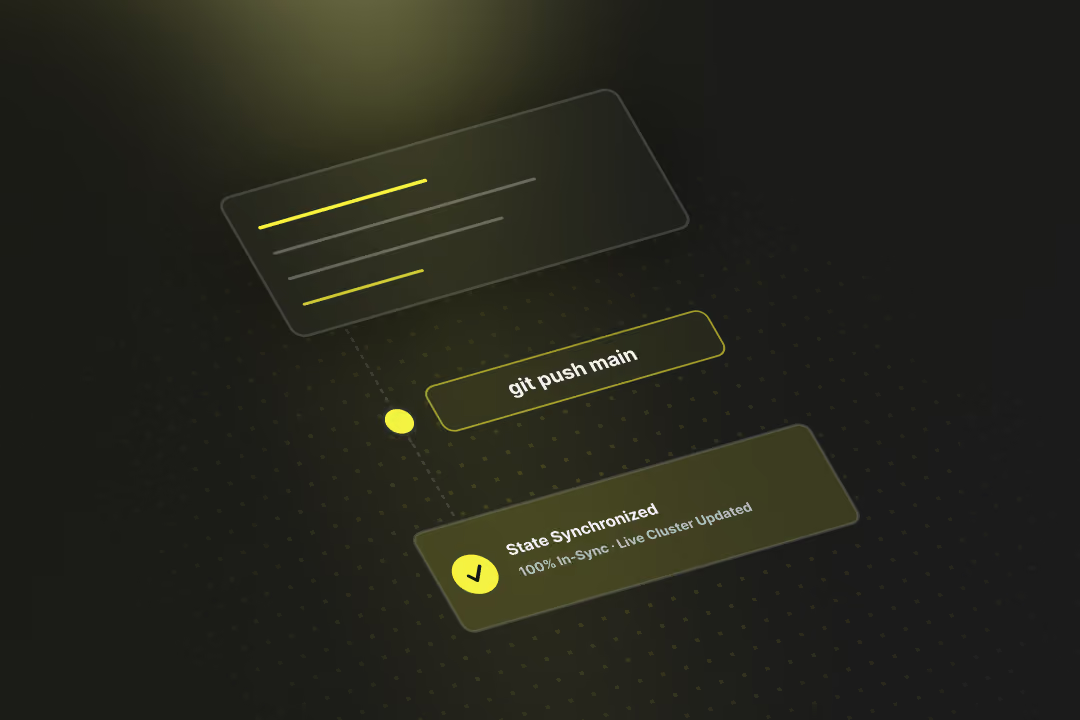
Software deployment is the process that moves finished code out of the development environment and into live production. GitOps, Progressive Delivery and DevSecOps make releases faster and safer. At the same time, the revDSG and even EU regulations reach into Swiss pipelines.
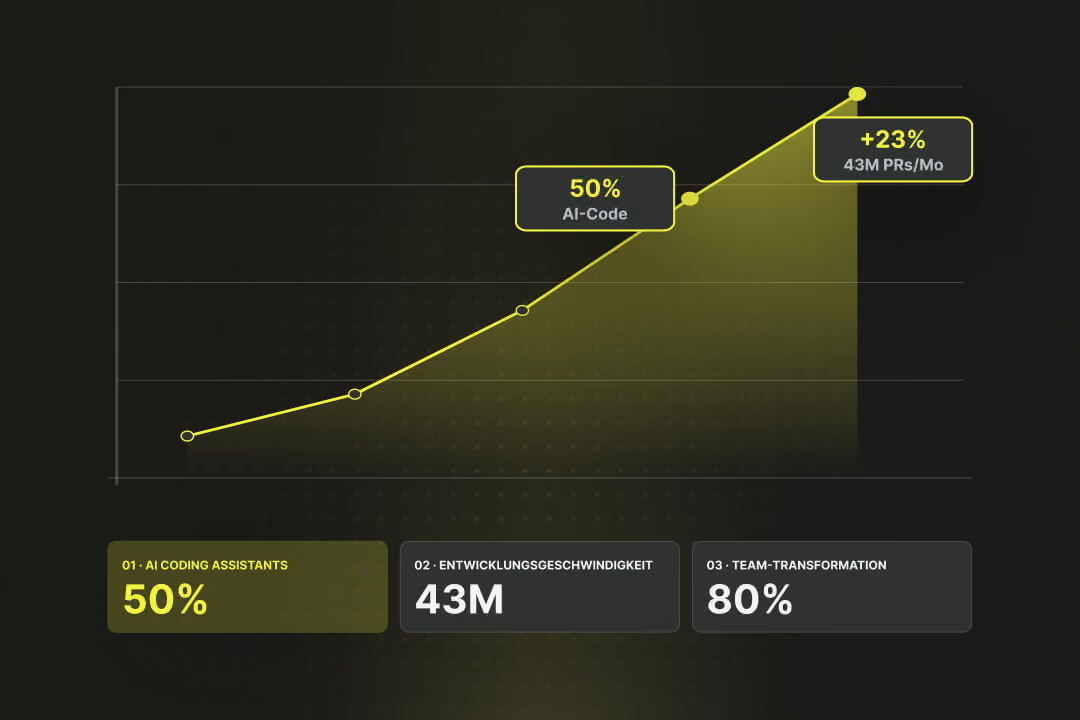
By the end of 2025, almost half of all code on GitHub was generated using AI tools, according to EY Switzerland. Each month, 43 million pull requests were merged, a 23% year-over-year increase (Source: EY Switzerland). Gartner predicts that by 2030, AI-native development platforms will lead to 80% of organizations transforming large developer teams into smaller, AI-augmented units (Source: Gartner). Software development is changing faster than ever before. We highlight the trends that truly matter in 2026, what's driving them, and what this specifically means for businesses.