Create an Online Marketplace: Step by Step
Your own online marketplace enables you to bring together sellers and buyers on a single platform, automate their transactions, and earn money from it.

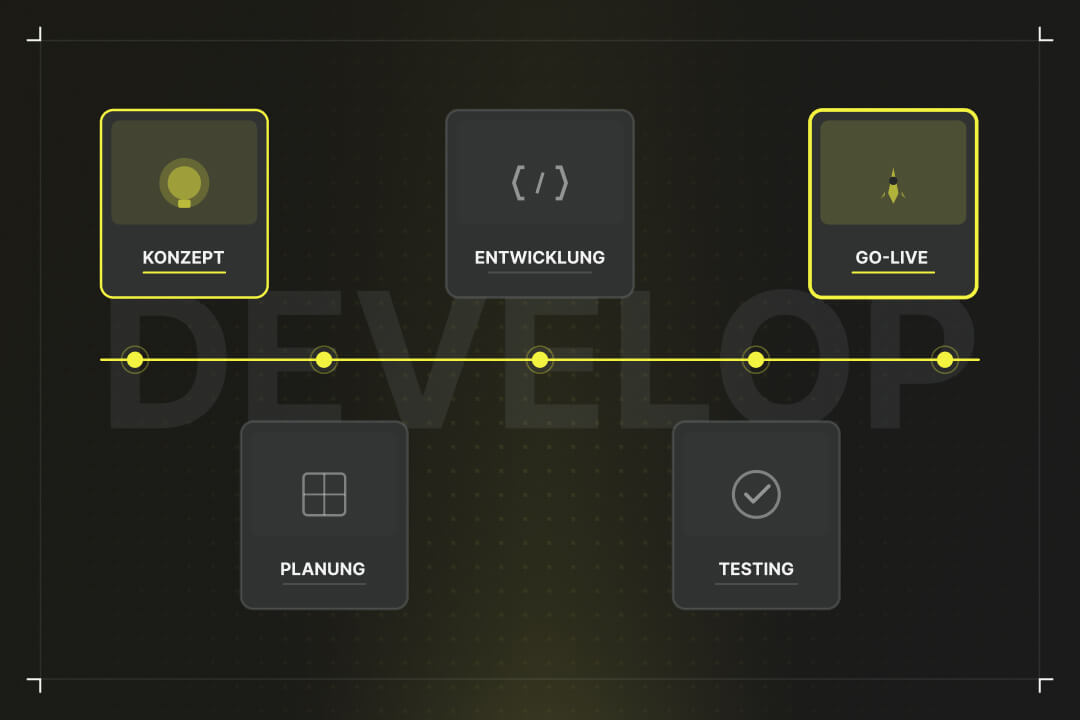
Creating an Online Marketplace: Key Takeaways
- First, define how you will monetize, e.g., with a percentage fee, memberships, or listing fees.
- For launch, an MVP (Minimum Viable Product) with essential features is sufficient: Login, listings, search, payments, and payouts.
- Choose the right technology path: Low-/No-Code for a quick start, open-source, or custom-built.
- Use a Payment Service Provider (PSP) like Stripe Connect, Datatrans, or Payrexx to process payments securely and compliantly.
- Consider Swiss legal obligations: data protection (revDSG), e-commerce regulations, and for physical goods, the VAT regulations for platforms.
- Development costs range between CHF 2,000 and 300,000, depending on the approach.
Guide: Creating an Online Marketplace
You create an online marketplace by first defining your business model, defining essential features, and then choosing a suitable technology.
You process payments through a licensed Payment Service Provider to ensure secure and compliant money flows.
Additionally, in Switzerland, consider data protection (revDSG), VAT rules for platforms, and local payment methods like TWINT.
1. Define the Business Model & Value Creation Logic of the Online Marketplace
First, define the business model of your online marketplace . It determines how you generate revenue and how money flows between buyers, sellers, and the platform. Only then can the technical architecture and payment setup be effectively planned.
Essentially, you decide who pays, when, and for what. A service marketplace with per-order fees operates differently than a product marketplace with a percentage commission or a B2B portal with subscriptions.
If you're just starting out, choose a model that is easy to explain, automatable, and understandable for providers.
2. Plan the Features of Your Online Marketplace
Determine which features your marketplace truly needs to get started. Many founders plan too extensively at this stage and get bogged down in details. Instead, focus on what's necessary for buyers and sellers to reliably transact with each other.
Tip: A Minimum Viable Product (MVP) is the smallest functional version of your marketplace. It allows you to test if your concept works without immediately building a complex system.
Core Features for Buyers
Your online marketplace must enable buyers to quickly find products or services and pay securely. Key elements include:
- Search and Filters: Users must be able to narrow down offers by location, price, category, size, language, etc.
- Listing Pages: Each service or product needs its own page with a description, price, images, and contact options.
- Shopping Cart or Inquiry Function: Depending on your business model: direct booking or inquiry to the provider.
- Rating System: Buyers want to see if others have had good experiences.
- Secure Payment System: Payments should be processed easily and reliably.
Core Features for Sellers
For sellers, your marketplace needs features for:
- Registration and Profile: Collection of basic data and verification, if necessary (e.g., by the payment provider).
- Listing Management: Creating, editing, and pausing listings.
- Order Overview: Easy view of open orders.
- Payment and Payout Overview: Clear representation of what has been sold and paid out.
- Messages or Notifications: So sellers can quickly respond to inquiries.
Admin Features
As the operator, you also need basic tools to manage the marketplace:
- User Management: Activating, suspending, or deleting accounts.
- Moderation: Monitoring listings and images to prevent fraud and abuse.
- Transaction Overview: Overview of payments, fees, and payouts.
- Support Section: Ability to manually intervene in processes or resolve disputes.
3. Choosing the Technology Path for Your Online Marketplace
Once you have defined your business model and feature set, it's time for the technical decision: Which technology will you use to build your marketplace?
This decision affects how quickly you can launch, how much flexibility you have for future customizations, and what ongoing costs you will incur.
Essentially, there are four main approaches:
- Low-/No-Code
- SaaS
- Open-Source
- Custom Development
No-Code / Low-Code
With low- or no-codesystems, you can quickly build an MVP without writing any code.
Examples: Sharetribe, Bubble, Softr
Advantages:
- You can get the marketplace online within days or weeks.
- Many standard features (login, listings, payments, reviews) are already available.
- No server maintenance or deep technical knowledge required.
Disadvantages:
- Limited options for special features.
- Dependence on the provider for hosting and upgrades.
- Scaling and performance can become an issue beyond a certain size.
Recommendation:
No-code is often very well suited for an initial proof-of-concept or a regional marketplace. You learn what users truly need before investing more money in technology.
SaaS Marketplace Solutions
When it makes sense: If you want a ready-made, professional solution that you can configure but don't have to develop yourself.
Examples: Mirakl (Enterprise), Arcadier, Shopboostr
Advantages:
- Stable operation and support from the provider.
- Often integrated payment, analytics, and reporting features.
- Scalable, without you having to manage your own servers.
Disadvantages:
- License costs, often dependent on revenue or user count.
- Limited customization.
- Partial reliance on the provider's technical infrastructure.
Recommendation:
SaaS is suitable for startups or companies looking to launch quickly, but is usually severely limited in terms of adaptability and scalability.
Open-Source / Headless Systems
When suitable: If you need more control over code, features, and interfaces.
Examples: MedusaJS, Spree Commerce, Shopware with multi-vendor plugin
Advantages:
- You can customize the system as needed.
- No license fees, full access to the code.
- Integration of your own interfaces, e.g., with CRM, ERP, or custom payment flows.
Disadvantages:
- You need experienced developers.
- Updates and security are your responsibility.
- Higher maintenance effort than with SaaS.
Recommendation:
Open-source is suitable if you want to maintain long-term control and have the appropriate technical resources.
Custom Development (Custom Build)
When suitable: If your marketplace requires specific logic, processes, or integrations that standard solutions cannot accommodate.
Advantages:
- Complete freedom in design, features, and architecture.
- No reliance on third-party providers.
- Technically scalable for growth and customizable for individual processes.
Disadvantages:
- Higher initial costs.
- Longer development time.
- Ongoing maintenance and hosting costs.
Recommendation:
In-house development is worthwhile if your concept is already validated, you have an experienced development team, or you are working with a technology partner.
Tip: If you can't decide on a technology and want a professional to handle the development of your online marketplace, feel free to contact us.
{{fs-btn-cta}}
4. Payment Setup and Legal Requirements in Switzerland and the EU
Once your marketplace is technically set up, you need to determine how payments will be processed. You must comply with legal obligations, as specific rules apply in Switzerland whenever money flows between third parties.
Define the payment flow
On a marketplace, you don't pay the seller directly; instead, you forward payments via a Payment Service Provider (PSP). This prevents you from being legally considered a financial intermediary, which in Switzerland is only permitted with a FINMA-license.
- The buyer pays on your marketplace, for example, with a credit card or TWINT.
- The money is received and temporarily stored by the Payment Service Provider.
- The PSP automatically deducts your fee (e.g., 10%).
- The remaining balance is paid out to the seller.
This process is called Split Payment or Payout Flow.
Suitable Payment Providers
In Switzerland, you have access to several reputable PSPs that offer marketplace payment solutions:
Legal Framework for Online Marketplaces in Switzerland
KYC and Anti-Money Laundering Act (AMLA):
- Payment Service Providers are required to identify sellers ("Know Your Customer").
- The PSP usually handles the verification, not you.
- Route all payments exclusively through the PSP.
- This way, you avoid being considered a financial intermediary yourself.
Value Added Tax (VAT):
- Effective 2025: If goods are sold through your marketplace, the platform may be considered a "deemed supplier."
- This means you may have to account for VAT on these sales.
- This applies to physical goods, not services.
- The obligation arises from a turnover of CHF 100,000.
Data Protection (revised DPA):
- The revised Data Protection Act has been in effect since 2023.
- You must inform buyers and sellers about which data is processed and shared with payment providers.
- In the event of high-risk data breaches, you must inform the Federal Data Protection and Information Commissioner (FDPIC) as quickly as possible.
E-commerce Obligations:
- Swiss regulations require you to have a complete imprint, clear pricing, and an order confirmation.
- Before completing the order, the buyer must clearly be able to recognize that a contract requiring payment is being formed.
What does it cost to create an online marketplace?
The range of costs is wide, depending on whether you work with a no-code tool, existing software, or custom development. For in-house development, you should expect at least CHF 2,000. The costs for an external developer depend on their hourly rate and experience.
A marketplace incurs recurring monthly expenses. Plan for these costs from the outset:
Examples of online marketplaces by Axisbits
At Axisbits, we have already implemented numerous development projects and created online marketplaces as well as platforms, apps, and web apps created.
If you already have a concrete project idea for your online marketplace and would like a consultation on the costs, please contact us. The better we understand your vision, the more specific we can be about pricing.
{{fs-btn-cta}}
Wir schaffen leistungsstarke Plattformen und Websites für Startups, Scale-Ups und KMUs, von Konzept bis Go-Live.
We advise you on building and create powerful software & apps for startups, scale-ups, and SMEs, from concept to go-live.
Building an Online Marketplace – Frequently Asked Questions
Costs depend heavily on the chosen technology. A simple MVP with no-code tools usually costs between CHF 2,000 and 10,000. For custom development, you should budget at least CHF 80,000. Additionally, there are ongoing fees for hosting, payment processing, and maintenance.
For a quick start, no-code solutions like Sharetribe or Bubble are ideal. They offer ready-made modules for listings, payments, and user management. If you need more control and scalability, open-source systems like MedusaJS, Spree Commerce, or Shopware are a good choice.
Payments should always be processed through a Payment Service Provider (PSP) like Stripe Connect, Datatrans, Payrexx, Mollie, or Adyen. The PSP collects funds from the buyer, automatically deducts your platform fee, and pays out the remainder to the seller. This ensures that you do not require a license as a financial intermediary and that all Know Your Customer (KYC) and anti-money laundering (AML) regulations are complied with.
In der Schweiz musst du die Vorgaben des Datenschutzgesetzes (revDSG), des E-Commerce-Rechts und, falls du physische Waren anbietest, der Mehrwertsteuerpflicht für Plattformen beachten. Bei Zahlungen über einen PSP übernimmt dieser die KYC-Prüfung (Identifikation der Verkäufer). Sorge ausserdem für ein vollständiges Impressum, eindeutige Preisangaben und aktuelle Datenschutzhinweise.
More articles
Many projects start with a clear idea: a digital marketplace, a SaaS offering, software for internal processes. But at the latest during implementation, it becomes clear that no construction kit, no WordPress site with a login, is enough here. A web platform is a technical system with its own logic, deep interfaces and genuine security requirements. In this article, you'll learn what a web platform is and what it needs beyond the front and back end to meet your requirements.

Perhaps it is already clear what should be booked: holiday home, course, vehicle, dates. But are you still not aware of how this can be technically implemented? This article gives you an overview of what a booking platform must do, which functions you should plan for and what is really important when creating it.