White Label Software 2026: How to Offer It Legally, Scalably and Profitably
White label software refers to fully developed software that you license, brand and sell to end customers under your own brand name, without programming it yourself. For SMEs and agencies, this model can be a fast route to market.

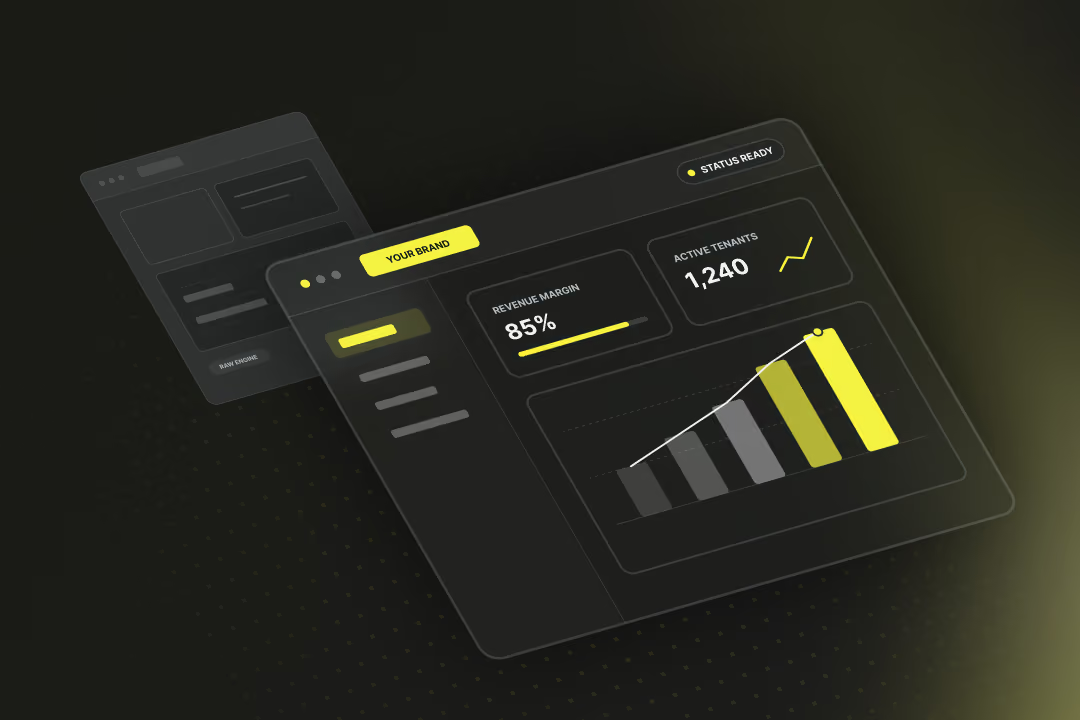
White Label Software: Key Takeaways
- White label software is software developed by someone else that you distribute under your own brand. You save development time and engineering capacity, but give up product control, code ownership and room for differentiation.
- With white label software, pay attention to your legal responsibility as a processor under the revised Swiss Data Protection Act (revDSG), the technical tenant separation in a multi-tenant architecture, and the margin terms in the reseller contract.
- SaaS white label software pays off in the early phase, when opening up a new market, or as a bridging solution. Custom build becomes the better option as soon as license costs exceed in-house development or investors demand code ownership.
- Axisbits in Zurich develops custom-build platforms as white label software with full code ownership and senior review on every line of code.
What is white label software and when is it worth it?
White label software is turnkey software that a manufacturer develops and licenses to resellers, agencies or brands. You typically take on the branding, sales and customer support, while the manufacturer is responsible for the code, hosting and further development.
The dividing line to OEM software lies in brand freedom: white label permits complete re-branding, while OEM licenses usually allow only partial adjustments.
The white label software model pays off in three constellations:
- When your market entry needs to happen in under six months and internal engineering capacity is missing.
- When you serve a niche in which a standard product with small adjustments is sufficient.
- When you are validating the business model before investing in custom software development.
Which white label software examples show what really works?
Examples of a viable white label model can be found in software for HR and recruiting, accounting and finance, and in e-commerce. What they all have in common is that certain workflows have become established within these areas, and that the differences between products tend to arise at the service level.
In all three clusters, the contract terms between you and the manufacturer decide the margin you can achieve:
- With SaaS white label software on a per-seat basis, your costs are predictable but you have little margin leverage as you scale. That is because you hand over a fixed fee to the manufacturer with every new customer. You can therefore never run such white label software more cheaply, even as you grow.
- The revenue share model shifts the risk onto the provider, but in the long run costs you a larger share of end-customer revenue. Here you pay a fixed percentage of revenue to the provider, but no minimum amount.
- Contracts with minimum purchase commitments usually get you a good price, but you pay the manufacturer a minimum amount per year regardless of whether and how many licenses you resell.
{{fs-banner-cta}}
Which legal aspects do I need to consider with white label software?
White label software makes you a processor under the revised Swiss Data Protection Act (revDSG) and therefore liable towards your end customers, even though the software belongs to the manufacturer. These are the aspects you should watch:
- Hosting region: With an EU or Swiss data center you avoid the Cloud Act problem that comes with US providers. Servers in the USA fall under the US Cloud Act, which grants American authorities access to data regardless of where the data owner is located.
- Data processing agreement (DPA): Mandatory content includes purpose limitation, technical and organizational measures, subcontractor clauses and audit rights. A revDSG-compliant DPA names every sub-processor explicitly.
- IP and code ownership: The contract clarifies who owns source code, configurations and customer data if the provider becomes insolvent. A source code escrow is the right safeguard.
- Security certifications: ISO 27001 and SOC 2 Type II on the provider's side have become the market standard in Switzerland for corporate customers with 100 employees or more.
What does a viable architecture for white label software look like?
A viable architecture for white label software is based on multi-tenancy, meaning tenant capability with sharp separation. Three architecture models have become established, each with its own risk profile and cost structure:
- Single-tenant per reseller: Each tenant gets its own database instance. Maximum isolation, highest hosting costs, sensible under FINMA or healthcare requirements.
- Multi-tenant with row-level security: Shared database, tenant separation at record level. Common for many SaaS use cases, a good balance between cost and separation.
- Hybrid per tier: Standard tenants share a database, enterprise tenants get dedicated instances. Scales with the pricing tiers and allows higher margins in the upper segment.
For the tech stack of white label software, TypeScript, React, Next.js and Supabase have become the market-standard combination for multi-tenant platforms, because row-level security is natively supported there.
Take care not to build on outdated stacks, because they lock you into a vendor, which becomes expensive later when you move to your own online platform.
When is custom build worth it instead of white label software?
Custom build pays off precisely when white label software slows your growth, or when you cannot scale appropriately:
- Margin ceiling: As soon as competitors offer the same software under a different label, your offering loses its differentiation. Prices then erode and your margin falls.
- Feature veto: When the provider's roadmap does not serve your most important customer segment and your feature requests are not implemented.
- Exit or funding requirement: Investors sometimes assess code ownership, barriers to market entry and the IP stack. A white-label license agreement might not count towards such a valuation, or might count against it.
How to grow your white-label offering into your own platform with Axisbits
White label software is a strong starting point that eventually exacts a price. As soon as your end customers demand their own workflows, your margin comes under pressure, or investors want to see code ownership, custom build software becomes the better answer for you than white label software.
At Axisbits you get a senior development team on a subscription basis, which works out cheaper for you than building an in-house development team.
- You own the code. On request, we take care of maintenance and further development permanently.
- Senior sign-off on every line of code, AI-assisted workflows deliver high development speed, and continuous senior review delivers the highest quality.
- revDSG-compliant hosting on European infrastructure, ISO 27001 certified.
Book your free introductory call. In 30 minutes we clarify the key parameters of your software project together. You get an honest assessment of development time and costs, with no sales pressure.
{{fs-btn-cta}}
Do you want to enter the market with your own software instead of white label?
At Axisbits, your Swiss provider for high-end software, you get your senior programming team on a subscription basis.
Wir schaffen leistungsstarke Plattformen und Websites für Startups, Scale-Ups und KMUs, von Konzept bis Go-Live.
We deliver a complete team at the push of a button that builds and maintains your software. You keep full code ownership, we take senior responsibility for production.
White Label Software – Frequently Asked Questions
White label software allows complete re-branding and free pricing, and the reseller appears as the sole brand provider. OEM software is integrated into a product of your own, often with a visible reference to the original manufacturer, and usually follows stricter license terms. The commercial model is more flexible with white label, while the technical integration model goes deeper with OEM.
The range is wide and depends on the industry and the depth of integration. Market-standard per-seat licenses for resellers sit at roughly CHF 10 to 35 per user per month, while revenue-share models take 15 to 30 percent of end-customer revenue. One-off setup and onboarding fees typically fall between CHF 500 and 5,000, and run higher where integration is deep. Minimum terms are predominantly annual, with 24 months in the enterprise segment. Always have the specific terms confirmed by the provider.
Market-ready options are TypeScript with React and Next.js for the frontend, Supabase or PostgreSQL with row-level security for database tenant separation, and Vercel or AWS for hosting. React Native is added for mobile extensions. Legacy stacks such as PHP or older Java constellations are no longer market standard for new builds in 2026.
The right time has come as soon as monthly license costs exceed in-house development, feature requests stall in the vendor's backlog, or a funding round demands code ownership.
More articles
Platform Engineering alleviates the burden on developer teams who, in addition to coding, often have to manage the entire configuration of cloud systems and security pipelines. By building an Internal Developer Platform (IDP), you equip your team with self-service capabilities that make databases or servers available at the push of a button.
.avif)
A prototype is a simplified, partially functional model of a product or software. It is used to test certain characteristics such as usability, function, form, or technology before the final version is developed or produced. A prototype is therefore a validation tool. It forms the basis for verifying assumptions about user behavior, technical feasibility, or market acceptance before a project moves into the often costly implementation phase.
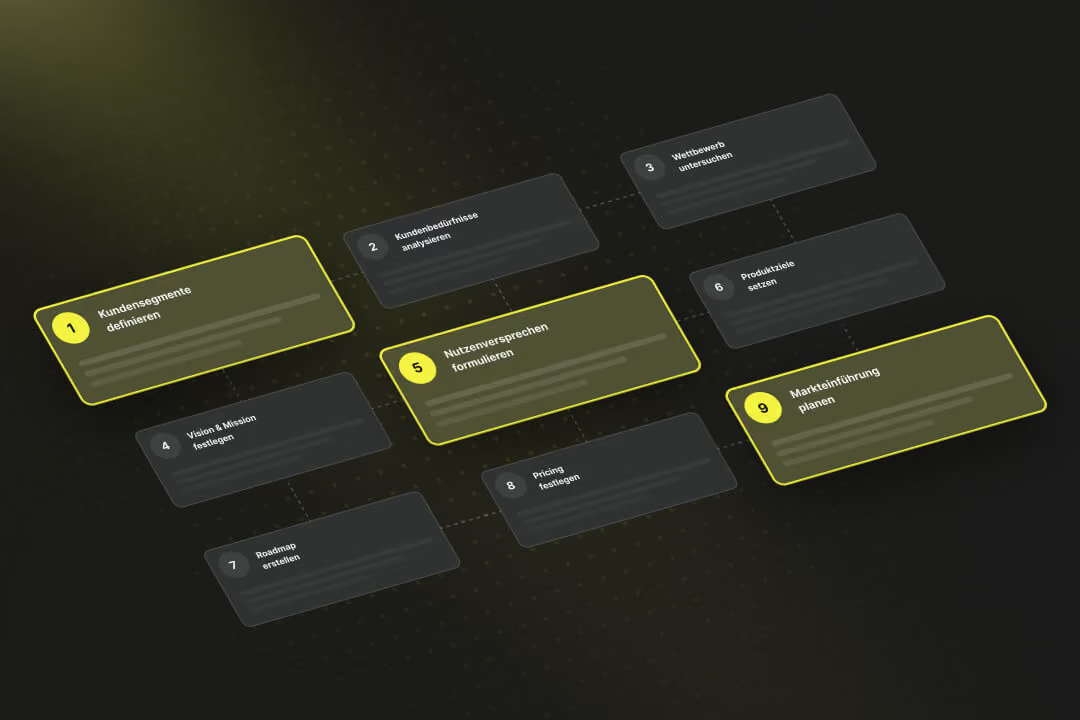
Your product strategy defines the specific value you create for different customer segments and how this value contributes to business success. It forms the foundation for all subsequent product decisions, from development and pricing to market launch.