Software Deployment: Methods, Tools and Compliance 2026
Software deployment is the process that moves finished code out of the development environment and into live production. GitOps, Progressive Delivery and DevSecOps make releases faster and safer. At the same time, the revDSG and even EU regulations reach into Swiss pipelines.

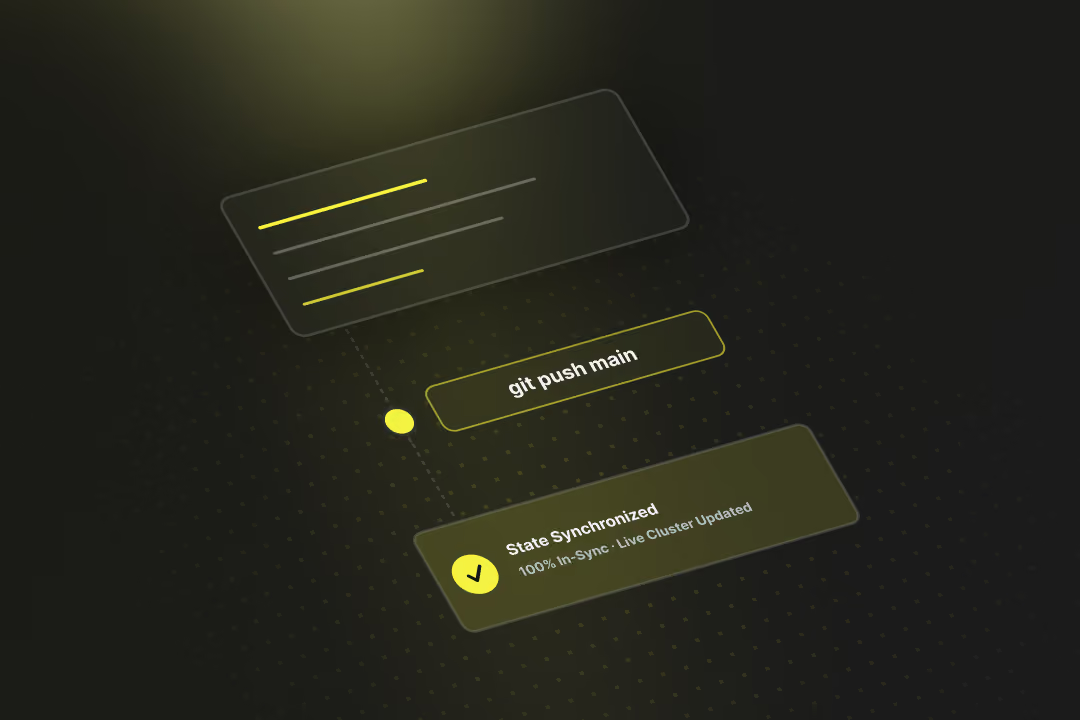
Software Deployment: Key Takeaways
- Software deployment covers every step from the code commit to running production, meaning build, test, staging and release, including rollback mechanics.
- Software deployment strategies such as blue-green, canary releases and feature flags limit faulty releases to a small group of users and make rollbacks possible within seconds.
- Swiss companies are directly bound by the revDSG and the Information Security Act when deploying software. EU regulations (CRA, NIS2 and the AI Act) apply indirectly through supply chain obligations, EU customer relationships and products placed on the EU market.
- Axisbits delivers a complete software team on a subscription basis with senior review on every line of code, so that software deployments run predictably and reliably.
What does software deployment cover?
Software deployment consists of four main phases that produce a repeatable, auditable release process. In the build, the source code is compiled and the deployment artifact is created. In the test phase, unit, integration and security tests run automatically. In the staging environment, teams check behavior on a production-like configuration. In the release, the code goes live.
With continuous delivery, every commit produces a release-ready artifact, while human approval is still required for go-live. Continuous deployment software automates that final step too, so that once the tests pass (a green build) the feature goes straight to the customer.
| Strategy | Approach | Strength | Use Case |
|---|---|---|---|
| Blue-Green | Two identical stacks, switched at the load balancer | Rollback within seconds | Business-critical applications |
| Canary Release | The new version goes to 1 to 5 % of users first | Early error detection in live operation | SaaS with high user numbers |
| Rolling Update | Step-by-step replacement, instance by instance | Low resource requirements | The Kubernetes default path |
Which software deployment tools are mainly used?
GitHub Actions and GitLab CI/CD have by now established themselves as the most widely used software deployment tools. Both trigger tests and deployments automatically as soon as someone pushes code to the repository, both are available as software deployment open source or with a free entry tier, and both can be set up without much configuration effort.
If you deploy on Vercel or Supabase, the deployment process comes included. A single Git push is enough and the rest runs automatically. That makes this route the realistic choice for most Swiss SME teams, as long as no dedicated server management is needed.
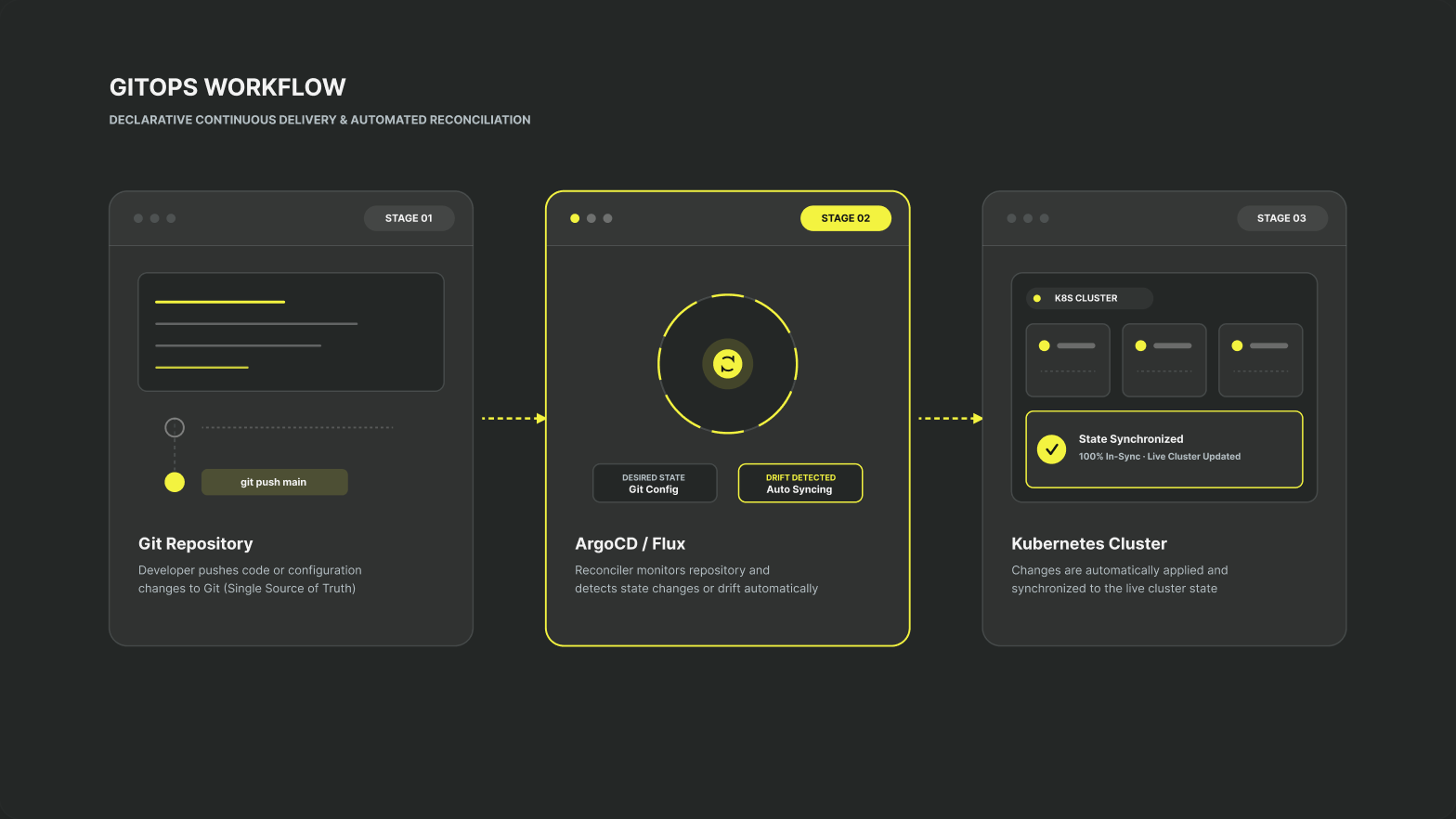
For teams running on Kubernetes, a system that distributes and scales applications across multiple servers, ArgoCD and Flux come into play. Both keep the production state automatically in sync with the repository and produce a complete audit trail while doing so: every change is traceable with author, timestamp and review.
Commercial software deployment automation tools such as Harness or CircleCI Enterprise only become relevant once contractually guaranteed response times, compliance reports or parallel development across several teams are required.
How do GitOps and Progressive Delivery change safe software deployment?
GitOps makes Git the single source of truth for infrastructure and software deployments. Every change to the production state goes through a pull request, is reviewed, merged and rolled out automatically. The state of production can therefore be reconstructed from the Git history at any time.
This process carries directly over into DevSecOps:
- Security check: programs are scanned automatically for known vulnerabilities.
- Secrecy: passwords never end up in public code, but in a digital vault (secret management).
- Certificate of authenticity: every software package receives a digital seal (signing) that proves: “This is the original and nobody has tampered with it.”
- Audit reliability: because every change runs through the version control system (GitOps), a complete log is created automatically.
Which compliance requirements shape software deployment for Swiss companies?
Swiss companies are subject to two regulatory levels in parallel. The revised Data Protection Act (revDSG) and the Information Security Act (ISG) apply directly. The Cyber Resilience Act (CRA), NIS2 and the AI Act apply indirectly, as soon as Swiss providers serve EU customers, place products on the EU market, or form part of the supply chain of an EU-regulated client.
revDSG and ISG Reporting Duty
The revised Data Protection Act (revDSG) has been binding since 1 September 2023. It requires Swiss companies to protect personal data equally in development and production environments, to maintain documented accountability, and to report data protection breaches promptly to the FDPIC (Federal Data Protection and Information Commissioner).
In parallel, the reporting duty under the Information Security Act has applied to operators of critical infrastructure since 1 April 2025. Cyberattacks must be reported within 24 hours to the Federal Office for Cybersecurity (BACS), with a follow-up submission within 14 days.
For the deployment pipeline, that means audit logs have to document every release step traceably, so the origin of an incident stays reconstructable within the 24-hour window.
How to build a Swiss deployment pipeline with EU compliance
A future-proof pipeline for Swiss companies satisfies the revDSG and ISG directly, and covers CRA, NIS2 and AI Act requirements far enough that EU customers can be served without extra effort.
- Test automation: unit, integration and security tests run on every commit.
- Adopting GitOps for auditability: infrastructure and deployments live in Git, while ArgoCD or Flux handle the sync into the cluster.
- Progressive Delivery for risk reduction: new features start as a canary on 5 % of traffic, and feature flags allow a fast rollback without a re-deploy.
- SBOM and vulnerability scans for EU market access: Syft, Grype and Trivy generate the software bill of materials and check container images before every release.
Who is responsible for my production code?
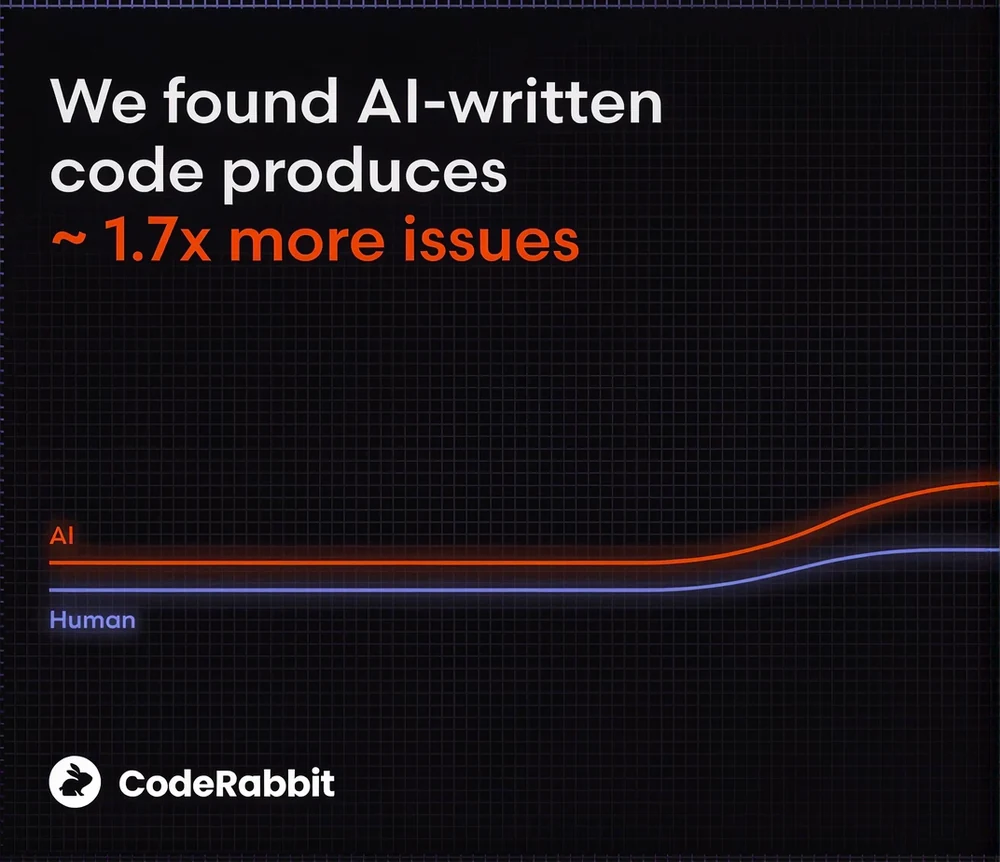
AI has made writing code cheap. It has not made responsibility for that code cheap. According to a CodeRabbit analysis, pull requests containing AI-generated code carry roughly 1.7 times more issues than human-written code.
With vibecoding tools such as Lovable, Bolt and v0, vulnerability rates of 40 to 45 percent have been measured. If you deploy software in Switzerland or with EU market exposure and carry those rates, it will obviously catch up with you quickly.
Axisbits offers you a complete software team on a subscription basis. From day one you get access to a full team of product owner, senior engineer, designer, QA, PM and DevOps.
- Senior sign-off on every pull request, including DevOps responsibility for deployment, monitoring, security checks and recovery
- A Swiss GmbH as your legal backstop, with the DSG fully implemented and ISO 27001 certification.
Book your free 30-minute diagnostic call. In 30 minutes we clarify together whether your current deployment and product situation is a fit for Axisbits. You get an honest assessment of pipeline, stack and compliance position, with no sales pressure.
{{fs-btn-cta}}
Wir schaffen leistungsstarke Plattformen und Websites für Startups, Scale-Ups und KMUs, von Konzept bis Go-Live.
We automate your deployment pipelines to DevSecOps standards. Reach the highest release frequency through our AI-assisted senior workflows.
Software Deployment – Frequently Asked Questions
Continuous delivery produces a release-ready artifact after every commit, but go-live requires a manual approval click. Continuous deployment software automates that step as well, so every green build reaches production without intervention. The choice depends on the regulatory environment and the team's appetite for risk.
For teams under ten developers, GitLab CI/CD or GitHub Actions are enough in most cases, combined with Vercel or ArgoCD depending on the infrastructure. All options are available as software deployment open source or with a free entry tier, and they cover build, test, release and rollback. Commercial add-ons only become interesting once compliance or support demands from EU customers increase.
No, the CRA only applies if you place products with digital elements on the EU market. If you sell software exclusively to Swiss customers, the CRA does not apply directly. It becomes relevant indirectly as soon as an EU customer contractually obliges you to CRA conformity, or your application becomes reachable via the cloud within the EU.
A brownfield takeover starts with phase A before the contract is signed: code analysis covering architecture, security, database, API, payments, deployment and frontend. If the codebase can be rehabilitated, phase B follows with refactoring, stack adjustment and documentation.
The customer, entirely. Axisbits works on a hireable stack of TypeScript, React, Next.js, Supabase and React Native, with no vendor lock-in. Architecture and pipeline are documented and transferable. If a customer pauses on MAINTENANCE from CHF 2,800 per month or moves to an internal team, the pipeline keeps running and the code remains fully in their ownership.
The CRA applies to manufacturers, importers and distributors that place products with digital elements on the EU market. Swiss companies are directly affected whenever they sell their own software products or connected devices in the EU, or make them available via the cloud within the EU. A reporting duty applies to actively exploited vulnerabilities, following a three-stage chain of 24 hours for an early warning, 72 hours for a full report and 14 days for a final report.
NIS2 obliges essential and important entities in the EU to secure their supply chains. In practice, an EU customer subject to NIS2 has to vet its Swiss software suppliers on security measures, anchor those measures contractually and audit them. Swiss providers therefore become audit addressees indirectly, without falling under NIS2 themselves.
The AI Act applies more directly. Anyone making AI components available on the EU market or putting them into service there falls under the act, regardless of where the company is based. Prohibitions have applied since February 2025, obligations for general-purpose AI since August 2025, and high-risk AI from August 2026. For deployment, that means model versions, training data and inference logs have to remain verifiable across the lifecycle.
More articles
Business Process Management (BPM) is the structured control of business processes through modeling, automation, measurement and optimization. The EU rules DORA and NIS2 reach Swiss companies too, by way of their supply chains.
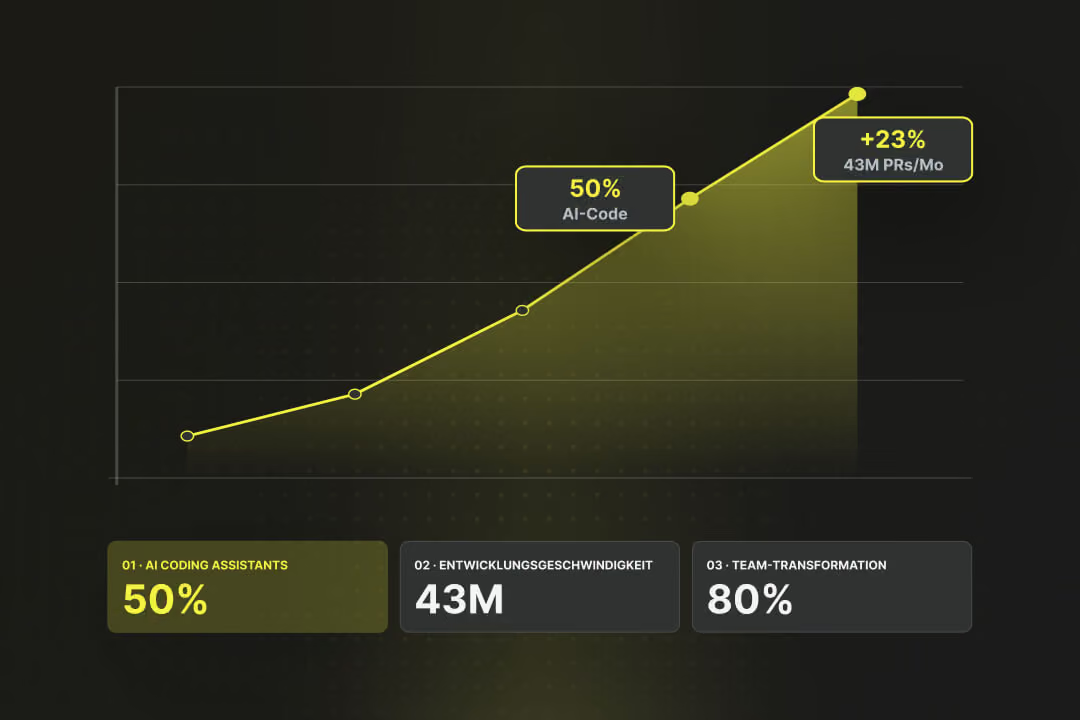
By the end of 2025, almost half of all code on GitHub was generated using AI tools, according to EY Switzerland. Each month, 43 million pull requests were merged, a 23% year-over-year increase (Source: EY Switzerland). Gartner predicts that by 2030, AI-native development platforms will lead to 80% of organizations transforming large developer teams into smaller, AI-augmented units (Source: Gartner). Software development is changing faster than ever before. We highlight the trends that truly matter in 2026, what's driving them, and what this specifically means for businesses.
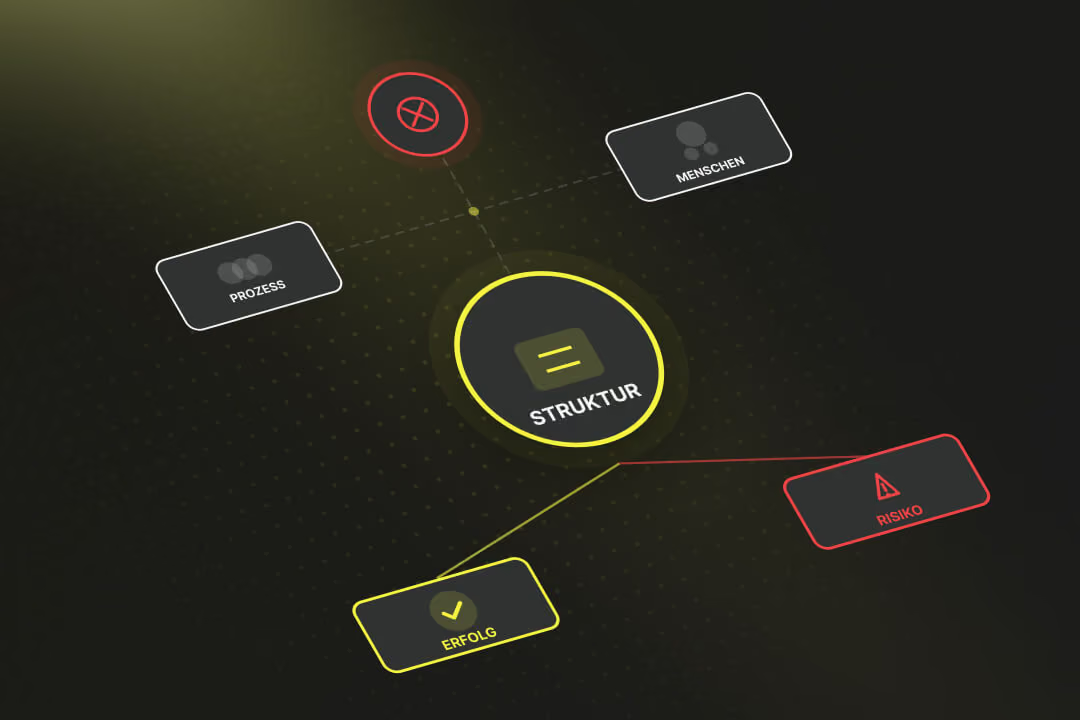
Anyone introducing new software, rebuilding server infrastructure, or automating existing processes encounters the same resistance: systems, teams, and habits don't change on their own. IT Change Management is the structured approach that guides changes in IT systems and organizations to ensure that ongoing operations are not disrupted and the new implementation is successfully adopted. What sounds simple often fails in practice for two reasons: the process and the people.