Business Process Management 2026: How to Implement It Compliantly and Profitably
Business Process Management (BPM) is the structured control of business processes through modeling, automation, measurement and optimization. The EU rules DORA and NIS2 reach Swiss companies too, by way of their supply chains.

Business Process Management: Key Takeaways
- Business Process Management (BPM) is the end-to-end control of business processes across modeling, automation, execution and continuous optimization.
- BPM rests on: process mining for the as-is analysis, BPMN modeling for the to-be definition, and low-code engines for automation including an audit trail.
- With DORA, NIS2 and the Supply Chain Act, Business Process Management also becomes a regulatory steering instrument, because only documented and monitored processes can produce the required evidence on resilience, IT security and due diligence.
- Axisbits builds and operates BPM platforms for Swiss SMEs and takes on architecture, implementation and maintenance with senior sign-off on every line of code.
What is Business Process Management (BPM)?
BPM is the method by which a company plans, steers and continuously improves its operations with foresight, much like an assembly line. That is what sets it apart from other tools:
- Workflow management: handles only a single task (e.g. “submit a holiday request”).
- Software robots (RPA): operate the user interface the way a person would, in order to carry out simple data transfers, for example.
A Business Process Management system is the management layer above such applications. It uses a single symbolic language (BPMN 2.0) to steer the entire process from customer request to result, and to log it in parallel (audit trail).
A BPM emerges across five development stages, which then run on as a continuous lifecycle that keeps questioning and refining the processes it maps:
- Planning: use your company goals to define the processes you need for them.
- Documenting the tasks: record how these processes should run in theory, usually as a diagram.
- Modeling: the processes are designed in full. They should run as quickly, error-free and resource-efficiently as possible.
- Execution: the processes run inside your software and set the pace of the work. They tell staff or systems automatically what to do next.
- Monitoring: you use the resulting data (process mining) to see whether and where things stall, and an AI helps distribute tasks more intelligently. Then the cycle begins again.
How are Business Process Management and compliance connected?
Business Process Management is developing into a regulatory tool that many companies have to maintain indirectly because of several EU requirements.
The Digital Operational Resilience Act (DORA) requires financial service providers and their IT partners to keep complete ICT risk processes. NIS2 obliges SMEs offering certain services to demonstrate risk management and sets reporting duties within 24 hours. Through supply chains, partnerships and customers in EU countries, Swiss companies are therefore affected by this EU law as well.
How Do I Interlock a BPM With DORA, NIS2 and the Supply Chain Act?
You interlock your BPM with the EU frameworks by building the resulting compliance requirements directly into the Business Process Model and Notation (BPMN) models.
Every single element of your running processes then carries metadata on risk class, retention obligation and audit trigger. That way all the necessary evidence and the processes themselves come into being in one step.
| Regulation | BPM | Benefit for your SME |
|---|---|---|
| DORA | ICT risk processes, incident workflows | Evidence of resilience towards regulators and customers |
| NIS2 | Cybersecurity process models, audit trail | Protection from fines and 24-hour reporting |
| Supply Chain Act / CSDDD | Supplier mapping, due diligence processes | Risk analysis per tier, documented measures |
On the ROI side, market analyses put the typical efficiency gains from BPM projects at 15 to 40 percent within the automated processes. The biggest lever comes from removing manual steps, where staff would otherwise be transferring data between disconnected software islands. A BPM therefore also contributes significantly to the digitalization of SMEs.
Which components belong in my Business Process Management system?
A contemporary, high-performing Business Process Management system needs process mining that delivers as-is data from your existing systems, BPMN 2.0 modeling that turns that data into to-be processes, a workflow engine to execute the models, and an integration layer to connect third-party systems. Governance and monitoring belong to it as well.
The modeling and automation layer speeds up when you combine it with low-code platforms. Low-code reduces the implementation time for your workflows. For important core processes, however, you should rely on a professionally built program, because low-code engines hit their limits on multi-tenant permissions and audit requirements.
Which tools are suitable for Business Process Management?
Your tool choice for Business Process Management follows three questions: what level of maturity exists in the company? What integration requirement is there towards existing systems? What depth of compliance is mandated? Those questions produce four categories of Business Process Management tools.
| Category | Use Case | Strengths | Limits |
|---|---|---|---|
| Suite platforms (Camunda, Signavio, Bizagi) | Standard processes with a BPMN focus | Fast rollout, broad modeling library | License costs, limited scope for special logic |
| Process mining specialists (Celonis, UiPath) | Data-driven as-is analysis | Deep analytics, AI-assisted optimization | No out-of-the-box workflow module |
| Low-code workflow engines (n8n, Make, Zapier Enterprise) | Moderately complex automations | Fast, strong on integration | Limited on multi-tenant and audit depth |
| Custom-built BPM platforms | Core processes with industry-specific logic | Full control, industry-specific compliance | Higher initial investment |
These off-the-shelf suites can nonetheless run into limits as soon as multi-tenancy, compliance demands or proprietary data models come into play. In those cases the step towards custom software as a BPM platform pays off, because you then control the data model and the permission layer completely.
How to build a BPM that unites compliance and AI in one platform
A Business Process Management system steers your processes and lets you meet applicable compliance requirements almost as a by-product. That also means you are on the safe side during audits and can evidence how your processes ran.
Building process mining, BPMN modeling and automations does, however, take a great deal of experience. If you would rather not own those steps internally, Axisbits can help. With us you get a senior development team that looks after your software permanently and keeps it stable well beyond go-live:
- Senior specialists in a fixed team on a subscription basis, cancellable at any time.
- AI-assisted build speed combined with senior review on every line of code.
- A Swiss contracting party, compliant and, on request, with full handover of the code to you.
Book your free intro call. In 30 minutes we clarify together whether your current BPM ought to meet the EU requirements. You get an honest assessment of development time and costs, with no sales pressure.
{{fs-btn-cta}}
Wir schaffen leistungsstarke Plattformen und Websites für Startups, Scale-Ups und KMUs, von Konzept bis Go-Live.
As an official HubSpot Solution Provider and an AI-assisted software team, we optimize your workflows with senior expertise – for processes that grow with your company.
Business Process Management – Frequently Asked Questions
Business Process Management steers processes strategically across the entire lifecycle, from modeling through to optimization. Workflow automation is limited to the technical execution of individual sequences. BPM uses workflow engines as one tool among several and complements them with process mining, BPMN modeling, governance and KPI monitoring.
BPMN 2.0.2 is the current standard for process modeling. The notation covers all common patterns, from pools, lanes and gateways through to compensation and subprocess. Every relevant BPM tool supports BPMN 2.0, so your models stay portable between platforms.
The greatest BPM leverage sits with industries that combine dense regulation with many recurring processes. Those include financial service providers (DORA), healthcare (medical device law and national requirements), logistics (customs and track-and-trace), and manufacturing with supply chain obligations.
AI is changing BPM in three directions: process mining becomes predictive and forecasts bottlenecks, routing decisions are taken by agents on the basis of historical data, and modeling suggestions arise automatically from process logs. The role of the process owner therefore shifts from modeler to reviewer of the AI's suggestions.
More articles
Software deployment is the process that moves finished code out of the development environment and into live production. GitOps, Progressive Delivery and DevSecOps make releases faster and safer. At the same time, the revDSG and even EU regulations reach into Swiss pipelines.
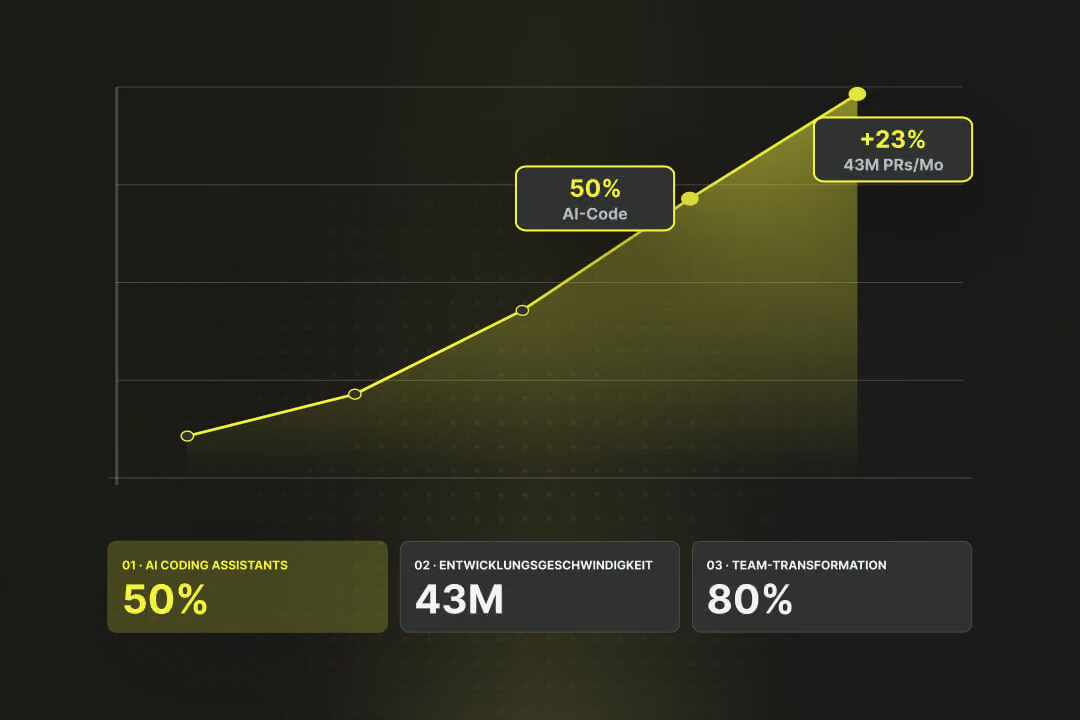
By the end of 2025, almost half of all code on GitHub was generated using AI tools, according to EY Switzerland. Each month, 43 million pull requests were merged, a 23% year-over-year increase (Source: EY Switzerland). Gartner predicts that by 2030, AI-native development platforms will lead to 80% of organizations transforming large developer teams into smaller, AI-augmented units (Source: Gartner). Software development is changing faster than ever before. We highlight the trends that truly matter in 2026, what's driving them, and what this specifically means for businesses.
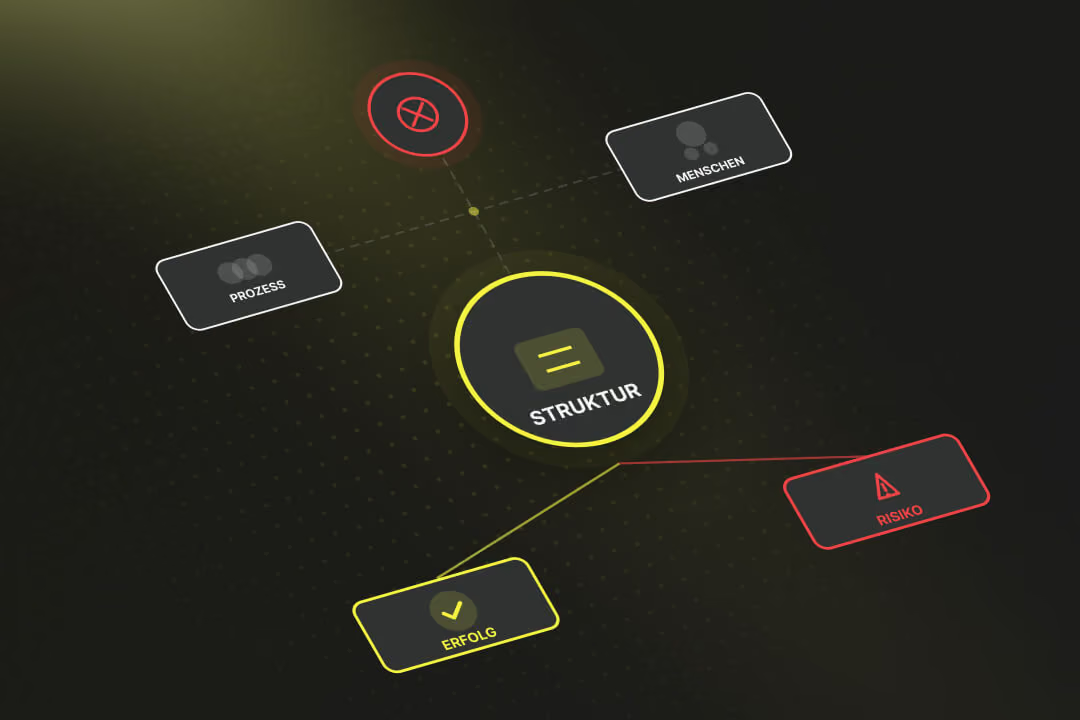
Anyone introducing new software, rebuilding server infrastructure, or automating existing processes encounters the same resistance: systems, teams, and habits don't change on their own. IT Change Management is the structured approach that guides changes in IT systems and organizations to ensure that ongoing operations are not disrupted and the new implementation is successfully adopted. What sounds simple often fails in practice for two reasons: the process and the people.