Trends in Software Development 2026
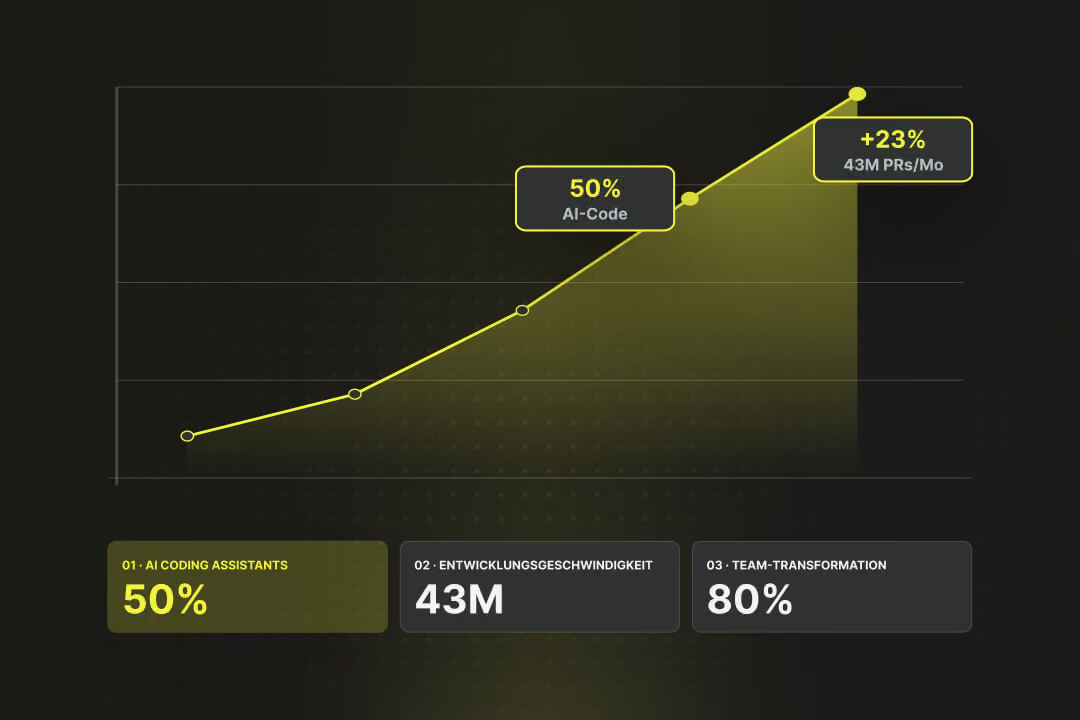
By the end of 2025, almost half of all code on GitHub was generated using AI tools, according to EY Switzerland. Each month, 43 million pull requests were merged, a 23% year-over-year increase (Source: EY Switzerland). Gartner predicts that by 2030, AI-native development platforms will lead to 80% of organizations transforming large developer teams into smaller, AI-augmented units (Source: Gartner). Software development is changing faster than ever before. We highlight the trends that truly matter in 2026, what's driving them, and what this specifically means for businesses.

Software Development Trends 2026: Key Takeaways
- Agentic AI is changing the development process: AI agents write code, run tests, fix bugs, and operate autonomously for hours or days. Almost half of all GitHub code is already generated with AI assistance.
- Custom Software gains ground over SaaS: AI significantly shortens development times. This shifts the cost-benefit analysis: In-house software becomes more economically attractive, while SaaS dependencies become more expensive.
- Sovereign AI becomes a critical location factor: In 2026, Swiss companies are examining closely where their data is stored and which models they rely on. Europe possesses only 5 to 10 percent of the world's AI computing capacity.
- Platform Engineering is gaining traction: Internal developer platforms relieve teams, standardize processes, and make compliance automatically enforceable with every deployment.
- Security by Design instead of piecemeal fixes: AI agents require their own security identities. Those who don't build in security from the start will create new attack surfaces faster than they can close them.
- Seamless Data Flow as a Prerequisite: Data discontinuities and silos prevent productive AI deployment. Anyone wanting to work with AI in 2026 must first establish clean data flows.
What are the most important software development trends for 2026?
New technologies often announce themselves loudly and then arrive quietly. With AI in software development, it's the opposite: The numbers are clear, but many companies still underestimate the impact on development teams and architectural decisions.
What's changing right now isn't just a productivity gain from better tools. It's a shift in who or what writes code, how software needs to be structured for AI to work effectively with it, and what strategic decisions regarding dependency or sovereignty must be made today. The following trends are happening right now. What differs is the pace at which individual companies are reacting.
Trend 01
Agentic AI
The term "Agentic AI" describes AI systems that autonomously plan, generate subtasks, and execute them over multiple steps. In software development, this means: A developer sets a goal, the AI agent breaks it down into subtasks, writes the code, runs tests, analyzes error messages, and self-corrects until the result meets the requirements.
According to EY Switzerland, by the end of 2025 almost 50 percent of the code processed on GitHub was created with AI assistance. On the platform, 43 million pull requests were merged monthly, a 23 percent increase compared to the previous year. This is no longer an experimental use, but productive daily work in thousands of development teams.
What this means for companies: The developer's role is shifting. Instead of writing individual lines of code, they monitor, review, and control AI agents. This changes the required skills, how teams are structured, and how much output a team can realistically achieve. Gartner predicts that by 2030, 80 percent of organizations will transform large developer teams into smaller, AI-powered units.
According to EY, the greatest effort lies not in the AI model itself, but in the accompanying structures: stable test environments, clean deployment processes, incident management, and clear governance. Anyone who wants to use AI agents in development first needs the technical infrastructure to support it.
Trend 02
Custom Software

For a long time, "buy" was the standard answer: purchasing or licensing off-the-shelf software is faster, cheaper, and less risky than developing it yourself. In 2026 that equation no longer holds true in such simple terms. AI is changing the cost structure of software development: development times are decreasing, documentation efforts are automated, and integrations are created faster. This makes proprietary software more economically attractive than it was three years ago.
At the same time, the disadvantages of SaaS solutions are increasing: license costs that multiply with the number of users, limited adaptability for differentiating processes, and dependence on feature roadmaps that do not align with one's own business model. A company that wants to map its specific core process in standard software compromises precisely those processes that differentiate it from the competition.
This does not mean that SaaS will disappear. Standard processes such as accounting, HR, or email management remain sensible within established systems. However, for core processes that define one's own business model, the calculation is worth revisiting.
Trend 03
Sovereign AI
A large proportion of Swiss companies that use AI productively rely on models from major US providers.
"Sovereign AI" describes the approach of building proprietary or European AI infrastructures to reduce this dependency. This raises specific questions for companies: Where are my data processed? Who controls the model that sees my customer data? What happens if a US provider restricts access for political reasons?
For Swiss companies, this is not merely a philosophical issue. The nDSG (new Data Protection Act) already sets requirements for data processing and localization. Enterprise interfaces of major AI providers contractually exclude the use of data for model training. Private instances on Swiss cloud regions go further: They ensure that data never leaves Switzerland.
Trend 04
Platform Engineering
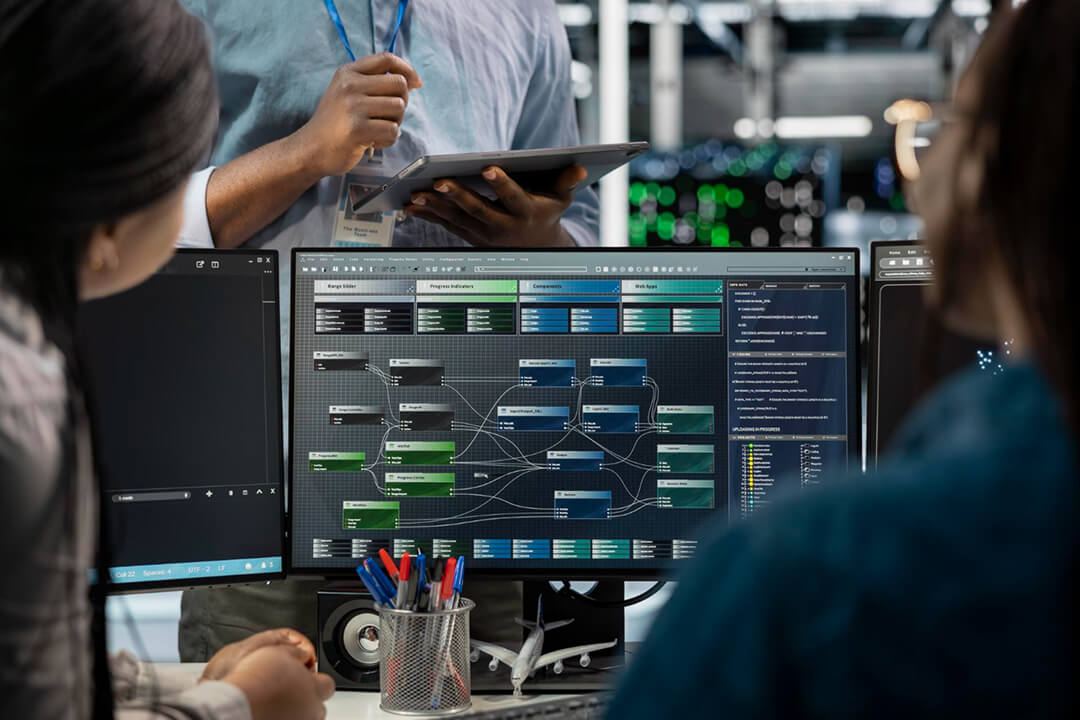
The more teams work on software in parallel, the greater the problem of infrastructure fragmentation becomes: Each team builds its own cloud setups, its own CI/CD pipelines, its own monitoring solutions. This creates shadow IT, burdens developers with infrastructure work, and makes compliance verification almost impossible.
Platform Engineering addresses this problem with Internal Developer Platforms (IDPs) that provide a self-service layer over the infrastructure. Developers request resources via a portal instead of manually configuring infrastructure. Compliance rules, security standards, and nDSG requirements are directly built into the platform and automatically enforced with every deployment.
The Model Context Protocol (MCP), a new open standard, is gaining importance: It standardizes how AI tools, data, and commands are exchanged between the components of an agent-based development environment. This allows various AI tools to be combined within a single platform without manually building each integration.
Trend 05
Security by Design

AI agents in software development create a new attack surface. A report from the Federal Office for Cybersecurity (BACS) indicates that agent-based systems and MCP servers are increasingly becoming targets for attackers in 2026. An AI agent with access to code repositories, databases, and deployment pipelines is an attractive target.
Microsoft Security clearly outlines the requirement: Every AI agent should have similar security measures as a human. This means a clear identity, limited access rights based on the principle of least privilege, logging of all actions, and mechanisms to prevent agents from being manipulated. Security is not added as an afterthought but built into the architecture from the start.
For companies using AI in development, this means existing security concepts must be expanded. Traditional perimeter security is no longer sufficient when AI agents operate autonomously within and between systems.
Trend 06
AI-Ready Data
AI can only operate reliably, scalably, and economically if data flows consistently, structured, and without media breaks through all process stages. Manual intermediate steps, isolated Excel solutions, and system breaks prevent robust data flows and effectively make the productive use of AI impossible.
In 2026 this is no longer a technical niche but a prerequisite. Companies that want to use AI must first clarify: Which systems hold which data? Where do data silos emerge? How does data get from System A to System B without manual human export and import? Only when these questions are answered can AI deliver the expected productivity gains.
An API-first architecture is the technical key here: Every system must be accessible via an interface. This applies to new systems but should be retrofitted to existing systems wherever possible. Those who operate legacy systems without APIs cannot integrate them into an AI-supported process landscape.
{{fs-banner-cta}}
Which of these trends are relevant for your company now?
Not every trend affects every company equally. A useful classification helps set priorities:
| Trend | Relevant if... | First Practical Step |
|---|---|---|
| Agentic AI | You have a development team or outsource software development | Ask whether your partner uses AI-assisted development processes and how code review and testing are handled. |
| Custom vs. SaaS | Your core processes cannot be adequately represented by existing tools or licensing costs are increasing significantly | Compare the total cost of SaaS licenses and integrations against the cost of a custom solution over five years. |
| Sovereign AI | You work with customer data, are subject to regulations, or position data sovereignty as a trust factor | Determine which AI services can access customer data and whether enterprise contracts include zero-data retention. |
| Platform Engineering | Multiple development teams work in parallel or deployment compliance evidence is missing | Audit current deployment processes: How much time do developers spend on infrastructure instead of product development? |
| Security by Design | You already use AI agents or plan to use them | Review your security model: Do AI agents have their own identities, limited permissions, and audit logs? |
| AI-Ready Data | Data is moved manually between systems or AI projects fail due to poor data quality | Map data flows: Where do media breaks occur and which systems lack APIs? |
What do these trends mean for software architecture?
The trends have very direct technical consequences for how software should be built today. Three principles that should be incorporated into every new architectural decision in 2026:
API-first is a fundamental prerequisite
Every component of an application must be accessible via a clearly defined interface. This applies to external integrations as well as to every internal function. An API-first architecture allows AI agents to specifically call individual functions without touching the entire source code. Systems without APIs cannot be integrated into AI-supported workflows and will become a bottleneck.
Modularity creates the context AI needs
AI agents work more precisely when their context is sharply defined. A clearly separated module with defined responsibilities provides the AI with exactly the context it needs to generate meaningful code. Monolithic systems, where everything is interconnected, overwhelm AI agents just as they do human developers.
Build in compliance, don't bolt it on
Whether it's nDSG, the EU AI Act, or industry-specific requirements: Regulatory requirements can be represented as code in a modern architecture ("Policy as Code"). They are automatically checked with every deployment, not just once a year through a manual audit. Those who build this in today will save significant effort tomorrow.
Software that keeps pace with the trends
Axisbits develops software with the architectures that work in 2026 and beyond: API-first, modular, AI-ready and compliance-ready. With over 100 completed projects, we know the pitfalls between a good concept and a system that runs in production.
AI-Native Applications
We develop platforms and apps in which AI functions are planned as part of the architecture from the start.
Modernizing Legacy Systems
Existing systems without APIs are given an API layer step by step, making them integrable into modern processes without interrupting operations.
Implementing Agentic Workflows
We set up the technical foundation on which AI agents can be securely integrated into existing development and business processes.
Data Protection and Compliance from Day 1
nDSG, Swiss data residency and zero-data-retention policies are treated as technical requirements, not as a checklist at the end.
{{fs-btn-cta}}
Your platform.
Built for 2026 and beyond.
We develop software with the architectures that enable AI integration, API-first design and seamless data flow from the start, instead of bolting them on afterwards.
Wir schaffen leistungsstarke Plattformen und Websites für Startups, Scale-Ups und KMUs, von Konzept bis Go-Live.
We build your software, develop your platform, or modernize your systems for AI.
Software Development Trends 2026: Frequently Asked Questions
Agentic AI describes AI systems that autonomously plan, write code, execute tests, and debug. Rather than offering individual code suggestions, these systems take on entire work packages. The developer defines the goal, and the agent handles the implementation. This shifts the developer's role from implementation to steering, review, and quality control. This changes how teams are assembled, what skills are required, and how much output a team can realistically achieve.
The decision depends on two factors: the strategic value of the process and the total cost over five years. SaaS makes sense for standard processes that are not a differentiator, such as accounting, HR, or email. Custom software is worthwhile when a process is your competitive advantage, standard tools force compromises on core functionalities, or the sum of licensing costs, integration effort, and limited customizability exceeds the cost of a custom solution. AI significantly shortens development times and thus lowers the investment threshold for custom software.
Sovereign AI describes the approach of building own or European AI infrastructures to reduce reliance on foreign providers. This is relevant for Swiss companies because a large portion of AI computing capacity and leading models are in US hands. Specifically, this means that data flowing into external AI models may leave Switzerland, could be used for model training, or access could be restricted for geopolitical reasons. Practical solutions include enterprise interfaces with zero-data retention, private model instances in Swiss cloud regions, or open-source models on self-hosted infrastructure.
The EU AI Act directly applies to Swiss companies if their software is used in EU markets or affects EU citizens. It categorizes risk classes ranging from prohibited to high-risk and limited risk. High-risk systems, such as AI in human resources or critical infrastructure, require documentation, human oversight, and risk management systems. This means that a company's AI governance must be considered already during the software design phase: What AI functions does the system have? Which risk class do they fall into? What are the documentation requirements?
Three technical prerequisites are crucial: API-first design, so AI agents can specifically invoke individual functions; strict modularization, ensuring the AI receives a narrowly defined context and generates more precise code; and consistent, unbroken data paths, allowing data to be retrieved from any system without manual export. Systems that do not meet these requirements cannot be effectively integrated into AI-powered workflows and will hinder the productivity gains that AI is meant to deliver.
More articles
Business Process Management (BPM) is the structured control of business processes through modeling, automation, measurement and optimization. The EU rules DORA and NIS2 reach Swiss companies too, by way of their supply chains.
Software deployment is the process that moves finished code out of the development environment and into live production. GitOps, Progressive Delivery and DevSecOps make releases faster and safer. At the same time, the revDSG and even EU regulations reach into Swiss pipelines.
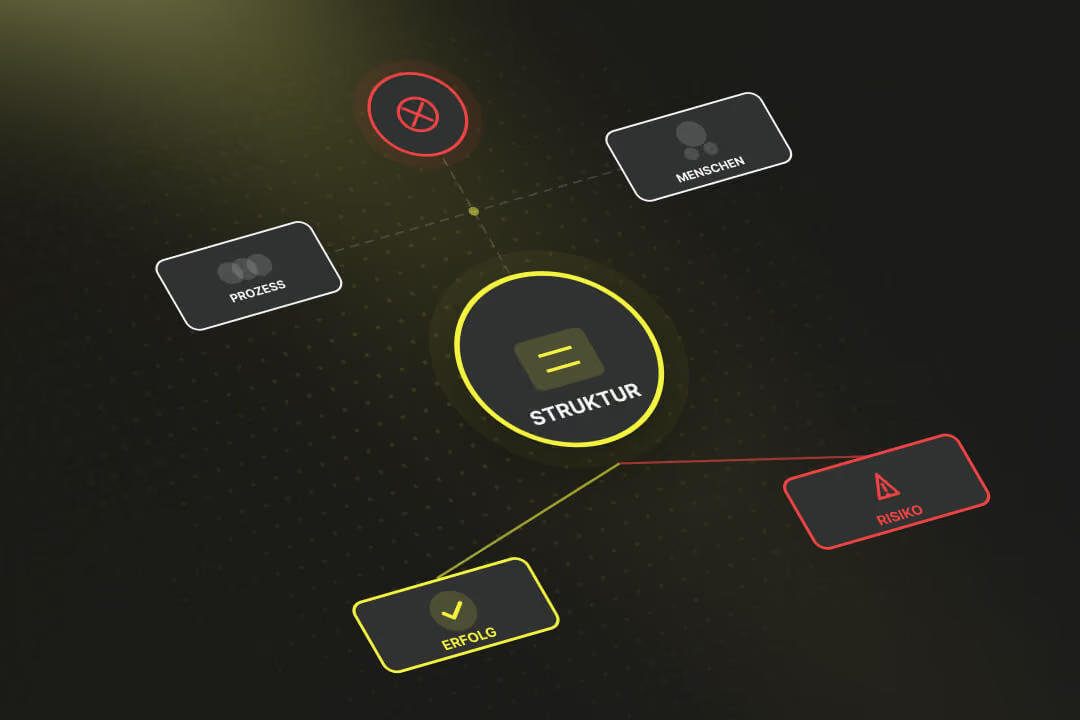
Anyone introducing new software, rebuilding server infrastructure, or automating existing processes encounters the same resistance: systems, teams, and habits don't change on their own. IT Change Management is the structured approach that guides changes in IT systems and organizations to ensure that ongoing operations are not disrupted and the new implementation is successfully adopted. What sounds simple often fails in practice for two reasons: the process and the people.